
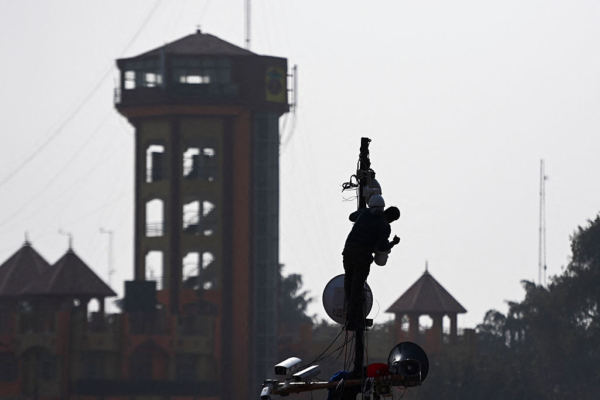
As part of a security system upgrade, the Indian government will be replacing nearly 140,000 Chinese-manufactured cameras in the capital region of Delhi starting from April 1st.
This decision, according to Parvesh Sahib Singh, the Minister of Public Works Department, is in response to recent government directives and broader national security considerations. Singh stated, “We have decided to gradually phase out most surveillance cameras in the city, especially those from Chinese manufacturer Hikvision.”
Previously, the Ministry of Electronics and Information Technology (MeitY) in India decided to ban the sale and use of Chinese-manufactured cameras from April 1st citing national security reasons.
Singh mentioned that the government has approved the replacement of 50,000 Chinese-made cameras in the first phase, calling it a “clear corrective measure.” All previously installed Chinese cameras will be gradually replaced with secure and reliable systems.
Delhi currently has had 274,389 closed-circuit television cameras installed in two phases by the Public Works Department (PWD). Of these, 140,000 cameras installed from September 2020 to November 2022 were Chinese-made, while the remaining 134,389 cameras installed from June 2025 to March 2026 were not of Chinese origin.
Starting from April, all closed-circuit television cameras sold in India must obtain certification under the government’s Standardization Testing and Quality Certification (STQC) framework.
Under these regulations, companies must disclose the origin of key components such as chipsets, pass cybersecurity tests, and ensure devices are protected from unauthorized remote access.
Indian authorities are refusing to certify products that use Chinese parts (including firmware and chipsets), meaning Chinese equipment cannot legally be sold in India without approval.
Major Chinese surveillance giants like Hikvision, Dahua, and TP-Link are expected to face significant repercussions. These three brands hold a considerable share of the Indian CCTV market. Recent data shows that Chinese-made cameras still make up around one-third of total sales in India.
This move is part of broader measures taken by the Indian government to enhance national security, reduce cybersecurity risks, and decrease reliance on Chinese technology.
Network CCTV systems are considered sensitive information as they can be remotely accessed, raising concerns about surveillance and data privacy.
These regulations are not new and actually originated from the “Essential Requirements” (ER) norms introduced by the Indian government in 2024, providing companies with a two-year transition period.
With the end of this transitional period, the new regulations officially come into effect in April 2026.
The two-year transition period has reshaped India’s surveillance industry landscape, with local brands rapidly occupying the market share vacated by Chinese brands, and many companies switching to non-Chinese components. Some Chinese companies have downsized or completely exited the Indian market.
For users who already own Chinese-made surveillance systems, there will be no immediate impact – devices will not be deactivated or removed. However, there may be long-term vulnerabilities in areas such as software updates, after-sales services, and network security support in the future.