
Despite the long-standing arms embargo imposed by the United Nations on the divided North African country of Libya, military strongman Khalifa Haftar in eastern Libya has managed to acquire armed drones through various channels. Experts believe that these drones are highly likely manufactured by China and Turkey.
According to Reuters, based on commercial satellite images, at least three drones appeared at the Al Khadim Airbase, located about 100 kilometers east of Benghazi, between April and December 2025.
The presence of these drones had never been exposed by the media before. Three weapons experts who reviewed the images stated that suspected installations of these aircraft could still be seen on-site this year.
Wim Zwijnenburg, a military technology expert at the Dutch peace organization PAX, pointed out that a drone appeared on the runway in images from Vantor, a U.S. satellite imaging company, on May 3 of the previous year, indicating its operational use.
Zwijnenburg mentioned that the drone’s size and body are similar to the Wing Loong II, but the wing design makes it more similar to China’s FL-1 reconnaissance and attack drone. Military analyst Joseph Dempsey from the International Institute for Strategic Studies (IISS) and Middle East expert Jeremy Binnie from Jane’s also agreed with this assessment.
However, due to a lack of publicly available photos of this model, it is currently challenging to fully confirm its specific model.
Justyna Gudzowska, executive director of the international law enforcement operation at The Sentry organization, cited reports indicating Haftar’s regime’s attempts over the years to acquire military drones from China.
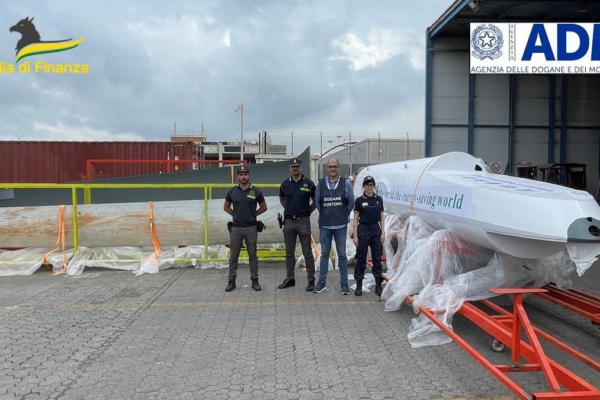
According to investigators from the United States, Canada, and Italy, there have been two incidents since 2019 where attempts were made to smuggle Chinese military equipment into eastern Libya. One of which occurred in June 2024 when Italy seized a batch of FL-1 drone parts destined for Benghazi from China.
Weapon experts also speculate that the remaining two smaller drones may be Bayraktar TB2 drones manufactured by Turkey. Their dimensions, wingspan, and twin tail design are consistent with the TB2, although the possibility of other models cannot be ruled out.
In addition to the widespread use of drones in the current Russia-Ukraine conflict and Middle East conflicts, drones played a crucial role during the Libyan civil war from 2014 to 2020.
At that time, Haftar’s Libyan National Army (LNA) attempted to overthrow the United Nations-recognized Tripoli government under the pretext of “combating armed gangs and terrorists.” The authorities in Tripoli denied these allegations.
The Libyan civil war reached a ceasefire in 2020 but remains divided to this day: the east is controlled by Haftar’s regime, while the west is under the leadership of Prime Minister Abdulhamid Dbeibah of the Tripoli government.
Anas El Gomati, director of the Sadeq Institute in Libya, stated that the arrival of new armed drones at the Al Khadim base is a “significant symbolic victory” for Haftar. This not only solidifies his control over most of the eastern regions (including major oil fields) but also strengthens his bargaining power for future negotiations to form a unified government.
Gomati pointed out that these weapons could also be used to defend the supply lines to the Rapid Support Forces (RSF) in neighboring Sudan. However, Haftar has consistently denied supporting this military organization.
As Haftar’s Libyan National Army may not possess the technical expertise to operate such advanced drones, Gomati identified a key issue when questioning, “Who is operating these drones?” It is speculated that since the drones likely originate from China and Turkey, there may be technical personnel from these countries assisting the National Army in their operation.
Reuters currently cannot confirm whether China, Turkey, or other UN member states have applied for waivers to deliver drones to eastern Libya and cannot ascertain the exact source and delivery time of the drones.
The committee of the Security Council responsible for handling such applications did not respond to questions about the drones, while the UN Department of Peacebuilding and Peacekeeping Affairs cited last year’s Security Council resolution as a response. The resolution expressed “serious concern” about ongoing violations of the arms embargo and reiterated that the transfer of weapons to Libya must be approved by the United Nations.
The Libyan National Army, the Chinese and Turkish governments, as well as military-industrial companies such as China’s CETC and Turkey’s Baykar, have not responded to detailed inquiries from the media. The Tripoli government also did not issue any comments.
Since the NATO-backed uprising in 2011 led to the overthrow of longtime dictator Muammar Gaddafi, the arms embargo has been in effect. However, a UN expert panel responsible for monitoring the embargo situation highlighted that a large number of high-tech weapons flowed into the country in the subsequent civil war, making Libya the first major drone battlefield in Africa.
Libya analysts, arms experts, and UN investigators indicate that although the current tension has eased, there is evidence that both sides in the east and west are strengthening their aerial firepower.
Reuters reported last year that the Libyan National Army (LNA) reached a $4 billion military equipment procurement agreement with Pakistan in December last year, including a joint development of the JF-17 fighter jet (known as the Thunder) with China.
Officials from Pakistan insisted at the time that the deal did not violate the arms embargo, while UN sanctions officials and the Pakistani Foreign Ministry did not respond.
According to records from the UN panel, if Haftar can indeed acquire drones from China and Turkey after the withdrawal of the Wing Loong II drone squadron deployed at the Al Khadim base in 2020, it would signify a significant boost to his military power.
In its annual report in 2017, the UN expert panel pointed out that the UAE viewed Haftar as a stronghold against Islamic extremist groups and had assisted the Libyan National Army in building its air force, including providing Wing Loong transport aircraft and potentially helping operate these drones.
On this matter, Abu Dhabi officials have repeatedly denied providing military support, and the UAE Foreign Ministry did not comment on the appearance of the new drones.
On the other hand, Turkey had previously provided Bayraktar TB2 drones and air defense systems to the UN-recognized Tripoli government, successfully repelling Haftar’s offensive in 2020, leading to a stalemate that continues to this day.
In October 2022, the Tripoli government signed an agreement with Turkey to purchase more advanced Bayraktar Akinci drones, with a payload roughly three times that of the Wing Loong II and higher flight altitude, giving the western Tripoli government greater aerial advantage.
However, there seems to be a slight warming in relations between Turkey and Haftar. Turkey is seeking to protect its economic and energy interests in Libya and hopes that the eastern regime will approve the controversial maritime border agreement signed with the western government in 2019.
In a statement, the Libyan National Army indicated that Ibrahim Kalin, the head of the Turkish National Intelligence Agency, met with Haftar and his son Saddam Haftar in Benghazi last August to discuss “strengthening intelligence and security cooperation.”
Saddam, as the deputy commander of the National Army, has visited Ankara three times last year, meeting with senior officials including the Minister of Defense. The Turkish Defense Ministry described this as a step towards “unifying Libya.”
(This article referenced reports from Reuters)