
Audience friends, hello everyone! Welcome to watch “Centennial Truth.”
The full name of the Central Disciplinary Inspection Commission is “Central Commission for Discipline Inspection of the Communist Party of China.” In 1993, it merged offices with the Ministry of Supervision of the CPC and became one institution with two names, collectively known as the Central Disciplinary Inspection Commission and the Department of Supervision.
This is the highest specialized institution for anti-corruption in the Communist Party of China. For officials of the Central Disciplinary Inspection Commission and the Department of Supervision, all their work revolves around anti-corruption efforts.
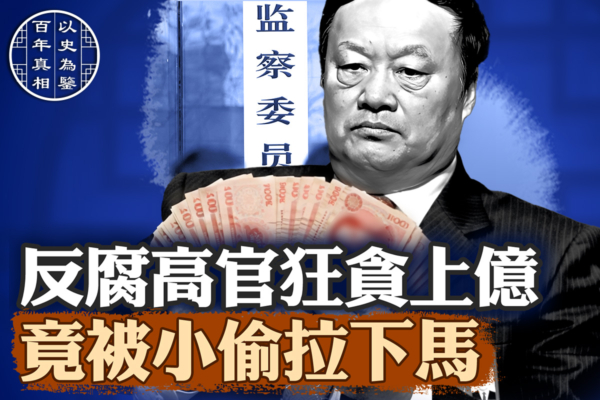
High-ranking officials from the Central Disciplinary Inspection Commission and the Department of Supervision were supposed to be role models of integrity and self-discipline when they parachuted down to local areas. However, there was one high-ranking official from the Central Disciplinary Inspection Commission and the Department of Supervision who, while speaking eloquently on stage, was actually a serious corrupt figure who pursued wealth and indulged in illicit relationships behind the scenes.
This person is Jin Daoming, who served as a member of the Standing Committee of the Shanxi Provincial Party Committee, Secretary of the Provincial Commission for Discipline Inspection, Deputy Secretary of the Provincial Party Committee, Secretary of the Provincial Political and Legal Affairs Commission, and Deputy Director of the Provincial People’s Congress.
In this episode, based on Ouyang Yanqin’s article “Jin Daoming’s Red Beauties and White Gloves” and other sources, we will share with you how this individual transformed into a corrupt official worth billions.
Jin Daoming, born in 1953 in Beijing, started as an ordinary urban management worker in 1970. He later joined the Beijing Municipal Committee of the Communist Youth League as the Minister of the Youth Work Department.
In 1987, when the Ministry of Supervision of the CPC was reestablished, Jin Daoming was transferred to the department and worked in the office. In 1990, he was promoted to Deputy Division-level Supervisor and Director of Foreign Affairs Office; in 1998, he was appointed Deputy Secretary-General of the Central Commission for Discipline Inspection and Director of the Office, eventually rising to the rank of bureau-level official.
From 1987 to 2002, Jin Daoming spent 15 years in the Central Disciplinary Inspection Commission and the Department of Supervision, overseeing the ministers, deputy ministers, secretaries, and deputy secretaries of the department. He underwent 15 years of education on the proper conduct of party leading cadres regarding power, money, relationships, and family. He personally handled investigations into numerous severely corrupt officials at the provincial level.
From 2002 to 2006, Jin Daoming served as the head of the Discipline Inspection Team of the Central Commission for Discipline Inspection stationed at the Ministry of Transportation, reaching the rank of deputy minister. During these four years, he was primarily responsible for leading anti-corruption efforts in the transportation sector.
In August 2006, Jin Daoming was parachuted from Beijing to Shanxi and appointed as a member of the Provincial Party Committee and Secretary of the Provincial Commission for Discipline Inspection. Over the next eight years, he quickly transitioned to become a corrupt official worth billions.
On February 27, 2014, just 1 month and 4 days after being elected as the Vice Chairman of the Shanxi Provincial People’s Congress, Jin Daoming was officially arrested.
By the end of the same year, Jin Daoming was expelled from the Party and removed from public office for “abusing his position for personal gain, soliciting and accepting huge bribes, receiving gifts, engaging in extramarital affairs,” and was handed over to judicial authorities for prosecution.
On October 14, 2016, the Intermediate People’s Court of Zhenjiang, Jiangsu Province, found Jin Daoming guilty of accepting bribes totaling 123 million yuan from the first half of 2007 to early 2014, sentencing him to life imprisonment.
Jin Daoming was the first “tiger” in Shanxi to be investigated after the 18th National Congress of the Communist Party of China and the first “tiger” to be investigated after being parachuted by the Central Commission for Discipline Inspection and the Department of Supervision to the local level.
So, how did the corruption case of Jin Daoming come to light? It has quite an ironic story:
On the evening of November 13, 2011, burglars broke into the home of Bai Peizhong, the chairman of the Shanxi Coking Coal Group. Two thieves had worked as security guards in his residential area before. That day, they followed Bai Peizhong’s nanny quietly, entered the house, forcibly opened the safe, stole cash, gold bars, luxury watches, diamond rings, bank cards, and more, then took Bai Peizhong’s wife Li Caiting’s car key, rode the elevator to the underground parking lot, and drove away in Li Caiting’s Audi.
Li Caiting, who was at home at the time, was shocked by this scene. She immediately called Bai Peizhong. Bai Peizhong was inspecting his subordinate company at the time and, without much thought, asked his wife to contact his brother Bai Peiguo, who worked in the police force. After receiving the call, Bai Peiguo suggested that Li Caiting contact Bai Peizhong’s good friend, Su Hao, Vice Director of the Shanxi Provincial Public Security Department and Director of the Taiyuan Public Security Bureau. After communicating with Su Hao, Li Caiting reported to the Taiyuan police through proper channels, claiming that she had been “robbed of 3 million.”
While Li Caiting reported the incident, the two thieves thought that the stolen items were Bai Peizhong’s ill-gotten gains and believed he wouldn’t dare to report the theft. Therefore, they confidently checked into a hotel using their real identities. Ten hours later, the two thieves were arrested by the Taiyuan police.
Days later, someone leaked to a certain media outlet in Shanxi that the total value of the money and items stolen by the two thieves from Bai Peizhong’s home was nearly 50 million yuan. Bai Peizhong was the owner of the largest state-owned enterprise in Shanxi. This information immediately drew widespread attention.
During the subsequent trial, one thief was sentenced to death with a reprieve, and the other was sentenced to life imprisonment. However, the court found that the amount of property they had stolen was not 3 million but 10.78 million yuan.
Following an investigation by the Shanxi Provincial Commission for Discipline Inspection, it was determined that out of the stolen property, only 840,000 yuan was related to disciplinary violations, and Bai Peizhong was given a one-year probation within the party.
Bai Peizhong’s blatant financial issues being addressed solely through party discipline and receiving such a lenient punishment certainly raised suspicions. The mastermind behind this event was none other than Jin Daoming, the Secretary of the Shanxi Provincial Commission for Discipline Inspection.
Many people speculated that there might be a relationship of interest transmission between Bai Peizhong and Jin Daoming.
From October 30 to December 29, 2013, a group of retired cadres from the Shanxi Provincial Party Committee and Provincial Government collectively reported to the Central Sixth Inspection Team while stationed in Shanxi.
In February 2014, Jin Daoming was taken away for investigation.
Two thieves brought Jin Daoming’s corruption case to light, while a pair of “sister flowers” mistresses also led to Jin Daoming’s downfall.
According to a report from Cai Xin Net on October 14, 2016, Jin Daoming had a pair of mistresses: the elder sister named Hu Xin, born in 1977, and the younger sister named Hu Lei, born in 1979, both college graduates.
These two sisters were over 20 years younger than Jin Daoming. The elder sister took the initiative, while the younger sister followed closely. They took turns charming him with fine wine, night after night of revelry, quickly bewitching Jin Daoming. Subsequently, a series of transactions involving power, money, and sex ensued.
A state-owned enterprise executive who had done business with Hu Xin said, “Hu Xin is not tall, only slightly over 1.6 meters, slim figure. She has a graceful temperament and is very capable and sophisticated in doing business. She has never explicitly mentioned the relationship between herself and Jin Daoming in front of us. She only referred to Jin as an ‘old villager,’ saying she is from Dalian, Liaoning, and Jin Daoming is from Chaoyang, Liaoning.”
After captivating Jin Daoming, from 2008 to 2009, the Hu family business swiftly rose, with the two sisters and their parents, Hu Xiangjun and Xiao Guihua, engaging in land acquisitions, coal resource integration, and government electronic engineering contracts.
The Hu family established several shell companies, which neither had fixed office locations nor actual staff. Yet, each company corresponded to a coal mining or real estate project. Once established, each company could secure projects worth several billion yuan, which were subsequently sold off to cash out.
Taking the three companies established by the Hu family in 2009 as examples, let’s see how these individuals profited through manipulation:
The first, Shanxi Boyi Real Estate Development Co., Ltd., founded by the Hu family, corresponding to the Begonia Garden project, was sold to a state-owned enterprise, “Lan Hua Group’s Real Estate Development Co., Ltd.,” four months after its establishment, generating an income of 400 million.
The second, Shanxi Kaicheng Real Estate Development Co., Ltd., founded by the Hu family corresponding to the C-07-1 plot in the Zao Yuan area of Taiyuan, was sold in its entirety to Dalian Tielong Real Estate Development Co., Ltd. five months after securing the land, netting 190 million.
In the third example, following the establishment of Shanxi Oakin Information Technology Co., Ltd. by the Hu family, Hu Xin borrowed 500 million from “Lan Hua Technology” and “Jinmei Group” to construct three high-rise office buildings—Jiaming International A, B, and C. After completing the construction of the buildings, Hu Xin sold each building for 750 million to three state-owned enterprises: Lan Hua Group, Jinmei Group, and Shanxi Investment Group, making a net profit of 1.25 billion.
Additionally, in 2010, the Hu family invested 86.93 million to acquire a 20% stake in Lan Hua Technology’s Yuxi Coal Mine. By 2013, Lan Hua Technology’s annual report showed that the total assets of the Yuxi Coal Mine had exceeded 1 billion yuan.
In March 2014, a month after Jin Daoming’s arrest, his mistress and “white gloves,” Hu Xin and Hu Lei, were investigated together.
So, how did Jin Daoming transform from an anti-corruption official into a corrupt official worth billions?
Apart from indulging in illicit relationships, there were two main reasons:
Firstly, corrupt behavior at higher levels leads to corruption at lower levels.
When Jin Daoming was promoted and began excessive corruption, it was during the period when the autocrat Jiang Zemin was in power or controlling affairs behind the scenes.
Shortly after Xi Jinping came to power in 2012, he launched an anti-corruption campaign, investigating and prosecuting 440 high-ranking officials above the vice-provincial level and other centrally managed cadres during his first term. The majority of these officials were promoted and favored by Jiang Zemin and Zeng Qinghong.
From the lists of high-level corrupt officials dealt with in Xi’s first term of anti-corruption efforts, it can be said without a doubt that Jiang Zemin and Zeng Qinghong were the ultimate backstage manipulators of the most seriously corrupt figures within the CPC’s party, government, and military system.
Not only was Jiang Zemin morally corrupt, but he also allowed his son, Jiang Mianheng, to climb the ranks while engaging in enterprises, amassing wealth in secret.
Similarly, the son of then-Politburo Standing Committee member and Vice President of the People’s Republic of China, Zeng Qinghong, namely Zeng Wei, purchased a luxury home in Sydney, Australia, paying the full amount of 32.4 million Australian dollars (approximately 250 million yuan) at once, followed by another 5 million Australian dollars (approximately 38 million yuan) for renovation. This incident demonstrates that the Zeng family is also a corrupt dynasty.
With Jiang Zemin’s and Zeng Qinghong’s families leading by example in corruption, Jin Daoming and others followed suit, engaging in corruption involving both money and relationships.
The second reason lies in the corrupt culture under Jiang and Zeng’s rule, leading to rampant corruption in Shanxi.
After Jin Daoming’s arrest in 2014, a wave of officials at all levels in Shanxi, from the provincial to municipal levels, were arrested.
Vice-provincial officials included: former member of the Shanxi Provincial Party Committee and Director of the United Front Work Department Bai Yun (sentenced to 12 years), former member of the Shanxi Provincial Party Committee and Secretary-General Nie Chunyu (sentenced to 15 years), former member of the Shanxi Provincial Party Committee and Deputy Governor Du Shanhua (sentenced to life imprisonment), former member of the Shanxi Provincial Party Committee and Deputy Governor of Taiyuan City, Chen Chuanping (sentenced to 6 and a half years), former Deputy Governor of Shanxi Province Ren Runhou (died during the trial), former Deputy Governor of Shanxi Province and Vice Chairman of the provincial CPPCC Ling Zhengce (sentenced to 12 and a half years), former Party Secretary of the China Association for Science and Technology, Vice Chairman, First Secretary of the Secretariat, and Party Secretary of the Taiyuan City Committee Shen Weichen (sentenced to life imprisonment), among others.
Zhang Zhongsheng, Deputy Mayor of Lvliang City, Shanxi Province, was found guilty of accepting bribes exceeding 1.04 billion yuan, with another 130 million yuan of unexplained assets, and received a suspended death sentence.
In essence, in the eight years that Jin Daoming spent in Shanxi, nearly every official, from top to bottom, was implicated in corruption.
As a side note, shortly after Jin Daoming was announced to be under investigation, Bai Peizhong, the chairman of Shanxi Coking Coal Group, was also taken away. On December 21, 2016, Bai Peizhong was sentenced to 13 and a half years in prison and fined 3 million yuan for accepting bribes totaling over 35.13 million yuan and engaging in bribery.
Jin Daoming was the first severely corrupt figure parachuted by the Central Commission for Discipline Inspection and the Department of Supervision to the local level, but he was not the last.
On October 14, 2025, Xuchuanzhi, former Deputy Ministerial-level Commissioner of the Central Inspection Team, was suspected of serious violations of discipline and law and was investigated. Xuchuanzhi worked in the Central Commission for Discipline Inspection and the Department of Supervision for 34 years, was later parachuted to Ningxia Hui Autonomous Region as a member of the Provincial Party Committee and Secretary of the Commission for Discipline Inspection.
The officials of the Central Commission for Discipline Inspection and the Department of Supervision, who are specifically in charge of leading the fight against corruption, seem to be “replaced one after another.” Can the anti-corruption efforts of the CPC avoid becoming more corrupt in the process?
That concludes today’s program. Thank you for watching. If you enjoyed our show, don’t forget to like, share, and subscribe. See you next time.
– Production Team of “Centennial Truth”