
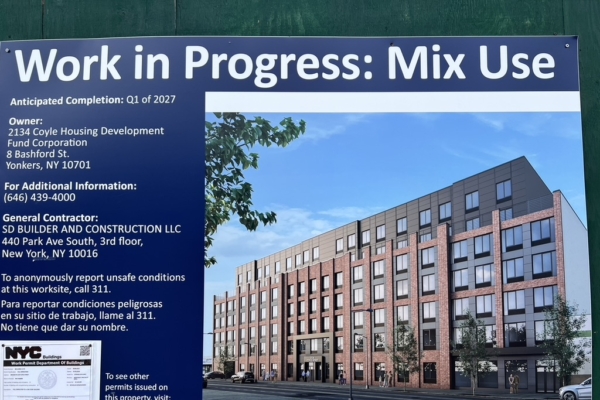
In recent years, public spending in New York City on the issue of homelessness has continued to rise. However, at the same time, affordable housing projects have faced difficulties in making progress due to limited profits or being deemed “unprofitable.” Against this backdrop, some projects originally approved as affordable housing have ended up being repurposed as shelters for the homeless, sparking community concerns. One such controversial case is the project at 2134 Coyle Street in Sheepshead Bay, Brooklyn.
A shortened document named “16-Coyle Budget v2” was obtained by a reporter from Epoch Times through a request under the Freedom of Information Law (FOIL) to the Department of Homeless Services (DHS). The document revealed that as early as March 15, 2021, a budget version outlined plans for the nonprofit organization Westhab to establish a shelter for 64 families at 2134 Coyle Street.
However, this timeline predates the Community Board 15’s support for affordable housing construction at the site in October 2021 and even precedes the City Council’s official approval of zoning changes in February 2022. The timing difference raises questions: was the planning for a homeless shelter initiated before the publicly stated housing purpose?
According to meeting records from Community Board 15 in October 2021, the owner at the time applied to rezone the plot from R4/C1-2 to R6A/C2-4 to build a five-story mixed-use building of approximately 129,000 square feet, including around 144 residential units, with 43 designated as affordable housing. The owner’s representative emphasized cooperation with the community at the meeting and pledged to retain the existing Dollar Tree tenant.
The project went through the standard Uniform Land Use Review Procedure (ULURP) and was ultimately approved by the City Council on February 24, 2022. Following the zoning change, the plot’s buildable area significantly increased, leading to a rise in land value.
Financial data from the city shows that in January 2024, the assessed market value of the plot was around $2.31 million. However, in May of the same year, the new owner, Coyle Street Owner LLC (a subsidiary of Slate Property Group), acquired the property for $24.37 million, a price difference of over $22 million.
Notably, the previous owner did not proceed with construction or apply for building permits after the zoning change. The new owner, on the other hand, plans to construct a long-term shelter facility capable of accommodating approximately 175 families for the New York City Department of Homeless Services (DHS).
Residents of Sheepshead Bay were shocked in March 2025 upon learning that the approved affordable housing project had been converted into a permanent shelter for the homeless. This revelation prompted thousands of predominantly Chinese residents to attend an explanatory meeting held by Community Board 15. Jim Coughlin, the Chief Operating Officer of Westhab, clarified during the meeting that the organization was not involved in the initial deal but secured the contract through a public bidding process.
However, FOIL documents indicate that Jim Coughlin was the proposer for the budget draft in March 2021 that outlined the establishment of a family shelter at 2134 Coyle Street. This discrepancy between the timeline and his public statements has raised concerns. Epoch Times reached out to Westhab, DHS, and the Mayor’s office for comments, but received no responses by the deadline.
Another key controversy surrounding the project is whether there was a “bait and switch” tactic involved.
During a housing and construction budget hearing at the City Council on March 25, 2025, Council Member and Chair of the Land Use Committee Rafael Salamanca pointed out that the 2134 Coyle Street project was not led by the city’s Department of Housing Preservation and Development (HPD), which oversees affordable housing. Instead, it was pushed through zoning changes and planning procedures by a local council member. As a result, the community initially supported an affordable housing solution, only to see the land transferred and repurposed as a homeless shelter.
He stated, “Such an outcome is unfair to the community and elected officials, damaging public trust.”
Salamanca called for an investigation into the roles and processes of the developers, lobbyists, and contractors involved. However, as of now, there is no evidence indicating clear violations of current laws.
Documents obtained through the Freedom of Information Law show that there were contacts with the operator before the bidding process for the project. In November 2022, the developer Slate inquired with DHS about a “preferred vendor” before the bidding started and received a response leaning towards Westhab. However, the public bidding process (RFP) did not officially commence until December of the same year, and ultimately, only Westhab submitted a bid.
Based on the current information available, there are several unanswered questions regarding the timeline, intended use, and policy connections of the 2134 Coyle Street project that require further clarification. Council Member Mercedes Narcisse has criticized this as a case of “bait and switch” and is urging preventive measures at the City Council level to avoid similar situations in the future. At present, the actions that can be taken are relatively limited. Meanwhile, community resistance is gradually transitioning from street protests to legal avenues, attempting to challenge the project’s legitimacy and compliance.