
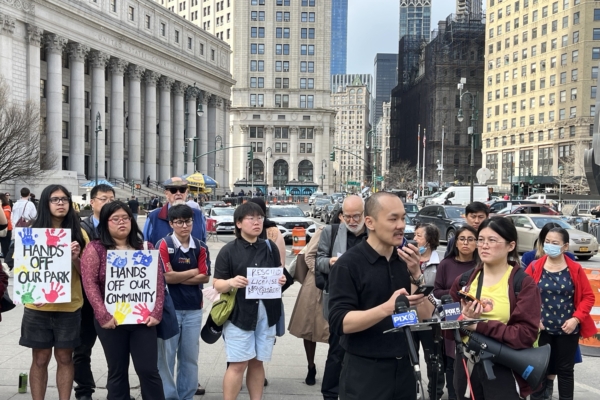
On April 1st, residents and labor groups from the Queens area held a press conference in front of the New York State Supreme Court in Manhattan, demanding an urgent reexamination by the judge of the legality of the licensing for the “Metropolitan Park” casino project. Protesters also urged the judge to issue a Temporary Restraining Order (TRO) to immediately halt the related construction projects.
The plaintiffs, consisting of several community residents and labor representatives, filed a lawsuit on March 20th, alleging a lack of transparency and fairness in the overall approval process, which they claim violates the New York State Open Meetings Law and related regulations. They believe that both the NYS Gaming Commission and the Community Advisory Committee failed to adequately ensure public participation rights during the hearings and evaluations, resulting in marginalized opposition voices.
Due to limited resources, five petitioners opted for a “pro se” approach to litigation. They acknowledged the high cost of legal fees but remained steadfast in their belief that “the facts and the law are on the side of the community” and hoped to rectify procedural injustices through legal recourse.
During the press conference, Flushing resident Hu Shijie shared his family’s experience, highlighting how his father’s chronic gambling addiction led to strained family relationships, financial difficulties, and even impacted his childhood. He emphasized, “This is not just a personal issue, but a risk that the entire community may face.”
Yunfang Zhang, a home care worker from the Flushing Workers’ Center, criticized Governor Huo Chu and the New York State Gaming Commission for approving the establishment of a casino in the vicinity of the Flushing Chinese community, equating it to “placing immigrant communities in high-risk environments.”
She further pointed out that last year’s public hearing process was severely imbalanced, with “pro-casino individuals given priority to speak, while opponents were silenced,” rendering public participation merely symbolic and undermining institutional credibility.
Participants of the press conference criticized State Senator Liu Chunyi for pushing through legislation related to land use conversion without the support of Senator Jessica Ramos, who represents the district and explicitly opposes the casino. They argued that this move weakened local representation. Additionally, Liu Chunyi had publicly acknowledged the negative impact of casinos on Asian communities but later supported related legislation, prompting questions about his shifting stance.
Opponents also questioned whether some officials participating in the Community Advisory Committee had failed to ensure an open and fair process, further fueling resident dissatisfaction and alleging a bias towards development interests in the overall decision-making process.
Regarding the lawsuit’s objectives, the petitioners clearly outlined three demands: first, to apply for a Temporary Restraining Order to immediately halt ongoing construction projects; second, to revoke the casino license decision; and third, to hold a fair, open, and genuinely inclusive public hearing process that incorporates community feedback.