
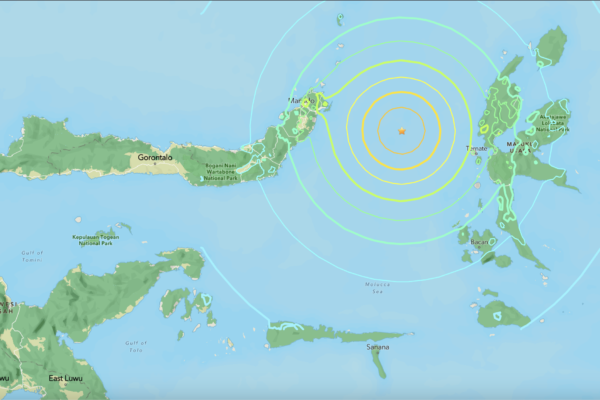
A strong earthquake with a magnitude of 7.4 struck the Molucca Sea in eastern Indonesia at local time 6:48 am on Thursday, April 2nd. The earthquake had a depth of 35 kilometers, leading Indonesia and neighboring countries to issue tsunami warnings.
According to the latest information from the Indonesian search and rescue team, a 70-year-old woman in Minahasa County, North Sulawesi Province, was tragically killed when hit by debris from a collapsed building.
The epicenter of the earthquake was located approximately 126 kilometers northwest of Ternate. The initial recorded magnitude by the US Geological Survey (USGS) was 7.8, later revised to 7.4, with the depth also corrected from the preliminary measurement of 10 kilometers to 35 kilometers.
Following the earthquake, the region experienced two aftershocks measuring 5.5 and 5.2 magnitudes, with officials anticipating further aftershocks in the future.
In Manado, the capital of North Sulawesi Province, a journalist from Agence France-Presse described the harrowing moments during the earthquake. “I immediately woke up and ran out of the house. Others followed suit,” he said. “There was a school nearby, and the students also rushed outdoors.”
The journalist noted that the shaking lasted “for a considerable amount of time.”
Footage from local media showed a building managed by the Manado Sports Committee severely damaged, with people screaming and shouting near the rubble, exclaiming, “Oh my goodness!”
The video depicted the building structure severely bent and deformed, with large furniture items thrown to the ground.
The Pacific Tsunami Warning Center warned that coastal areas within a 1,000-kilometer radius of the epicenter in Indonesia, the Philippines, and Malaysia may experience tsunami waves ranging from 0.3 to 1 meter. Coastal areas in Taiwan, Japan, Guam, Papua New Guinea, among other places, may see waves below 0.3 meters.
The Japan Meteorological Agency stated that while slight changes in water levels may occur along the Pacific coast, no significant damage is expected. The Australian Bureau of Meteorology confirmed that there is currently no tsunami threat to mainland Australia and its territories.
Indonesian authorities reported damaged buildings and injuries, urging people to stay away from coastal areas and areas prone to landslides, following local evacuation directives.
Indonesia is located on the geologically active “Ring of Fire,” prone to earthquakes and volcanic eruptions. In recent years, Indonesia has suffered several devastating earthquakes, including a 5.6-magnitude earthquake in West Java in 2022 that claimed at least 602 lives and the 2018 Sulawesi earthquake triggering a tsunami that claimed over 4,300 lives.
The deadliest on record was the 2004 Indian Ocean earthquake and tsunami, which caused over 230,000 fatalities across more than ten countries, with a significant number of victims in Indonesia’s Aceh Province.