
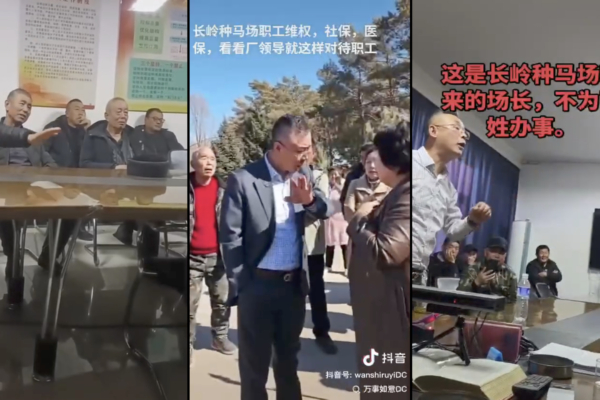
On March 30, more than 200 retired workers from the Shangling County Stud Farm in Songyuan City, Jilin Province, went to the Social Security Bureau to safeguard their rights. They accused the unit of paying social security contributions at the “minimum standard” or even in an incorrect manner for a long time, leading to extremely low retirement pensions and lack of medical insurance. As a provincial state-owned agricultural and animal husbandry enterprise under the Jilin Provincial Government’s Livestock Management Bureau, the Stud Farm has been seeing ongoing rights protection actions by hundreds of workers. According to interviewed workers, serious problems exist in payment, account management, and historical policy implementation by the farm, and multiple negotiations have yielded no results, leading to escalating conflicts.
Retired worker Zhang Baoyue (pseudonym) told Epoch Times that workers have been fighting for their rights, “starting to call the 12315 complaint hotline, calling every two to three days, with hundreds of people calling. Since January this year, 500 workers have successively visited the Municipal Party Committee, the Social Security Bureau, and the Personnel Bureau. County leaders summoned farm leaders and claimed to be discussing and processing the matter.”
However, after two months, “there has been no progress at all,” and workers have not even received a formal response.
On March 30, around 200 retired workers marched to the Shangling County Social Security Bureau to safeguard their rights. This was the latest collective action in the long-standing rights protection campaign.
Workers expressed that the corrupt officials at the Shangling County Stud Farm “are living off the people’s hard work and not serving the people,” and that “the Stud Farm has left us common people with no way out.”
Established in 1958, the Shangling Stud Farm is a provincial state-owned agricultural and animal husbandry enterprise under the Livestock Management Bureau of the Jilin Provincial Government, located in the eastern part of the Kerqin Grassland. In terms of administrative divisions, the Stud Farm serves as a class township unit of Shangling County. The issues concerning pensions and medical care for the 785 registered workers have remained unresolved to this day.
“We have been calling to complain for two months now, and they still haven’t resolved our issues,” Zhang Baoyue said. In the core of our rights protection movement is the fact that the nature of our social security has been “swapped.”
According to her recollection, in 2007, all 785 workers at the farm collectively paid 3,062.56 yuan, with the farm promising to pay for the “highest-tier employee social security” on behalf of the workers.
The money was handed over, and the workers believed they were now protected. It wasn’t until they received their payslips after retirement that they realized the significant reduction in benefits. “Some workers with three to four decades of service would start receiving four to five hundred yuan a month, and now as retirees, they only receive eight to nine hundred yuan.”
What made it even more unacceptable for the workers was that when they checked the payment records, they found anomalies. Zhang Baoyue disclosed, “They (the leaders) took our money (3,062.56 yuan), of which 1,982 yuan was paid for social security under their (leaders’) names. Our own accounts only had a little over 1,000 yuan.”
The money belonged to the workers, but it was the leaders’ names on the accounts, while the social security records were counted against the workers. Zhang Baoyue noted that the farm’s later explanation of being “voluntary” was moot, saying, “We didn’t sign or agree to anything, but they claim it was voluntary. Isn’t it the same now? They are deceiving our people.”
Moreover, according to official regulations, workers with years of service before 1995, even if they didn’t actually contribute, can have those years counted as “equivalent contributions,” which could result in higher retirement benefits.
However, workers specifically checked with the Social Security Bureau and found a problem. Zhang Baoyue stated, “They didn’t treat the years before 1995 as ‘equivalent,’ they simply never paid on our behalf.” In other words, while the farm took the workers’ money, they also gave up on pursuing the intended policy benefits, leaving the workers empty-handed. “Moreover, in 2020, they only paid one month of social security for us.”
Apart from the pension issues, dissatisfaction among the workers also stemmed from the medical insurance matter.
According to regulations, in-service workers should be covered by employee medical insurance, with reimbursement rates ranging from 80% to 90%. However, the Stud Farm quietly enrolled the workers in the new rural cooperative medical system originally meant for farmers, where the reimbursement rate was only 30% to 40%, resulting in a significant disparity.
“We are workers of a state-owned enterprise, but we are getting the lowest treatment like farmers. Do you think we will just sit idly by?” Zhang Baoyue questioned. The problem doesn’t stop there; not only did the workers not pay the contribution for the cooperative system, but they also didn’t receive any corresponding wages or subsidies for it.
Furthermore, there was a significant gap in the payment standards between the rural cooperative system and the employee medical insurance: around 400 yuan per year for the former and 360 yuan per month for the latter, totaling about 4,000 yuan annually. With lower payments and weaker coverage under the cooperative system, the question remains whether the difference flowed elsewhere. While Zhang Baoyue lacks direct evidence, she asks, “We only paid for the cooperative system, but where did the money intended for the medical insurance go?”
According to official regulations, units are supposed to bear 20% of the social security contributions, while individuals bear 80%. Zhang Baoyue mentioned that in recent years, the farm had not even paid the full 20%, reducing it to 16%, with the official reason being “national policy.”
However, after reviewing the documents, workers felt that the farm was deceiving them. Zhang Baoyue said, “We looked at the documents, and they are all liars, not reflecting reality.”
As a subordinate unit of the Livestock Management Bureau of the Jilin Provincial Government, the Stud Farm isn’t lacking in funds. Zhang Baoyue did some calculations: the entire farm covers five to six thousand hectares of land, along with grasslands, and “the farm earns five to six million annually from land sales.” Land prices have been rising continuously for four years, with increases of 10%, 10%, 30%, and 70% each year.
The whereabouts of this money remain a mystery. “There are only seven or eight people in the office, earning five to six million a year, not even contributing to our social security, so you should at least pay us something. We asked for transparency in the accounts, but they wouldn’t do it.”
Workers recall an earlier time when they had to contribute 6,000 kilograms of maize and 200 kilograms of soybeans annually. At that time, the farm could make around 1.5 million from selling these crops. “The farm didn’t pay our social security, so where did that money go?”
In 2025, the farm moved some land from the workers’ names, with the government providing a subsidy of 3,500 yuan to each worker, while the farm added over 500 yuan, ostensibly as a subsidy to the “elderly youth.”
However, Zhang Baoyue noticed that the land subsequently appreciated by 70%, “Will that money ultimately end up back in the pockets of the thieves? Have they taken our money back again?”
She stated, “Nowadays, all leaders are corrupt, which led to the current situation. In the past 25 years, through six generations of leaders, they used our money without paying our social security.”
According to multiple videos provided by workers to reporters, retired workers had previously negotiated with the Stud Farm with no substantial results.
The current farm director told the workers present, “Now all the common people think that the previous farm directors weren’t trustworthy and didn’t do anything to gain your trust. You all think that Li Yong has embezzled, and ‘was anybody greedy… Qianshan (approximation of a name)’. In one year, Li Yong embezzled two million. I’m just thinking, I haven’t even started yet, I’ve been working here for half a year, and how do we end up in debt.”
The official described the workers’ behavior as “disturbing office order,” while workers questioned the official, “You haven’t been in the office all morning, nor did you come out. Since you are a working person, why aren’t you in the office? Where did you go? It’s unacceptable to draw your salary but not be at your post, isn’t it?”
The official responded that there was no need to report schedules to the workers. Workers continued to ask, “Because I am a worker in the factory, I have the right to stand here. This place isn’t yours, nor is it mine.”
Workers also questioned how the farm couldn’t even maintain basic food security, “All the cafeteria staff have left, you can’t even buy rice or cook anymore. Why is that? I hear you saying you have money, so why aren’t you spending the money on these essential matters?”
Faced with workers’ inquiries about the progress of their rights protection, a leader stated that a document had been sent regarding the 2020 payment issue. When workers asked how it would be resolved, the leader said, “There is a document, from 1995.” The two sides became deadlocked on this issue, with negotiations ending without any results.