
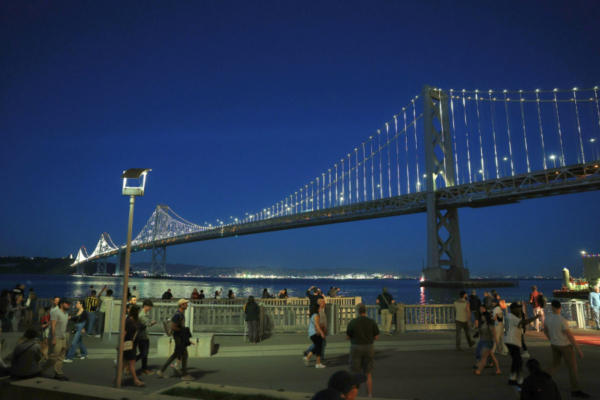
On the evening of March 20th, the iconic public art installation “The Bay Lights” on the Bay Bridge in San Francisco was relit after a 3-year hiatus for technical upgrades. The Bay Lights, a light show that illuminates the Bay Bridge, shone once again, bringing together elected officials, project teams, artists, and community representatives along The Embarcadero to witness its return amidst the serene sea breeze.
This moment marked not only the reappearance of the lights but also symbolized San Francisco emerging from the shadows of the pandemic, moving towards cultural revival and social cohesion.
Initiated by the nonprofit art organization Illuminate, the “Bay Lights” first debuted in 2013, created by artist Leo Villareal. Originally planned for a two-year display, it quickly became one of the most popular and iconic public art installations in San Francisco.
California State Senator Scott Wiener recalled that when the project was initially proposed, it was considered a “temporary project.” However, he insisted that it would become a permanent fixture, believing that everyone would fall in love with it.
The flowing lights gradually became an indispensable part of the city’s night sky. However, due to the early use of commercial lighting fixtures that couldn’t withstand the Bay’s strong winds and moisture, the lights went out in 2023. Subsequently, the Bay Area communities raised around $25 million to continue and upgrade the project.
The relaunched version of “The Bay Lights” now features a more durable professional lighting system that significantly enhances its artistic expression.
Illuminate’s founder, Ben Davis, described the new “Bay Lights” as a “qualitative leap,” achieving significant breakthroughs both technically and artistically. The upgrades included custom equipment from Musco Lighting in Iowa, improved weather resistance, enhanced lighting control accuracy, resulting in a more intricate and layered visual effect.
He believed that the 1.8-mile-long light display is a unique piece of art in the world. Davis stated, “There is no other landscape that can compare to ‘The Bay Lights,’ not even close.”
For him, this upgrade took the artistic expression to a new level, making it noticeably more fluid and vibrant in its overall experience.
Villareal, the creator of “The Bay Lights,” emphasized the core significance of the artwork in bringing people together. He likened the piece to a “Digital Campfire,” where people naturally gather around it, viewing it as a remedy for the current world’s divisions, polarizations, and chaos.
Villareal recalled that “The Bay Lights” started as a 45-second animation concept that seemed implausible even to himself, but through the joint effort of thousands of people and 15 years of dedication, it transcended technological and institutional barriers to become a reality.
He stressed that the project was not just “his” work but “our” work, hoping that “The Bay Lights” would inspire more communities and artists to create similar works.
San Francisco Mayor Daniel Lurie expressed that the return of “The Bay Lights” symbolizes the city’s resurgence. Despite the challenges faced in recent years, he proudly proclaimed San Francisco as the greatest city in the world.
The city’s differential factor lies in its creative class and cultural forefront, with “The Bay Lights” serving as a testament to this spirit, showing San Francisco as a “City of Awe.”
Davis described San Francisco as a city that inspires awe, possessing the power to influence the world, with culture and creativity as vital driving forces. He believed in the enormous energy that unity around beauty can bring.
Davis shared that his collaboration with Villareal felt like fate. When feeling lost about how to proceed with the project, Villareal was the first name that came to his mind. Their connection felt like a divine intervention, uniting them in this project.
With approximately $25 million raised for the project, Davis saw it not only as an engineering feat but also as a manifestation of a “generous culture.” He believed that the willingness to contribute to public art was vital in uniting cities and showcasing them to the world.
Senator Wiener highlighted the importance of San Francisco’s radiance shining brightly in the current global turmoil, a mission carried by “The Bay Lights.” As the countdown illuminated the Bay Bridge once more with thousands of LED lights, spanning the bay like a flowing Milky Way, a quote from the late South African Archbishop Desmond Tutu was cited to conclude the event: “Hope is being able to see that there is light despite all of the darkness.”