
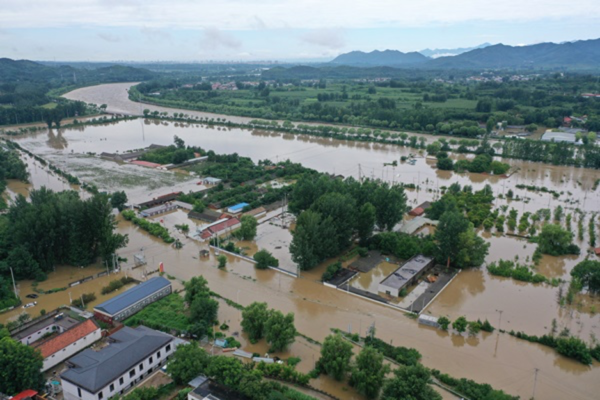
Recently, the water departments in provinces and cities such as Chongqing, Wuhan in Hubei, and Liuzhou in Guangxi have issued warnings of flood risks in 2026. The year 2026 falls under the ancient Chinese calendar as the “Bing Wu” year, which historically signifies a warning of “spring and summer floods” according to ancient texts.
According to a report on the official website of the Chongqing Municipal Government on March 25, 2026, the pre-flood training for hydrological and water-related disaster prevention work in Chongqing was initiated. Officials from the Chongqing Water Resources Bureau stated that in 2026, the city faces a severe situation in terms of flood and drought disaster prevention. The upcoming flood season may see a complex situation of “coexistence of floods and droughts, with prominent risks of extreme disasters,” with an expectation of about 16 heavy rainfall events throughout the city. The Jialing River is predicted to have above-average water levels, and there is a higher probability of major floods in multiple small and medium-sized rivers, with increased risks of localized flash floods in small watersheds.
On March 27, 2026, during a press conference held by the Wuhan Municipal Government in Hubei Province, the Wuhan Hydrological Bureau presented predictions for the water trend during the 2026 flood season. The forecast indicates that the main flood season in Wuhan in 2026 will experience both droughts and floods, with a higher risk of regional and periodic flood and drought disasters.
Specifically, during the flood season from May to October 2026, the Three Gorges Reservoir is expected to have water levels 1-2% above normal levels. In the peak rainfall period, the water level in the Wuhan section of the Yangtze River may be higher than usual. During the main flood season from June to August, there is a higher risk of major or above-standard floods in the main small and medium-sized rivers in Wuhan, such as the Jiu River basin and the Jin River basin, compared to 2025. Towards the end of the flood season in September and October, the Wuhan section of the Han River may experience significant flooding.
As reported by Guangxi News Network on March 24, 2026, a flood prevention mobilization coordination meeting was held in Liuzhou City, Guangxi. The water resources department in Liuzhou predicted that during the 2026 flood season (April to September), there is a significant possibility of major floods in major rivers such as the Duliu River, Guyi River, Rong River, Liujian River, and Luoqing River. Moreover, some small and medium-sized rivers in Rongshu Miao Autonomous County, Sanjiang Dong Autonomous County, Rong’an County, and Luzhai County may experience moderate to severe flooding.
The year 2026 is the “Bing Wu” year in the Chinese calendar. In the Chinese sexagenary cycle, both “Bing” and “Wu” belong to the fire element, with the color red associated with fire, hence also known as the “Red Horse Year” or “Scarlet Horse Year.”
The well-known ancient text “Di Mu Jing” clearly states, “In the Bing Wu year, there will be many floods in spring and summer. Planting should be done in high places to avoid being washed away by water.”
“Di Mu Jing” is a traditional agricultural prediction text in Chinese almanacs, often mentioned alongside the “Spring Ox Diagram.” It follows a sixty-year cycle, with a corresponding poem and divination statement for each year, used to forecast agricultural harvests, weather conditions, and natural disasters, while also guiding farming activities and avoiding misfortunes.
The “Kong Sheng Zhen Zhong Ji” also has a similar description: “In the Bing Wu year, water flows endlessly, and planting is best done in high places. Low-lying fields will be flooded, and the mouths of celestial worms are sharp.”
The “Kong Sheng Zhen Zhong Ji,” also known as “Zhong Zhong Ji,” is an ancient predictive work attributed to Confucius, with an unknown date of composition. The book is divided into three sections of 60 years each, predicting changes in celestial timing, natural disasters, and agricultural fortunes.
These ancient texts consistently point towards the same warning: in the Bing Wu year, there may be unusually heavy rainfall in the spring and summer seasons, posing risks to low-lying areas.
Looking back at history, during the previous Bing Wu year in 1966, the Yangtze River basin experienced major flooding; in the Bing Wu year of 1906, Southern China was hit by catastrophic floods. Going further back to the Bing Wu year of 1846, widespread flood disasters occurred in the North China region.