
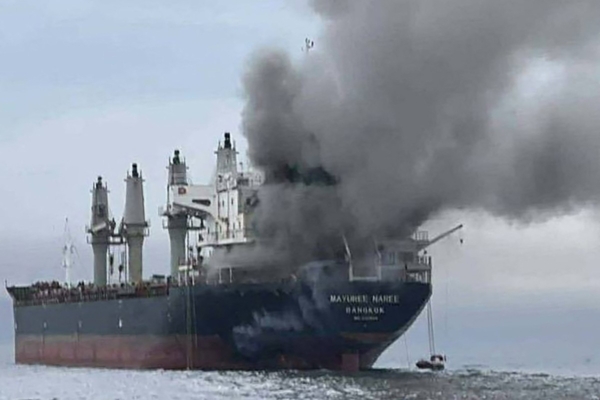
On Monday (March 30), a Kuwaiti oil tanker carrying crude oil was attacked off the coast of Dubai, sparking a fire and causing international oil prices to rise once again. Dubai authorities confirmed that this was a drone attack targeting the commercial vessel. Currently, all 24 crew members on board have been safely rescued, and relevant departments are working to control the fire and assess potential oil spill risks.
According to a statement released by Kuwait Petroleum Corporation (KPC), the attacked vessel is a large crude oil tanker named “Al-Salmi” which was anchored approximately 31 nautical miles northwest of Dubai Port at the time of the incident.
The attack caused damage to the ship’s structure and ignited a fire. KPC stated, “Emergency response and firefighting teams were immediately mobilized to closely coordinate with relevant departments to effortfully control and manage the situation.”
Although the United Kingdom Maritime Trade Operations Office (UKMTO) indicated in initial assessments that the incident did not result in environmental impacts, KPC warned that the attack might lead to an “oil spill incident in the surrounding waters.” Detailed technical assessments are currently underway.
Since the outbreak of conflict in Iran on February 28, several commercial vessels in the Gulf region and the Strait of Hormuz have been consecutively targeted by missiles or drone attacks. This incident is just the latest in a series of such attacks.
As a result of this event, the price of West Texas Intermediate (WTI) crude oil futures in the United States surged by 2.9% to reach $105.91 per barrel.
On the same day as the attack on the “Al-Salmi,” another Greek cargo ship, the “Express Rome,” was harassed by unidentified projectiles off the coast of Saudi Arabia but fortunately did not result in casualties.
Currently, no organization has claimed responsibility for the attack on the oil tanker.
With Iran’s closure of the Strait of Hormuz impacting 20% of global oil and liquefied natural gas (LNG) supplies, along with energy infrastructure in multiple Middle Eastern countries coming under attack, damaged natural gas fields, refineries, and ports may take years to repair. The International Energy Agency (IEA) has warned that the disruption caused by the Middle East crisis could have far-reaching effects on global energy.
The wave of energy price fluctuations has already affected global consumer goods prices, directly increasing gasoline and diesel prices, while transportation costs have led to overall price hikes.
Crude oil, natural gas, and by-products produced during the refining process, such as urea, helium, and naphtha, are crucial for the production of semiconductors, automobiles, airplanes, plastics, and fertilizers.
Maximo Torero, Chief Economist at the Food and Agriculture Organization of the United Nations, pointed out that if the conflict continues for several more weeks, global food supplies will be severely disrupted.
“This will affect planting, impacting the supply of major crops, cereals, feed, as well as commodities like dairy and meat,” he stated.