
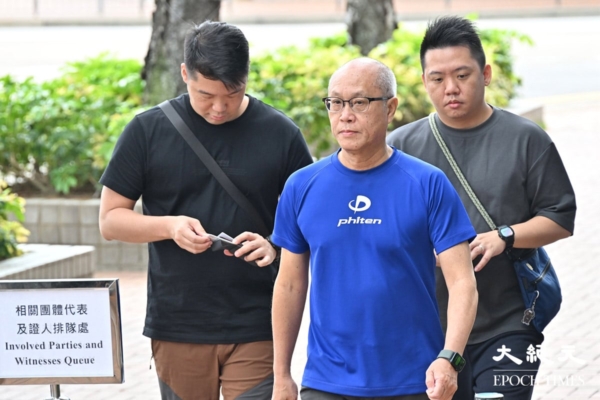
On March 30, 2026, the Independent Commission of Inquiry into the 5th-level fire at Hong Kong Tai Po Wang Fu Yuen held its fifth round of hearings. Apart from residents giving testimony, representatives from a firefighting engineering company also testified.
Yip Ka-ku, a resident of Wang Tai Court in Wang Fu Yuen, lost his partner in the fire. He testified that he noticed a fire at Wang Cheong Court that day and went downstairs to check on it while his wife stayed at home. As he went downstairs, he saw scaffolding on fire, and the flames spreading to Wang Tai Court. He tried to go back to his unit but was stopped by police. He called his wife, asking her to wait at home for rescue.
He recalled later being informed by neighbors that his wife had gone door to door seeking help during the fire. He raised concerns about smoking issues among workers in Wang Fu Yuen, noting that complaints were made during early construction meetings. He also mentioned discovering unusual cigarettes not common in Hong Kong, reporting it to the contractor, but the problem persisted.
Additionally, after a typhoon hit Hong Kong last year, the contractor replaced damaged scaffolding. Yip pointed out that the new scaffolding was thinner and had finer wires compared to the old ones, even visible to the naked eye. He complained in engineering meetings, but the contractor only responded with a smile and no action.
Yip also mentioned his experience attending an owners’ meeting, where unauthorized votes were added to the ballot box before counting, and he noted unfamiliar faces in the meeting room through the glass, questioning the legitimacy of the proceedings.
Moreover, Yip had previously complained to the Buildings Department about unreasonable terms in the construction contract but was told they could not intervene as they only provide funding.
Yip criticized the government’s handling of the fire, attributing it to a series of negligence and calling for a change in the bureaucracy’s approach from “do less, make fewer mistakes” to a more proactive stance.
Following Yip’s testimony, his neighbor Lam Yin-ming took the stand. She recounted being alerted by Yip’s wife about the fire, smelling smoke but not seeing anything unusual from her window. She eventually saw the fire and thick smoke in the lobby after leaving her unit with her dog.
She also reported complaints about workers smoking on-site and observed cigarette butts on the scaffolding despite the contractor providing a bucket for disposal. Lam tearfully thanked Yip’s wife for her kindness, expressing that she did not deserve such a fate.
Another resident, Law Tak-pui of Wang Tai Court, testified that he went downstairs at 2:52 PM that day, witnessing the fire at Wang Cheong Court and flames reaching Wang Tai Court. He did not hear the fire alarm but only heard security guards urging people to evacuate.
Law mentioned receiving a notice from the management and association about the fire system being turned off for maintenance for 14 days last year. He inquired about it but was informed it was due to engineering needs. He expressed surprise that it lasted six months and criticized the lack of fire alarm, which impacted residents’ evacuation efforts.
Law criticized the management companies and contractors for their negligence, pointing out that over a hundred innocent lives were lost in the fire, and emphasized the importance of finding answers and justice during the inquiry to provide closure to the families of the victims.
Su Xiaofeng, a resident of Wang Zhi Court, revealed concerns about the fireproofing measures during the renovation period and recalled his parents’ tragic fate during the fire. He expressed remorse for the loss of his parents and emphasized the need for truth and justice to be served for the deceased.
Su acknowledged the criticism of being greedy for justice and truth and emphasized the importance of seeking justice for the victims. He described the past four months since the fire as the most painful period of his life, but he appreciated the support from friends and called for unity among the residents.
Zhou Zhi-wai, a resident of Wang Cheong Court, recounted the harrowing experience of witnessing the fire with his wife in their unit. He highlighted the lack of a fire alarm and the ineffective fire suppression methods during the incident. He criticized the management and contractors for their shortcomings.
Huang Sheng-qin, a resident of Wang Jian Court, described hearing commotion outside his home during the fire and trying to extinguish the flames with neighbors but faced
challenges due to the lack of water flow. He was eventually evacuated by family members and personally ensured his son was safe after leaving the fire site.
Wang Hui-chen, a resident of Wang Jian Court, recalled seeing the fire with his wife and the absence of a fire alarm before they descended in the elevator. He also pointed out discrepancies in the materials used for window protection during the renovation and criticized the lack of oversight in the worksite safety measures.
In the afternoon, Huang Jianhua, an employee of a registered fire contractor, “Wang Tai Fire Engineering Co., Ltd.,” confirmed that they had conducted the annual fire inspection in Wang Fu Yuen on March 24-26 last year. He mentioned damages to the fire hose reels and parts based on his inspection report.
During the inquiry, it was revealed that the fire hose system had been disabled after repairs, potentially hindering safety assessments. Questions were raised about the lack of communication with other contractors and authorities regarding the shutdown, highlighting potential oversights in fire safety protocols.
As the inquiry delved deeper, it became apparent that there were systemic failures and oversights leading up to the tragic fire incident at Wang Fu Yuen. Residents and witnesses sharing their accounts shed light on the critical need for accountability and reforms in fire safety regulations and construction practices. The testimony presented at the hearing underscored the urgent need for transparency, oversight, and accountability to prevent such disasters from reoccurring in the future.