
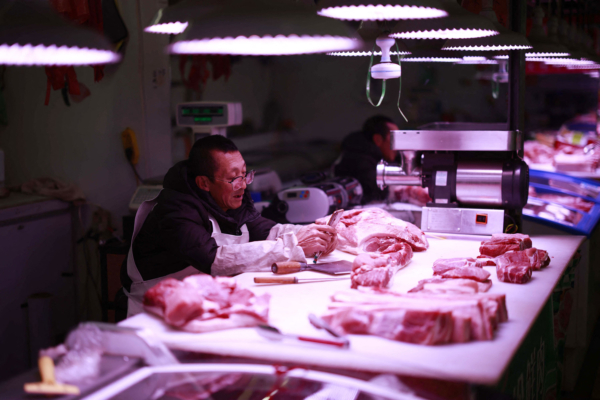
Recently, the price of pork in mainland China has been continuously decreasing, drawing widespread attention from the market. In Shenyang, Liaoning Province, pork hind leg meat is specially priced as low as 1.99 yuan per half a kilogram; in Fuzhou, Fujian Province, the price of pork is even lower than bamboo shoots. At the same time, pressures of losses at the breeding end are increasing, putting strain on the industry chain.
As of late March 2026, the national average price of live pigs has dropped to 10-11 yuan per kilogram, with some areas even falling below 9 yuan per kilogram, reaching a new low in nearly seven years.
According to Red Star Capital Journal, on March 29, several fresh supermarkets in Shenyang, Liaoning, launched limited-time “flash sale” activities, offering pork hind leg meat at a special price of 1.99 yuan per half a kilogram, limited to 3 kilograms per person, leading to queues of residents scrambling to purchase. This price marks a new low in nearly seven years, with a drop of over 85% from the high price of 15 yuan per half a kilogram during the Chinese New Year period.
Internet users commented on this:
“Zhang Jie from Shenyang”: “I queued up at 6 a.m., 1.99 yuan per half a kilogram is too good, bought 6 kilograms enough for a week’s worth of meals!”
“Li, a pig farmer”: “Watching the meat prices drop, feed costs rising, pig prices falling, I really don’t know how to get through this year.”
“Foodie Xiaozhou”: “Bamboo shoots at 11.5 yuan per half a kilogram, pork only 2 yuan, these prices are so magical, better stock up on meat!”
The 1.99 yuan per half a kilogram pork in Shenyang is not an isolated case, as low prices like 4.9 yuan per half a kilogram have also appeared in Fuzhou, Chengdu, and other places.
On March 29, a consumer in Fuzhou, Fujian said, “Recently, bamboo shoots have become more expensive than pork.” She found that after the Chinese New Year, pork prices had dropped again, with fresh pork front leg meat selling for 9 yuan per half a kilogram near her home, and online discounted prices as low as 4.9 yuan per half a kilogram, while the price of bamboo shoots is around 11.5 yuan per half a kilogram.
Yonghui Supermarket also offered “high-quality and affordable pork belly” at 11.9 yuan per half a kilogram; fresh pork soup bones at 7.9 yuan per half a kilogram, and fresh pork hind leg at 8.9 yuan per half a kilogram. Ms. Yu, a consumer present at the scene, exclaimed, “The price of pork is getting cheaper and cheaper.”
Monitoring information from the Chinese Ministry of Agriculture and Rural Affairs shows that wholesale pork prices have been continuously declining since August 2024, with the national average wholesale price of pork dropping to 7.92 yuan per half a kilogram, a decrease of about 43% from the peak of 13.88 yuan per half a kilogram.
According to reports from the official Chinese media, recently, it has been learned from various places including Liaoning, Henan, and Beijing that pork prices in many areas have reached lows in recent years, and after March, they are still declining rapidly.
On March 24, in Hunnan District, Shenyang City, Liaoning Province, the price of pork in a farmers’ market near Xuecheng Road had dropped to around 10 yuan per half a kilogram, with the promotional price of pork even lower than the prices of green peppers, ginger, and garlic nearby.
Stall owner Wang Hongliang explained that after the Chinese New Year, the price of pork had dropped by about 2 yuan per half a kilogram compared to the holiday period. “Although low prices attracted many passersby, fresh pork is a fast-moving consumer good, and the increase in daily sales volume is not significant.”
Huang Dan, the person in charge of Ruihui Industrial Co., Ltd. in Yiyang City, Hunan Province, stated, “Since August 2025, the price of commercial crossbred pigs has been steadily declining, from over 7 yuan per half a kilogram to just over 5 yuan now, reaching the lowest price in years.”
The decline in pork prices is transmitting to the upstream sectors, and the breeding industry is facing significant pressure, falling into a situation of “raising one pig and losing one pig”. Monitoring of 500 county trading markets and collection points nationwide by the Chinese Ministry of Agriculture and Rural Affairs shows that in the third week of March 2026, each kilogram of piglets was priced at 26.2 yuan, a decrease of 2.6% compared to the previous period, and a drop of 30% year-on-year; each kilogram of live pigs was 11.05 yuan, a decrease of 2.9% compared to the previous period, and a drop of 28% year-on-year; each kilogram of pork was 22 yuan, a decrease of 2.1% compared to the previous period, and a drop of 16.5% year-on-year.
The person in charge of the Livestock Section of the Agricultural and Rural Bureau in a county in Henan Province stated that currently, the local price of live pigs ranges from 4.7 yuan to 6 yuan per half a kilogram, which is not sufficient to cover costs even under self-bred conditions. If labor costs are factored in, raising a pig may result in a loss of two to three hundred yuan.
Even leading companies are not immune to the situation. Take Muyuan Group, which emphasizes cost control, as an example. On March 28, the company released its 2025 annual report, showing an operating income of 144.145 billion yuan, a 4.49% year-on-year increase, and a net profit attributable to the parent company of 15.487 billion yuan, a 13.39% year-on-year decrease.
In addition to Muyuan Group, Wens Foodstuff Group saw its sales revenue reach its lowest level since February 2025, while sales income of Tangrenshen increased in volume but decreased by 22.74% year-on-year.