
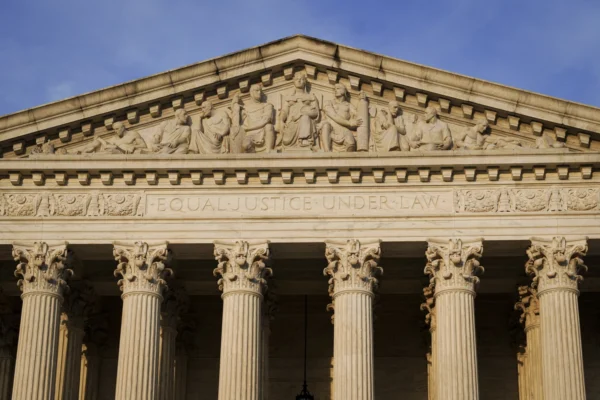
The Supreme Court heard oral arguments last Monday (23rd) to decide whether a law in the state of Mississippi (referred to as “Mississippi”) is in conflict with federal law. The justices raised questions during the session, with most leaning towards supporting the allowance of post-election day mail-in ballots. Chief Justice John Roberts Jr. remained relatively quiet, while three liberal female justices agreed to provide a grace period for receiving mail-in ballots after election day.
The court is expected to make a ruling on “mail-in ballots received after election day” in late June or early July in the case Watson v. Republican National Committee (RNC), which could potentially impact the elections in November.
Following the COVID-19 pandemic in 2020, many states utilized mail-in voting and allowed for ballots postmarked on Election Day to be received afterward. Mississippi also passed a controversial law allowing election workers to process mail-in ballots up to five days after the election, provided they were postmarked by Election Day. Secretary of State Michael Watson argued that ballots are considered “cast” when submitted by voters.
In January 2024, Mississippi voters, county election officials, the Mississippi GOP, and the RNC jointly sued, pointing out that state law contradicts the federal definition of “election day.” Congress established the first Tuesday after the first Monday in November as “election day” in 1845.
In July of the same year, a federal district court dismissed the plaintiffs’ claims. By October, a panel of three judges in the Fifth Circuit Court of Appeals ruled that all ballots must be received on or before “election day.” Subsequently, the appeals court rejected the state government’s request for a rehearing. In June 2025, the state government appealed to the Supreme Court, which agreed to hear the case in November.
Deputy Attorney General of Mississippi, Scott Stewart, argued last Monday in the Supreme Court that states have broad autonomy in election matters, and state law aligns with federal law, emphasizing that voters make their decisions on election day.
Justice Neil M. Gorsuch questioned Stewart’s argument, pointing out a logical inconsistency regarding who the ballots should be handed to, as Stewart mentioned both election officials and “common carriers.” Gorsuch raised a scenario where a voter, after learning about a candidate scandal post-election day, decides to retract their ballot sent through a courier like FedEx, which could potentially alter the election outcome.
Stewart insisted that such a situation would not occur, as state law does not permit voters to retract their ballots. Gorsuch countered that the state law does not specify this provision.
Justice Ketanji Brown Jackson countered that the issue in this case does not concern ballot retractions or past election practices.
Justice Elena Kagan noted that the Electoral Count Reform Act passed by Congress in 2022 explicitly defines a “period of voting,” implying that election day is not limited to just one day.
Justice Samuel Alito observed that the concept of election day in the United States has evolved into election month(s), questioning how long states can receive ballots post-election day. He emphasized the importance of maintaining public confidence in the election results, highlighting the potential impact of accepting a large number of late-arriving ballots after polling stations close.
Justice Clarence Thomas questioned whether handing a ballot to a neighbor constitutes a “choice.” Stewart acknowledged that handing it to a neighbor is indeed a choice but not the officially recognized final choice.
Thomas further inquired about the moment when a choice becomes the final decision. Isn’t submitting the ballot itself part of the formal state process?
Stewart clarified that a choice is only officially recognized when voters hand over the ballot and formally submit it to state election officials, making it publicly known.
Justice Amy Coney Barrett asked whether there is a fundamental distinction between mailing a ballot to the post office or a common carrier compared to handing it to a relative or a neighbor for delivery, as neither are government officials.
Justice Sonia Sotomayor questioned RNC’s counsel Paul Clement about whether it is illegal for overseas residents and military personnel to submit absentee ballots (received after election day).
Clement explained that the Uniformed and Overseas Citizens Absentee Voting Act (UOCAVA) applies not only to federal elections but also to state primaries, general elections, and special elections, whereas the election day regulation only applies to federal elections, requiring ballots to be received by election day.
Sotomayor interjected, “By that logic, we should have had a different president.” She referred to the 2000 presidential election case Bush v. Gore, where Florida counted late-arriving overseas ballots post-election day, leading to George W. Bush’s victory.
Clement criticized Sotomayor as a “red herring,” diverting attention with misleading arguments. He mentioned that the UOCAVA necessitates mailing ballots 45 days in advance, which Florida failed to comply with, leading a judge to issue a “consent decree” as a remedy.
Justice Brett Kavanaugh asked Clement whether if the Supreme Court ultimately supports their plea and announces the judgment in June (before the recess), would states be able to implement the ruling before the November elections?
Clement stated that there is ample time for overseas residents and military personnel to mail their federal election ballots 45 days prior to election day, typically by mid-September.
Judicial Watch submitted court documents arguing that when Congress drafted legislation, the term “election” encompassed the entire voting process, including the stage where officials receive ballots. The organization pointed out that counting ballots arriving after election day not only creates opportunities for fraud but also undermines public trust in the electoral system.
“This case boils down to whether federal election laws can truly be enforced as intended. Congress established a single and unified national election day, and states cannot undermine federal directives by unilaterally extending the ballot receipt deadline,” stated Chairman Tom Fitton. “The Supreme Court is facing a crucial opportunity to reestablish clear and uniform national election standards.”
Currently in California, ballots postmarked on the actual “election day” are allowed to arrive at the election center up to seven days after. In the upcoming primary on June 2nd, ballots were mailed starting on May 4th, with in-person voting ending at 8:00 PM on June 2nd, and mail-in ballots being accepted until June 9th. ◇