
In Southern California’s East Orange County, the Canyon area has been repeatedly certified as a “Firewise Community” under the National Firewise Communities Program, enhancing the residents’ sense of security and making it easier to obtain home insurance in California. Mary Schreiber, Chair of the Canyon Fire Safety Committee (FSCEOCC), emphasized the constant threat of wildfires in the rugged canyons and foothills, highlighting the importance of community cohesion and proactive wildfire prevention measures.
Twenty-five years ago, real estate broker Mary Schreiber moved to Silverado Canyon near the Cleveland National Forest. At a vegetation management meeting, she was encouraged by fire department official George Ewan to establish the committee. Despite initial hesitation, Schreiber took on the responsibility and has been leading the committee for 25 years, actively liaising between the fire department and residents, ensuring accurate information dissemination to dispel rumors during emergencies.
Apart from emergency coordination, FSCEOCC continuously promotes public safety education, fosters information exchange among Canyon and foothill communities, enhances residents’ awareness of wildfire prevention and emergency response, leading to multiple certifications as a “Firewise Community”. Schreiber is also a volunteer for the local Community Emergency Response Team (CERT) and Trauma Intervention Program (TIP). The committee is driving efforts such as clear address signage and private road naming across communities, ensuring swift response of emergency vehicles and organizing regular bush clearing and Canyon clean-up activities.
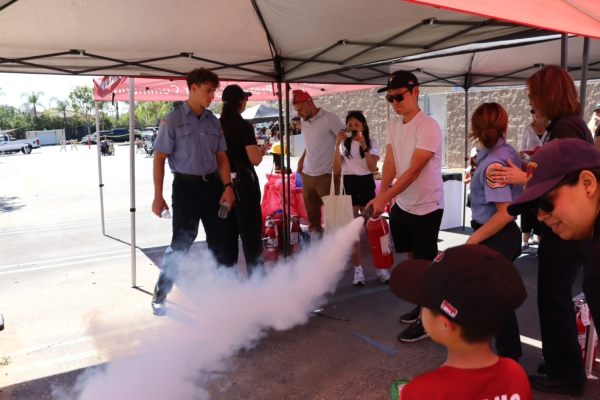
During the 2026 Orange County Fire Department’s “Open House” event, Schreiber and volunteers shared practical wildfire prevention knowledge. One volunteer recounted an incident where a resident’s house, covered in beautiful Bougainvillea vines, caught fire due to the dry fuel provided by the vines, resulting in damage to the roof skylight and interior.
Key areas for residential fire prevention include the roof, eaves, vents, chimney, drainage system, exterior walls, door and window seals, fences, balconies, terraces, and maintaining a 5-foot non-combustible zone around the house. Current fire prevention concepts advocate:
5-foot Buffer Zone: Clearing all flammable materials within 5 feet of the home can increase the house’s survival rate by 50%.
Defensible Space: Clearing dead plants, roof debris, and gutter build-up within a 100-foot range of the house, and installing hard surfaces.
Plant Layering and Selection: Recommended planting of succulents and high-water content plants, ensuring sufficient vertical and horizontal spacing between plants.
The event also demonstrated the proper utilization of common “ABC fire extinguishers” for different fire types: Class A for general combustibles, Class B for flammable liquids and gases, and Class C for electrical equipment (not suitable for Class K oil or Class D metal fires).
Volunteer Jason mentioned Orange County’s Alert OC, a reverse 911 emergency notification system where the county government sends alerts to registered residents. He shared examples of notifications during wind outages in Silverado Canyon and evacuations during wildfires, emphasizing the system’s critical role. Alert OC allows registration of multiple addresses (home, workplace, friends) to receive information from various areas; he advised setting up out-of-state contacts to facilitate messaging during major disasters.