
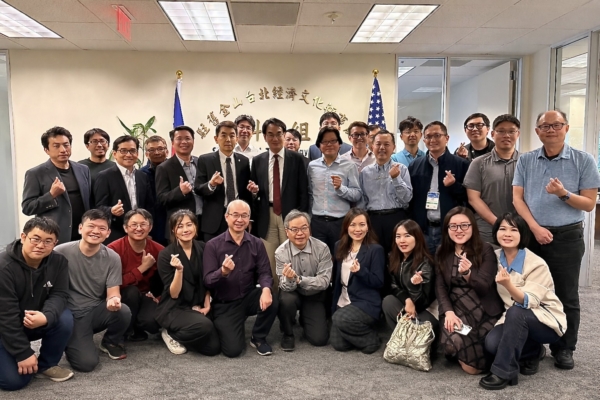
The Taiwan Minister of Digital Development, Lin Yi-jing, held an exchange meeting at the South Bay San Francisco Tech Group office on March 25th to present Taiwan’s digital policy and cybersecurity industry development direction to Silicon Valley tech professionals. Lin personally conducted a special briefing focusing on the four main themes of “Anti-fraud, Software Industry, Cybersecurity Resilience, and Digital Government.”
This event was an important extension of the Taiwan Digital Development Department’s delegation’s participation in the “RSA Conference 2026” in San Francisco, inviting cybersecurity practitioners to share technology applications and industry insights, exchange views with the Silicon Valley industry, and participate in brief media interviews afterwards.
Lin Yi-jing stated that for over three years, the Digital Development Department has focused on industry and digital government as its main tasks, with combating online fraud becoming a core mission due to the increasing severity of cyber scams.
Through the department’s “Online Fraud Reporting and Query System,” the public can report suspicious messages for government-assisted takedown, with over 300,000 fraudulent contents processed to date. Subsequently, in collaboration with Meta, Google, and LINE, the department trained AI models to intercept fraudulent messages before distribution, totaling approximately 7.8 million interceptions. Through international cooperation, they traced fraud origins, targeting scam hubs including Cambodia.
Lin Yi-jing pointed out that Taiwan’s software industry has primarily focused on customized projects, lacking productization and international marketing capabilities. The Digital Development Department is driving industry transformation and constructing an AI ecosystem in five dimensions:
– Computing Power: Providing public computing resources to reduce startup barriers
– Data: Promoting relevant legislation, establishing a Taiwanese language corpus, developing data convergence and privacy enhancement technologies, accumulating over 1 billion tokens
– Talent: Establishing an application, development, and research triple certification system
– Marketing: Facilitating enterprise and market alignment through Demo Day
– Funding: A joint public-private investment of NT$10 billion over 10 years from the National Development Fund
He emphasized that startups need market opportunities more than mere subsidies.
Facing national-level cybersecurity threats, the Digital Development Department has set three major goals: uninterrupted networks, invulnerable systems, and data non-disclosure.
Lin Yi-jing mentioned that hackers could penetrate key companies through the supply chain, thus promoting semiconductor device cybersecurity standard “SEMI E187” to enhance supply chain security and drive cybersecurity certification, consultancy, and product opportunities.
Furthermore, the government is enhancing digital resilience from land, sea, and air aspects, including bolstering 5G networks, reinforcing submarine cable protection, and adopting satellite communication systems to ensure communication even in extreme scenarios.
In terms of digital government, the Digital Development Department is promoting “Digital Credential Wallets” employing a “Selective Disclosure” mechanism to provide necessary information only during identity verification, thus reducing the risk of personal data leakage. This approach is currently applied in scenarios such as parcel pick-ups at convenience stores.
Moreover, the government has developed a “Life Event-Oriented” service model where citizens can complete all related administrative procedures in one stop by simply selecting events such as moving or getting married.
The Taiwan delegation’s visit to the United States was to participate in the global cybersecurity summit “RSAC 2026,” where they set up the “CYBER TAIWAN PAVILION” showcasing AI security, Post-Quantum Cryptography (PQC), and Zero Trust architectures, as well as collaborating with eight Taiwanese cybersecurity firms to expand into international markets.