
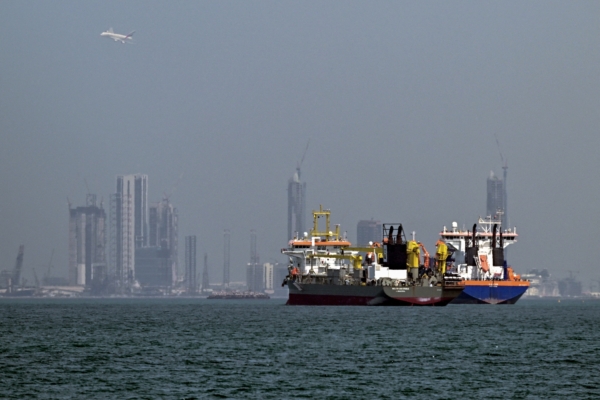
Amid the escalating situation in the Middle East, the Legal Department of the China Council for the Promotion of International Trade issued a report on March 17 acknowledging that the military standoff between the United States, Israel, and Iran has severely disrupted transportation in the Strait of Hormuz, affecting over 40% of China’s oil imports and involving key raw materials for chip manufacturing. It is widely believed that this concentrated impact has exposed China’s long-standing high dependence on energy channels and external markets in the Middle East, leaving China’s foreign trade system lacking in buffering capabilities amidst geopolitical conflicts.
The report reveals that over 40% of China’s imported crude oil needs to be transported through the Strait of Hormuz. The strait accounts for approximately 30% of global oil flow, and the conflict has led to disruptions in shipping, causing international oil prices to briefly surpass $111 per barrel, directly raising energy costs for China. Multiple shipping routes from China have been forced to detour around the Cape of Good Hope, resulting in delays of 10 to 20 days and a more than 50% surge in freight costs, squeezing profit margins for Chinese foreign trade enterprises and increasing the risk of order defaults.
A senior professional in the electromechanical industry in Jiangsu, Mr. Lu, told reporters, “This geoeconomic storm is hitting us directly. Many companies here are reflecting losses on their books, as Middle Eastern clients have ceased placing orders.”
Lu added, “The Middle East market used to be a ‘safe haven’ for countless Chinese enterprises, but now it has turned into a graveyard. Many products can’t be shipped out or brought in. The shift from profitability to loss makes it difficult for us, small-margin-dependent businesses, to survive. If the situation doesn’t improve within 3 months, most manufacturing industries in Jiangsu, Shandong, and Zhejiang will be in big trouble.”
He further pointed out, “In the current chaos, discussing prices is meaningless; ‘whether delivery can be made on time’ has become the sole matter of life and death. Many overseas customers have already switched to other supply channels without looking back.”
The report also notes that there is a contraction in demand in the Middle East market, leading to a decrease of around 15% to 20% in export orders for some Chinese enterprises. The local economy is shifting resources towards security and defense sectors, weakening infrastructure and consumer demand, which directly impacts China’s exports.
Ms. Guan, a staff member in China’s foreign trade and economic system, told reporters, “This is the result of long-term suppression of domestic demand. China is a manufacturing powerhouse and an export giant; if exports cease, manufacturing will have to shut down. The reason is simple: China itself cannot absorb such a massive amount of consumer goods, so exports are the only way out.”
A researcher in foreign trade in Yiwu, Zhejiang, privately stated, “The so-called ‘foreign trade thirst’ is not a naturally occurring market outcome but a structurally ingrained reliance shaped by long-term policy orientation. When domestic demand is suppressed and exports are subsidized, the entire economic system can only rely on external markets. Once the external environment changes, risks will concentrate and erupt.”
The report acknowledges that the Middle East is not only a significant source of China’s crude oil but also crucial for the supply of key raw materials for chip manufacturing and other industries. Miss Zeng, a representative of a private company in Shenzhen, told reporters that Middle Eastern clients have suspended orders due to the conflict, and what’s even more critical is that final payments for some orders that have already been shipped are now “stuck” due to the breakdown of local financial chains.
Zeng expressed, “Many used to believe that the supply chain was stable, but now they realize it’s built on a fragile line. Once one part goes wrong, the entire chain will break.”
Mr. Li, a businessman who has shifted his assets to Vietnam, told reporters, “On one hand, companies can’t escape the constraints of the US dollar system; on the other hand, the RMB settlement system promoted by the Chinese government is as fragile as a piece of waste paper in times of war. Companies are stuck in the middle, bearing all the institutional costs and security risks at the grassroots level.”
The researcher in foreign trade in Yiwu, Zhejiang, privately mentioned that this “dual reliance” structure places Chinese enterprises under a double constraint of the US dollar system and the failure of the RMB system in times of geopolitical conflicts, making it difficult for the financial alternative path promoted by China to provide support in the face of practical challenges.
An international trade scholar in China, who goes by the pseudonym Stone, told reporters, “This report seemingly signals risks but actually reflects China’s high dependence on the Middle East in foreign trade. This is not just a warning but also a reckoning. Once the situation spirals out of control, the destructive impact of this vulnerability will rapidly spread and amplify.”
He pointed out, “The channel from China to the Persian Gulf has become extremely unstable. The soaring costs are just the tip of the iceberg; the bigger issue is that the supply itself has lost certainty. When the energy ‘lifeline’ turns into a ‘hanging thread’ that could snap at any moment, what we need to discuss is no longer about making more or less profit but the fundamental aspect of survival security.”
Political scientist Liao Gang told reporters, “When the structural foundation of the external environment has loosened, there is actually very limited room for adjustment at the enterprise level. If critical channels remain in an unstable state for a long period, such risks will continue to accumulate and eventually concentrate at a certain point.”