
Recently, during the recently concluded annual sessions of the National People’s Congress and the Chinese People’s Political Consultative Conference, the Chinese government officially claimed that the “overall employment situation is stable.” They stated, “The situation of rural migrant workers returning to work after the holiday is generally stable, and employment remains stable.” However, multiple interviewees from mainland China told Epoch Times that they are “worried sick” because they cannot find jobs. The official rhetoric of “flexible employment” has been criticized as linguistic manipulation to conceal the true plight of the laborers.
In Anhui, a man named Chen Xian (pseudonym) has worked as an electrician for seven to eight years. He used to work in the Jiangsu-Zhejiang-Shanghai region but this year, he couldn’t find work and had to return home.
“I got married, born in ’84, haven’t bought a house. But it’s tough (to find a job), worrying. “He told Epoch Times, “I don’t even know what else to do now, feeling lost. The wages for electricians have generally decreased now. Even when I work, it’s hard to get good pay.”
Chen Xian usually works for private bosses who subcontract from big companies and typically works for a year or half-year at a time. “This year, my boss doesn’t have any work. The boss is now doing casual labor like plumbing. He’s from Anqing. I went home straight (in January). Even now, he can’t find much work with the boss.”
Wages have also decreased. Electricians now earn only 300 to 350 yuan a day, compared to nearly 400 yuan before. Chen Xian hasn’t been able to receive his full wages from last year until now. “They said they would pay in April this year, but I don’t know if they will pay at that time. I still owe more than 30,000 yuan. I worked on a project for five months, they gave me some living expenses in between and paid a part of the wages, but the rest is still pending.”
“Now, there is much less work. If you don’t work, someone else will. But when you work, you are afraid of not getting paid well. So, I don’t even know what to do now,” he sighed.
Chen Xian plans to look for factory work in Hangzhou in a few days as he doesn’t want to work on construction sites anymore due to the difficulty in receiving payment, although the factory wages are lower.
In Zhejiang’s Yiwu, Xiao Fang, a 25-year-old with a technical diploma, has been looking for stable work but can’t find any. She rents a 700 yuan per month room. “I’ve been in Yiwu for over a year, and I can’t find a stable job. I keep looking for temporary gigs like helping at exhibitions but I don’t have any specific skills. Like operating a sewing machine, Yiwu mostly requires experienced workers, they don’t have time to train newbies.”
Xiao Fang said, “Nowadays, there are more job seekers than employers, and there is fierce competition. Even getting a job as a casual worker is difficult. Even jobs that pay 18 yuan per hour are hard to come by, let alone those paying 20 yuan per hour. The wages are really low now, even long-term workers earn around 18, 15, or 13 yuan per hour. It’s tough. Working for a little over ten yuan an hour feels like working as fast as an airplane on an assembly line.”
In big cities like Beijing, Guangzhou, and Shanghai, there is a concentration of migrant workers, leading to intense competition in the casual labor market.
In the Zero-work Market on Baiyang Road in Fangshan District, Beijing, there are too many job seekers and too few jobs. Recently, as soon as a boss appeared at the market, workers surrounded him. (Video Link)
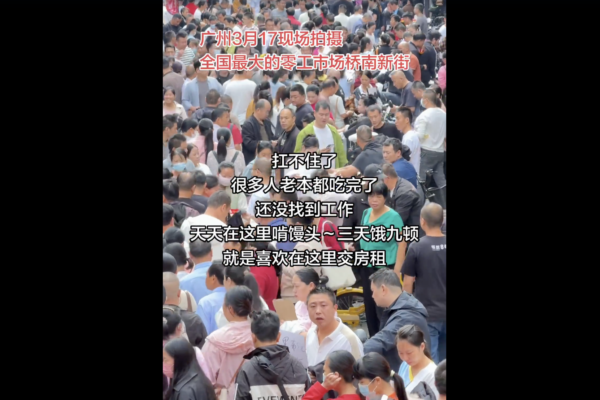
A blogger released video footage showing that in late March, at Qiaonan New Street in Guangzhou, one of the country’s largest casual labor markets, there was a large crowd of job seekers, creating a staggering scene.
On March 11, a blogger released a video saying, “At 4 a.m., hundreds of people are waiting for work at Songjiang Xinqiao’s casual labor station in Shanghai but can’t get any: please help them find work!”
Xiao Deng, a 23-year-old from Nanyang, Henan, had been working in Hefei, Anhui, but went to Shenzhen alone to find work over half a month ago. He studied computer science, but it hasn’t been useful in finding a job.
Deng told Epoch Times that now he just wants to work in a factory to save some money and learn new skills. However, “There are too many job seekers here, and factories don’t lack workers. It’s tough!”
When asked why he doesn’t seek help from intermediaries, he said he was deceived by one before. He tried four or five factories, but none of them worked out, and he even lost his ID. “The intermediary asks for money for transport, medical check-ups, and all sorts of things, but then can’t arrange any work for you. Also, when you get to the factory, you find out it’s completely different from what the intermediary promised.”
He now sleeps in a 25-yuan bed at night with only 20 yuan left. He plans to take up daily-wage work for a few days and then get a longer-term job in a factory.
“If I don’t find daily-wage work by tomorrow, I’ll have to sleep on the streets. It’s tough now, I can’t even find casual work,” he said.
Deng commented, “The job market is really bad now, especially this year, it’s even harder. There are quite a few homeless people here now.”
Ms. Yang Xiang (pseudonym) in Shenzhen, who works as a labor intermediary, told reporters that it’s hard to find work now, with low wages and strict selection criteria – preferring males aged 18 to 20 and females aged 19 to 45. Many factories don’t require workers, and those that do pay only 16 to 17 yuan per hour, with no signs of wage increase except for technical jobs.
“I don’t have any job offers to give to others now,” she said.
Chen Le (pseudonym), a man who worked as a tiler on construction sites in Shangrao, Jiangxi, for over twenty years, is currently unemployed. He also expressed his struggles, saying, “It’s hard to find work this year. I went to Zhejiang to work for ten days but had to return home as there were no jobs.”
Chen Le is actively looking for work through referrals from acquaintances or by submitting resumes online, seeking recommendations from peers in the field.
“This year, there is much less work, and prices are low. I have to inquire about the next job even before completing the current one, fearing I won’t find another opportunity,” he said.
“In Shangrao, I earn only 260 yuan a day, but the cost of living is similar to Zhejiang,” Chen Le stated. The overall job market has declined year by year. “Work is hard to find, wages are low, money is hard to come by. I want to change careers but don’t know what else to do. I’ve worked on construction sites for decades, I don’t know where else to go.”
China is facing an aging population and a decrease in the birth rate, and the Chinese Communist Party is vigorously promoting marriage and childbirth. However, under the pressure of survival, many young people are choosing not to marry.
Chen Le, who is married, expressed envy towards those who choose not to marry. “One of the workers I know doesn’t get married. He works for a day and plays for five days, very relaxed, no pressure, no one to answer to. I also want to not get married in my next life, and I’ll live happily.”
He believes the current environment is unfavorable, stating that eighty percent of people probably can’t even earn 300 yuan a day, some not even 200 yuan, and in dire situations, they have to borrow money to survive. This is the condition of the common people today.
China is entering an era of casual employment. The Chinese manufacturing industry is witnessing a new trend in employment. Many manufacturing companies are lowering their labor costs by employing dispatch workers, “shared casual labor,” and hiring university students and older workers at low wages. Dispatch workers are those who sign labor contracts with dispatch companies and have no direct labor relationship with the employing firm.
According to a study by a team led by Professor Zhang Dandan from the National Development Institute of Peking University, the total number of dispatch workers in the Chinese manufacturing sector is estimated to be around 40 million, accounting for 31.12% of the workforce in the manufacturing sector. The traditional long-term and stable employment model is gradually being replaced by short-term workers and casual laborers, with casual labor becoming the main body of employment in the manufacturing sector. In large-scale manufacturing plants with workforces of over ten thousand employees, the proportion of dispatch workers can reach as high as 80%.
The Chinese government refers to individuals without stable jobs as “flexibly employed.” According to the current official definition of flexible employment, it covers anyone who hasn’t signed a standard full-time labor contract but works for at least one hour per week and earns corresponding income. This category includes self-employed individuals, platform-based new job formats laborers, and traditional casual workers.
In May 2021, officials from the Chinese Ministry of Human Resources and Social Security revealed that the flexible employment scale, including part-time self-employment and new job forms, reached 200 million people. Over four years later, in December 2025, the ministry officials claimed that “the number of flexibly employed individuals has exceeded 200 million.” The wording changed from “reached 200 million” to “exceeded 200 million,” but there is no clear data or statistical source provided.
Many observers believe that the actual scale of “flexibly employed” individuals in China has already surpassed this figure.
An article from Caixin on February 27 of this year reported that the flexible employment group, totaling around 200 million, accounts for 27% of the total employed population of approximately 740 million nationwide and nearly 43% of the 470 million urban employed population. The total number is substantial, but many flexibly employed individuals are still considered “non-mainstream” and face multiple challenges like lack of social security, unstable income, and unclear career development.
The report mentioned a job report on the employment of online ride-hailing drivers, indicating that the current online ride-hailing market is saturated and demanding orders are slowing down. This imbalance in supply and demand in the industry signifies that there is a limit to job opportunities.
Commentator Yuan Bin stated that the Chinese Communist Party claiming that the flexible employment force in China has exceeded 200 million may sound like a positive employment situation at first glance, but in reality, it signifies a looming wave of unemployment. The Chinese authorities not only manipulate unemployment data but also play with language, labeling those unable to find jobs as “self-employed,” transforming delivery workers, ride-hailing drivers, and street vendors into “self-employed entrepreneurs”; barely surviving on casual labor income is glorified as being part of the “diversified employment” force. A negative piece of news about economic decline has been turned into a shiny achievement in resolving employment issues.