
【Epoch Times, March 25, 2026】Pop Mart released its 2025 performance report on Wednesday, showing increases in both revenue and profit. However, shortly after, its stock price plummeted. Additionally, Pop Mart is facing a slowdown in the terminal market, with several new IPs struggling to gain traction. Analysts believe that Pop Mart’s rapid growth is unsustainable, with six major concerns lurking behind the scenes.
On Wednesday afternoon, Pop Mart International Group announced its 2025 financial report, with revenue of 37.12 billion yuan (RMB), a 184.7% year-on-year increase, and adjusted net profit of 13.08 billion yuan, a 284.5% year-on-year increase.
However, investors were not convinced, and shortly thereafter, the stock price of Pop Mart on the Hong Kong Stock Exchange (09992.HK) plunged, dropping by over 20% at one point during trading. By the end of trading, the stock was down 22.51% to 168.30 Hong Kong dollars per share, leading to a market value loss of over 50 billion Hong Kong dollars in a single day.
During the annual performance release conference held on Wednesday, Pop Mart’s Chairman and CEO, Wang Ning, appeared lacking in confidence. He stated that in 2026, Pop Mart hopes to achieve growth rates not lower than 20%.
The significant drop in Pop Mart’s stock price can be attributed to a clash between high valuation and unsustainable growth. According to Wall Street News, Morningstar analyst Jeff Zhang pointed out that Pop Mart’s growth rate dropped significantly in the fourth quarter of the previous year, raising concerns about the enduring appeal of its core IP. In addition, the company reduced its dividend payout ratio from 35% in 2024 to 25% in 2025, sending another negative signal.
An analysis article published by “Financial Association CLS,” a financial platform under Finance News, highlighted six reasons behind the sharp decline in Pop Mart’s stock price.
1. The peak in expected growth, including the disappearance of the base effect and the fading of the “buying frenzy” mentality. With revenue jumping from around 13 billion yuan in 2024 to 37.1 billion yuan in 2025, achieving high growth on top of this in 2026 presents a significantly increasing challenge.
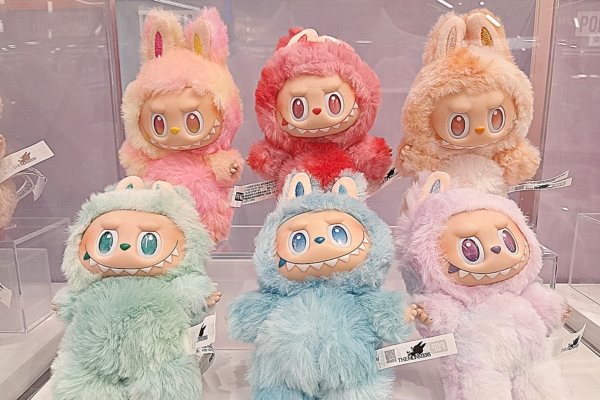
2. Dependence on a single IP. The financial report indicates that nearly 40% of Pop Mart’s revenue comes from the single IP, LABUBU. Market concerns arise about whether the company has enough secondary IPs to fill the gap if LABUBU’s popularity naturally wanes in 2026. Meanwhile, Sanrio’s Hello Kitty and Disney’s classic character Mickey Mouse have both maintained market appeal for decades.
3. Lackluster growth of mature IPs. MOLLY, a longstanding IP of Pop Mart, generated a revenue of 2.9 billion yuan in 2025, significantly below the market expectation of 4.6 billion yuan. This underperformance hints at a potential growth bottleneck for mature IPs. If LABUBU faces a similar fate in the next two years, the company may find itself in a dilemma of “stagnant old IPs and unestablished new IPs.”
4. Revenue falling short of expectations. Despite achieving revenue of 37.12 billion yuan in 2025, it was slightly below the market’s widespread expectation of 38 billion yuan. When actual performance fails to surpass inflated expectations, profit-takers move quickly, resulting in a sell-off. The capital market is always looking not just for good performance but for better-than-anticipated results.
5. Surging inventories. Pop Mart’s inventory surged from 1.52 billion yuan in 2025 to 5.47 billion yuan, with inventory turnover days increasing from 102 to 123 days. In the consumer industry, inventory is often a leading indicator of slowing demand.
6. Long and short speculation. Morgan Stanley analysts pointed out in their report that southbound capital remains a major source of long positions, while foreign hedge funds are the main source of short positions. The sharp decline following the financial report release indicates that, for now, the bears have the upper hand in the speculative game.
Moreover, in 2025, Pop Mart’s overseas income totaled 16.27 billion yuan, a 291.9% year-on-year increase. However, geopolitical risks, intensifying US-China trade tensions, changes in tariff policies, and potential resistance to cultural exports are all looming challenges for Pop Mart.
Pop Mart is already facing a slowdown in the terminal market, with several new IPs failing to attract interest. The days of “buying to profit” seem to be fading away.
On March 22, Pop Mart released a collaboration between LABUBU and Sanrio for the first time, featuring resin plush keychains. However, many consumers did not experience the expected quick profit as secondary market prices rose sharply before quickly dropping, with some regular items even falling below the original sale price.
Since the launch of the LABUBU-Sanrio collaboration, members of the online toy collector community have been selling products at or even below the original purchase price. “LABUBU Sanrio Melody, selling at the original price,” “LABUBU Sanrio Pacha Dog, selling at a loss of 145 yuan,” “LABUBU Hello Kitty, no free shipping.”
In a post on March 15, Finance News reported that in 2026, Pop Mart has accelerated the introduction of new IPs, releasing three new characters, Supertutu, Merodi, and Key A. While Supertutu and Merodi figurine blind boxes have been officially launched, market response has been tepid.
Data from Pop Mart’s Tmall flagship store shows that as of now, the “Superhappy ING!” series figurines released in January have sold just over 1,000 units, while the “After-School Merodi” series released in February has sold just over 6,000 units.