
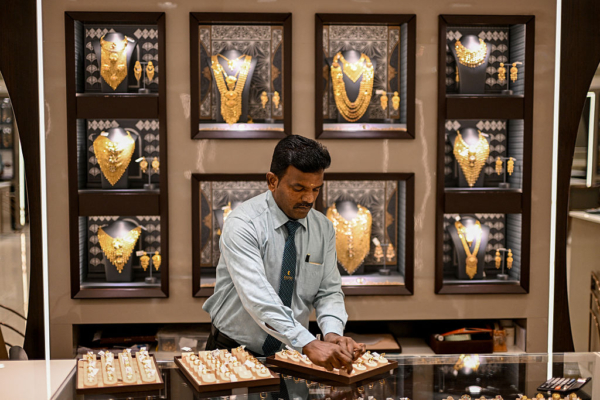
The military actions of the United States and Israel against Iran have entered their fourth week, leading to a sharp drop in gold prices. Indians have started rushing to buy gold, with a surge in customers at jewelry stores on Monday, March 23.
Since the outbreak of the Iran conflict on February 28, precious metals have dropped by about 22%, falling about 25% from the record high of $5,594.82 on January 29.
Gold rebounded on Monday following recent selling, but with the easing of the Iran conflict and new hope emerging from US-Iran negotiations, investor confidence was boosted, causing gold prices to bounce back strong from the initial steep decline.
On Monday morning, spot gold prices fell over 5% to $4,262.50, before recovering to $4,431.09.
The recent significant drop in gold prices has sparked interest among gold-loving Indians to rush to jewelry stores for purchases. Buyers noted that the decrease in gold prices compared to recent highs has made gold more affordable, prompting them to plan purchases for future use.
According to Reuters, ASHWINI JAVDEKAR, a customer at a jewelry store in Surat, Gujarat, said, “Yes, the prices of gold and silver have both fallen a lot. So, we feel we should invest immediately. It’s a good opportunity because if the prices go up again later, we won’t be able to buy as much.”
Another customer, SANSKRITI, from Pune, Maharashtra, expressed, “It’s good for us because it has relaxed us as we can now afford to buy that much gold, earlier it even reached 170,000 rupees ($1,823.43). At that time, buying gold was not really worth it for us. So now, people are really looking forward to being able to purchase a certain amount of gold for future use.”
The Iran conflict has led to a rise in energy prices, further adding bets for maintaining higher interest rates in the long term. Although gold is hailed as a hedge against inflation and a safe haven, the rising interest rates have increased the opportunity cost of holding this non-yielding metal, making it difficult for gold to benefit.
VIREN CHOKSI, a jewelry store owner in India, informed Reuters, “There were expectations of a rate cut by the Federal Reserve, which supported the gold. But since the US did not cut rates, that becomes the reason the gold didn’t rise and further fell.”
According to a report from Kotak Institutional Equities, as of January 2026, the total value of gold holdings by Indian households has soared to over $5 trillion, accounting for about 125% of the country’s GDP.
The report stated, “The value of gold holdings by Indian households currently accounts for 65% of their non-property wealth. We estimate the value of gold holdings by Indian households is at 175% of their deposit and equities value.”
With gold prices soaring over 200% in the past 2-3 years, will Indians consider selling gold to raise cash? There are no official figures yet, but reports indicate that despite record gold prices, most Indian households have not sold gold. Instead, they opt for gold loans.
According to The Financial Express, data from the Reserve Bank of India shows that banks and non-banking financial institutions disbursed $20 billion and $23.4 billion in gold and gold jewelry loans in the fiscal years 2025 and 2026, respectively, compared to an annual average loan amount of $3 billion from fiscal year 2022 to 2024.
Narinder Wadhwa, Managing Director and CEO of SKI Capital Services, told The Financial Express, “Indians do not sell gold in difficult times but use it as collateral for loans to protect wealth and tradition.”
“For generations, gold has not only symbolized wealth but also dignity, family honor, and social status. It is accumulated throughout one’s life – through marriages, festivals, and inheritance – and is rarely seen as something to liquidate. In many families, selling gold is considered inauspicious or a sign of financial distress, and it is usually avoided unless absolutely necessary,” he added.