
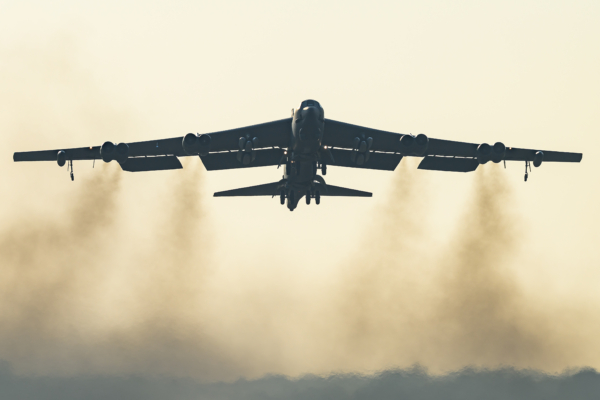
The “Operation Epic Fury” carried out by the United States against Iran has entered its third week. The US Air Force B-52 “Stratospheric Fortress” bombers are conducting missions over Iran, which clearly indicates the direction of the war and serves as a powerful demonstration of American air superiority.
As the B-52 bombers are not stealth aircraft and have a large physical footprint, even poorly maintained air defense systems can easily detect this massive target. Therefore, B-52 bombers are usually used to strike in regions where the US has established air superiority.
Currently, the B-52 bombers are carrying out missions unhindered in Iranian airspace, indicating that the F-22 “Raptor”, F-35 fighters, and precision-guided weapons have destroyed Iran’s integrated air defense system.
Kris Osborn, a former Pentagon senior expert and now CEO of the “Warrior Maven” website and military analyst, believes that the appearance of these non-stealth bombers confirms the destruction of Iran’s Russian-made S-300 and S-400 air defense systems, enabling the B-52 bombers to use precision-guided Joint Direct Attack Munitions (JDAM) and standoff cruise missiles to target Iranian command centers, ammunition depots, and troop positions.
The B-52 bombers can serve as a large “weapons warehouse” aircraft, conducting devastating strikes in regions where the US holds air superiority. In the future, they will also be able to launch drones and employ laser weapons, and serve as airborne command and control centers.
Currently deployed at the RAF Fairford airbase in the UK, the US Air Force strategic bombers continue to participate in the “Operation Epic Fury” military operations, with B-1 and B-52 bombers flying missions almost daily, with the latter carrying a significant amount of external payload.
According to the Central Command report, the B-52 bombers have taken part in strikes against Iranian missiles and control stations.
Let’s now delve into the impressive weapon capabilities and technological upgrades of the B-52 bombers.
The massive size of the B-52 allows it to carry approximately 70,000 pounds (31,751 kilograms) of weapons, including bombs, smart weapons, torpedoes, and missiles. The H-model B-52 can also carry up to 20 air-launched cruise missiles. The B-52 can carry both nuclear and conventional weapons, including gravity bombs and nuclear cruise missiles.
The current B-52 bombers, by equipping reconfigured internal weapon bays, have significantly expanded the variety and quantity of weapons they can carry.
The 1760 Internal Weapons Bay Upgrade (IWBU) allows the B-52 bombers, besides carrying six bombs under each wing, to carry up to eight of the latest Joint Direct Attack Munitions (JDAM) series bombs internally.
While the B-52 bombers previously had the capability to externally carry JDAM weapons, with the IWBU (Integrated Weapon Battle Unit), the aircraft can now internally carry more advanced precision-guided weapons like Joint Direct Attack Munitions (JDA) and Joint Air-to-Surface Standoff Missiles (JASMS).
Other upgrades such as new engines, radars, avionics systems, and weapon integration upgrades are impacting the basic tactical functions of the B-52 bombers, transforming them from primarily “area attack weapons” to platforms capable of executing more advanced and precise long-range attacks.
These bombers not only possess formidable firepower but also have an astonishing range of up to 8,800 miles (approximately 14,000 kilometers), which can be further extended through aerial refueling, with a top speed of 650 miles per hour (about 1050 kilometers per hour).
As a regional attack platform, the B-52 has historically been capable of dropping a large number of “non-guided” bombs on enemy territories for comprehensive bombing and facilitating optimized maneuvers for ground forces.
Compared to some newer rivals, the operating costs of the B-52 bombers are relatively lower.
The B-52 can also operate as an intelligence node, meaning it can transmit and relay target information across platforms.
With a new digital communication system named Combat Network Communication Technology (CONECT), the B-52 crew can receive mission and target updates while in flight, allowing adjustments based on new operational information.
An often overlooked but crucial aspect of modernizing combat aircraft is the ability to extend the aircraft’s lifespan and maintain optimal performance through proper maintenance and structural reinforcement.
This holds true for the B-52 bombers, as the operational environment and technology in which they operate today are vastly different from the Vietnam War era. The current technical composition and operational concept of the B-52 bombers are likely heavily influenced by the lessons learned from the US Air Force weapons development personnel in actual combat situations during the Vietnam War.
In 1972, as part of the “Operation Linebacker II”, US B-52 bombers dropped over 20,000 tons of bombs on North Vietnam within 11 days.
These bombers also played significant roles in the Gulf War “Operation Desert Storm” in 1991 and the Iraq War in 2003.