
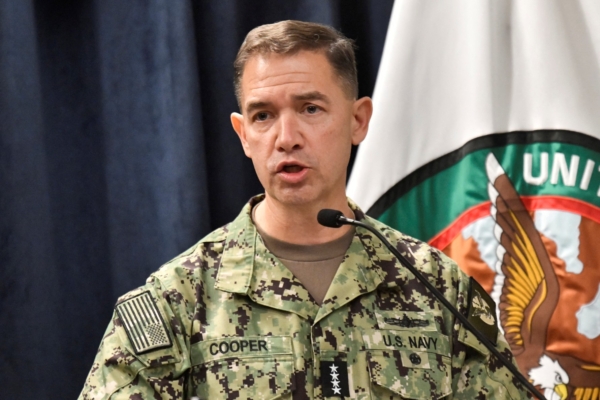
On Saturday, March 21, after three weeks of joint military operations between the United States and Israel targeting Iran, Commander Brad Cooper of the United States Central Command released a video updating the progress of the “Operation Epic Fury” and summarized the outcomes of the military campaign.
Commander Cooper took to the social media platform X to deliver a roughly 4-minute long speech. He stated that on the 22nd day of the operation, the US military continued to take bold actions and advance according to plan to neutralize Iran’s capacity to project power beyond its borders.
Over the past three weeks, Cooper noted a significant decrease in Iran’s operational capabilities. He mentioned that the US had already struck over 8,000 military targets in Iran, including 130 Iranian naval vessels, marking the largest naval assault within three weeks since World War II.
“Our assessment of the operation remains: Iran’s operational capabilities are steadily diminishing while our offensive strikes are intensifying,” Cooper emphasized. He added that the US forces were in the process of “destroying thousands of Iranian missiles, advanced attack drones, and the entire Iranian naval fleet used to disrupt international shipping.”
“Their navy is unable to sail, their tactical fighters cannot fly, and they have lost the ability to launch missiles and drones at the high frequency seen at the beginning of the conflict,” he explained. “Our progress is evident.”
Cooper further stated that the US military remained focused on eliminating the threat Iran poses to the freedom of navigation through the Strait of Hormuz over the last several decades.
For example, he described a recent airstrike on an underground facility along the Iranian coastline where 5000-pound bombs were dropped. This facility was known to secretly store anti-ship cruise missiles, mobile missile launchers, and other equipment posing a danger to international shipping.
“We not only destroyed the facility but also disrupted the intelligence support sites monitoring ship movements and missile radar relay systems,” Cooper added.
As a result, Iran’s capability to threaten navigation freedom in the Strait of Hormuz and its surrounding areas has been weakened, and efforts to track these targets will not cease.
Just two days prior, the US Army conducted the most extended field artillery strike in military history using precision-guided missiles to destroy Iran’s military infrastructure, showcasing the unmatched range and lethality of the US military.
Cooper highlighted that the US military maintains air superiority over Iranian airspace, having executed more than 8000 combat flights. “From refueling aircraft to fighters, bombers, and land and sea-based aviation units, all our crew members have exhibited exceptional performance in combat,” he stated. “Fighter jets are expanding their operational range to maintain pressure on our enemies, precisely targeting our main objectives. Our pilots are actively seeking out and destroying threats in real-time.”
In addition to the US military’s powerful offensive capabilities against Iran, the air defense forces are working together to defend against Iranian attacks. “We have built the most extensive air defense system in the Middle East region, thanks to years of joint investment with allies and partners, creating a strong and integrated air defense and missile defense system,” Cooper emphasized.
Benefiting from this robust air defense system, Cooper emphasized that the US Gulf partners have successfully fended off thousands of Iranian drone attacks.