
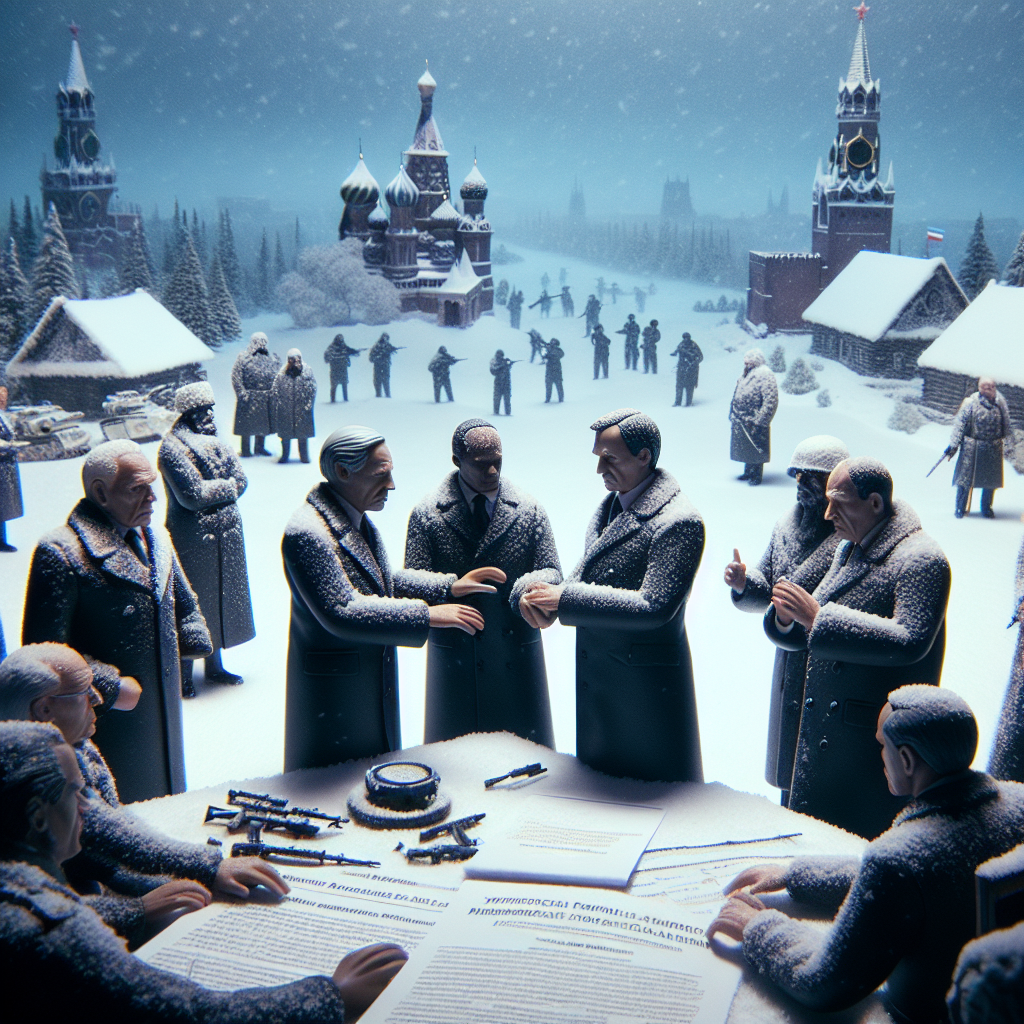
After the outbreak of the war between Russia and Ukraine, President Trump has been trying to draw Russian President Putin closer, persuading Putin to cease fire, while criticizing Ukrainian President Zelensky, which has displeased some European allies. A recent analysis by Politico suggests that Trump’s actions are driven by a broader strategic goal: to counter China and help the global order break free from dependence on China.
The article points out that the Trump administration believes that convincing Russia to halt the fighting and embracing Russia economically back into the Western camp could ultimately help the global order reduce its reliance on China. While this approach may seem like a gamble and unsettle Ukrainians, it signals to the world that the US views the biggest geopolitical threat faced by the US and the West as China, rather than Russia.
This is why despite over 15 months of negotiations with no results, and repeated threats to walk away from the talks proving ineffective, the Trump administration has not given up and continues to seek a breakthrough. A Trump administration official, who declined to be named, revealed to Politico that finding ways to strengthen cooperation with Russia could shift the power balance vis-a-vis China.
However, many observers believe that the prospects of success in this approach are slim. Ukrainian officials also argue that attempting to lure Russia back into the Western fold through economic incentives has proven futile in the past and even led to Russia waging war against Ukraine. Both China and Russia share a common dislike for the US, making it difficult to separate them.
The article suggests that even though the prospects might be slim, luring Russia for the purpose of countering China aligns with the broader foreign policy objectives of the US government. Actions such as overthrowing the authoritarian leader in Venezuela, pushing the Cuban government to the brink of collapse, successfully pressuring Panama to withdraw from China’s Belt and Road Initiative, warning Peru against deep-water port agreements with China, etc., have all weakened China’s penetration and influence in the Western Hemisphere.
The article mentions that the recent joint US strike against Iran has disrupted China’s calculations for cheap oil imports. China has exploited loopholes in US and international sanctions by importing black-market oil from Venezuela, Iran, and Russia at significantly lower prices (at times $30 per barrel lower than market prices). By 2025, Iran was supplying China with over 13% of its oil, amounting to over a hundred billion dollars annually in recent years.
While there have been reports of intelligence sharing between Russia and Iran, dialogues between the US and Russia are ongoing. Last week, the President’s envoy team met with senior advisors of Putin, with the Russian side describing the meeting as productive, while US representatives stated that dialogues would continue. At the same time, Trump has requested multiple countries, including China, to assist in ensuring the security of the Hormuz Strait.
The National Security Strategy released in November repeatedly indicates the threat posed by China, with many bipartisan members of the US Congress unanimously agreeing that China is the most serious long-term threat to the US and the globe. Alexander Gray, former staffer of the National Security Council during Trump’s first term and current CEO of American Global Strategies, stated that the long-term US strategy has been to oppose a Sino-Russian alliance as it is detrimental to American interests, expressing the need to divide them or at least engage in tactical cooperation with the lesser threat.
A spokesperson from the US State Department told POLITICO that China’s economic cooperation with Latin American countries threatens US national security, and the US government is working on ways to mitigate this threat.
Fred Fleitz, another former staffer of the National Security Council during Trump’s first term and current Vice President of National Security Affairs at the America First Policy Institute, revealed that President Trump had pressured Putin to end the war, normalize relations between Russia, the US, and Europe, and even pushed for Russia to rejoin the G8.
This indicates that on one hand, President Trump sought ways to end the war and peacefully coexist with Russia. He also recognized the growing threat to US and global security posed by the Sino-Russian alliance, which outweighs the threat of the Russia-Ukraine conflict, thus making continuous efforts to improve US-Russia relations to weaken or dismantle the Sino-Russian alliance.
Following his recent appointment, US Secretary of State Rubio warned in an interview that if Russia remains forever subservient to China, it will not bode well for Russia, the US, or Europe, highlighting the dangers of excessive reliance on China and obedience towards China. Rubio acknowledged that breaking the Sino-Russian alliance completely is no easy task, as he previously expressed doubts on the successful detachment of Russia from its relationship with China.
In conclusion, Adam Savit, the China Policy Director at the America First Policy Institute, believes that while the Sino-Russian alliance may complicate China’s strategic position, given Russia’s rapid decline and weak position in the Russia-China relationship, Russia’s role remains marginal and will not be a decisive factor in the US-China competition, emphasizing that the key focus for the US lies in East Asia.
However, some remain skeptical. Craig Singleton, Senior Director of China Programs at the Foundation for Defense of Democracies, believes that the China-Russia relationship is unbreakable, and at most, Russia may engage in limited tactical cooperation with the US rather than fully sever ties with China.
On the flip side, China is also actively trying to court Russia, with Chinese Foreign Minister Wang Yi recently claiming that the relationship between China and Russia has withstood various tests in this ever-changing world.