
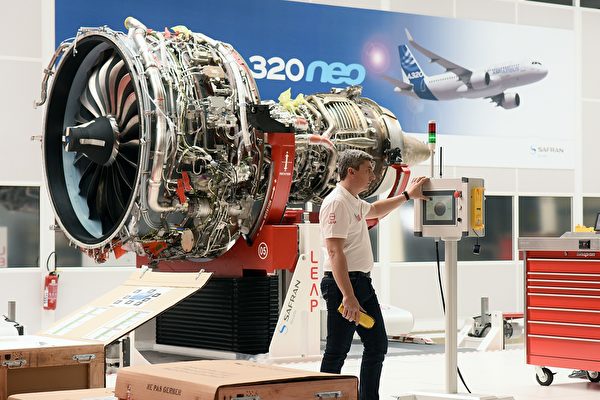
The United States House of Representatives’ Select Committee on the Chinese Communist Party (CCP) Chairman John Moolenaar raised concerns in a letter sent to the Pentagon late on Thursday (March 19th) regarding the French aerospace company Safran’s activities in China while holding US defense contracts. The letter stated that Safran’s operations in China may be assisting the CCP military in developing military technology, citing its collaboration with the Aviation Industry Corporation of China (AVIC).
According to a report by Reuters on Friday (March 20th), Republican Congressman Moolenaar highlighted in his letter to US Secretary of Defense Pete Hegseth that Safran’s business in China might be directly supporting Chinese entities to enhance the CCP’s military capabilities.
Moolenaar expressed concerns about Safran’s joint venture with the Commercial Aircraft Corporation of China in 2012, focusing on the production of electrical wiring systems for the domestically-produced C919 commercial aircraft, which has potential military applications. He noted that the company had been involved in the manufacture and maintenance of Chinese military aircraft.
The letter also mentioned Safran’s joint venture with Xi’an Aircraft Industry Group, a subsidiary of AVIC, established in 2011 to produce jet engine nacelle components and thrust reverser door assemblies used for military purposes.
Additionally, Safran is a partner of CFM International, a joint venture with General Electric (GE), collaborating with the Chinese Aviation Engine Group on helicopter research and development projects.
Safran has over 20 entities in China, including manufacturing plants, maintenance facilities, and a research and development joint venture, engaging in deep cooperation with Chinese aviation industry in various areas such as aircraft engines, nacelles, and landing gear.
Moolenaar also pointed out that Safran has secured various US military contracts, including research on quantum sensing technology, engine maintenance for the US Army’s UH-72A Lakota helicopter, and providing landing gear systems for multiple US military aircraft.
The Pentagon responded that they will provide a direct response to Moolenaar. Both Safran and the Chinese Embassy in Washington did not immediately respond to requests for comments.
Moolenaar emphasized the importance of ensuring that defense contractors working with the US military do not simultaneously provide support to the CCP military.
He stated, “We expect Western companies doing business with the US government to cooperate sincerely with us to sever relationships that jeopardize US national security.”
He further added, “We have noticed a pattern: French companies initially collaborate with China on civil helicopter research and development, but then the Chinese military integrates this civilian helicopter technology into its military equipment.”
Moolenaar’s committee on China-related issues has been continuously reviewing the business activities of US and Western aerospace companies in China for months. In December last year, the committee sent a similar letter to the Pentagon regarding the close cooperation between Airbus and Chinese companies.