
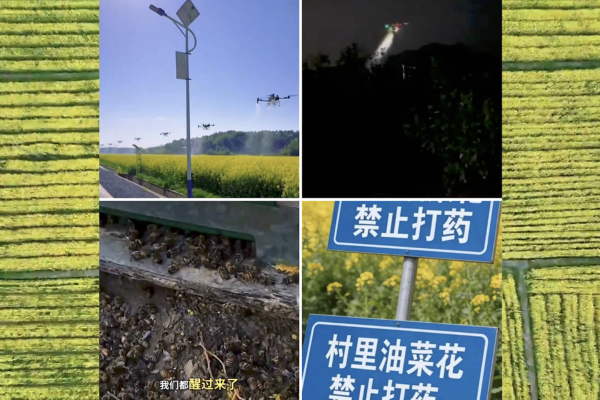
In recent times, China has been implementing large-scale drone “integrated prevention and control” in many regions. Official media has been extensively reporting on the high efficiency and labor-saving advantages of using drones, including for pesticide spraying. However, in stark contrast to the official narrative, beekeepers in provinces such as Hunan, Hubei, and Yunnan have been reporting widespread pesticide poisoning of bees during the peak flowering period of rapeseed crops, resulting in heavy losses and no means of recourse. Industry experts warn that this action may disrupt the pollination chain, endangering food security.
Entering March 2026, rapeseed crops in multiple provinces of China have reached the early to full blooming stage, with a drone-led aerial pest control movement being widely promoted by local governments and official media in major production areas.
According to a recent report by the China National Radio, in Daye City of Hubei Province, where 270,000 mu of rapeseed fields have entered the early blooming stage, the local agricultural department has deployed over 280 plant protection drones along with 30 professional drone operators, extolling the control effectiveness of drone pesticide spraying.
Apart from the aforementioned regions, areas such as Nanchuan District in Chongqing, Malong District and Anning City in Yunnan, Ziyun County and Jinping County in Guizhou, Ningyuan County and Chenxi County in Hunan, and Tongzhou District in Jiangsu have also successively promoted the use of drones for “integrated prevention and control” in agriculture. Officials claim that this move will “reduce pesticide usage by 30%” and refer to it as a crucial measure to boost “rural revitalization.”
However, while the official narrative emphasizes the increased agricultural output, thousands of beekeepers who collect nectar during the flowering season are facing an unprecedented disaster.
Liu Baoguo (pseudonym), a beekeeper from Shaanxi who pursues nectar collection in Tianmen City, Hubei Province, described in a phone interview with Epoch Times that pesticide spraying operations occur day and night without regard to timing. He expressed distress over the situation, mentioning witnessing the same rapeseed field being sprayed two to three times.
He suspects that some drone operators engage in repetitive operations to inflate the area treated and receive more subsidies, stating, “They use a counter to measure the area and then go to the government to claim money.”
Despite making multiple complaints to the village committees, local police stations, and government officials, Liu received only excuses, with authorities claiming that the spraying did not go through them and therefore was not their responsibility.
At his apiary, the number of bee colonies went from being full to now having only one platform. Due to consecutive days of rainfall, evidence of dead bees was washed away, making it hard to find solid proof. Having been a beekeeper for seven to eight years, he bluntly stated that this was the first time he had encountered such a large-scale poisoning incident.
Another beekeeper, Zhang Aimin (pseudonym), originally from Yunnan and now residing in Xishuangbanna to avoid rapeseed fields, suffered similarly devastating losses. With 400 beehives and nearly 30 years of experience in beekeeping, his estimated losses this year exceed 200,000 RMB based on market prices.
Zhang told Epoch Times reporters about the aftermath of bee poisoning: “Sometimes, they (bees) come back, barely making it to the doorstep, and die just outside the door.” He receives numerous calls each day from beekeepers nationwide, with almost all reporting cases of poisoning.
Both Liu and Zhang mentioned that the scale of drone pesticide spraying this year is unprecedented, with little to no incidents of bee poisoning reported in previous years. They have both decided not to pursue rapeseed nectar collection next year. Liu emphasized that if all beekeepers refrain from collecting rapeseed nectar, the crops will have difficulty in seed production.
The ecological crisis that has silently emerged beyond the official narrative has sparked intense reactions on the internet.
According to reports from portals such as China.com on March 16th, large-scale drone pesticide spraying in various parts of the country has led to mass bee deaths. Videos show “swaths of bees lying motionless on the ground due to poisoning.”
Reportedly, the core issue lies in the overlap of pesticide spraying during the flowering period with bees collecting nectar. The pesticides used include neonicotinoids, organophosphates, and other insecticides, leading to immediate bee poisoning and causing invisible damage to their reproduction.
The Xinjing Daily reported that several beekeepers in Hengyang County, Hengyang City, Hunan Province, reported massive bee deaths due to local rapeseed spraying with pesticides. On March 16th, staff from the Agricultural Bureau of Hengyang County claimed that some beekeepers did not report their beekeeping activities, making it impossible for the village committees to contact all beekeepers before the spraying.
However, local beekeepers stated that they had never heard of the need to report beekeeping activities to relevant departments, and had received no notifications before pesticide spraying, resulting in severe losses.
As reported by NetEase, regulations state that when using aircraft for pesticide spraying, the operators must inform beekeepers within a 5-kilometer radius of the operation area at least five days in advance. Yet, in this incident, this legal provision was essentially disregarded.
Many netizens strongly criticized the situation, with some stating that it was a case of neglecting responsibilities and, in more severe terms, disregarding life. The related videos generated over 1,400 comments and were shared over 1,300 times, fueling continued public outrage against the violations.
Both interviewed beekeepers expressed concerns extending well beyond personal losses about the far-reaching impact of this incident.
Liu highlighted significant issues with the timing of pesticide spraying, as bees typically fly out around noon when it’s warmer to collect nectar. However, by starting spraying at that time, the bees are killed.
He also raised concerns about the safety of rapeseed oil, as pesticides directly entering the rapeseed forming process during the flowering season would impact the oil quality. With pesticide residues lasting around 30 days and rapeseed maturing between spraying and harvesting, the safety window may not be sufficient.
From an ecological perspective, Zhang issued a deeper warning. He stated that the drone-led integrated pest control “completely disrupts the biological chain,” resulting in damages not only to domestically raised bees but potentially more catastrophic losses for wild bees and other pollinating insects, although these losses might go unnoticed.
He has observed the specific consequences in Lincang, saying, “After the drones have sprayed, the rate of empty rapeseed pods is very high, and they can hardly be pollinated.” Refuting claims that “wind pollination” could replace bees, he argued, “Wind can pollinate? The wind here is super strong; I’ve never seen wind pollination.”
On an industry level, Zhang described the beekeeping sector’s pre-existing challenges, such as plummeting purchase prices reverting to levels of 25 years ago, where a pound of honey fetches only about 3 RMB, compared to the peak period of 10 to 15 RMB per pound in 2017 and 2018.
He cautioned, “Since the pandemic, over eighty percent of apiaries have been struggling to operate and barely turning a profit.” The recent large-scale bee poisoning incident has undoubtedly intensified these challenges. He issued a stark warning that if this trend continues, the beekeeping industry could collapse rapidly, with potentially no one willing to keep bees in three to five years.
Should professional beekeepers exit rapeseed producing areas, natural pollination of rapeseed crops would face a severe threat. As Liu put it, “If the bees are killed off, and no one is there to keep bees, the rapeseed probably won’t grow very well.”
According to Zhang’s observations, some northern farmers hold strong resistance towards forced spraying activities, with some preferring to use tillage machinery to destroy all rapeseed fields as a silent form of protest.