
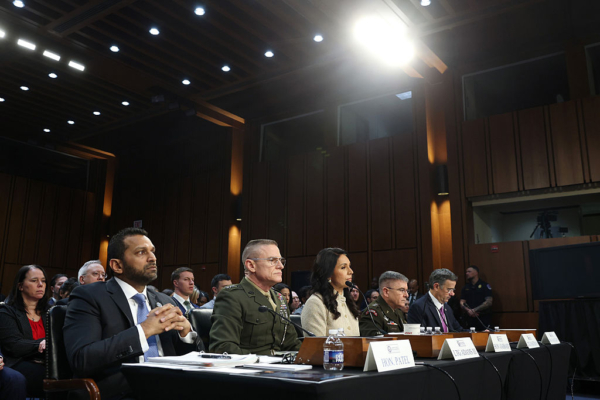
On Wednesday, March 18, the US intelligence agencies pointed out that the Chinese Communist Party (CCP) has realized that conducting an amphibious invasion of Taiwan would be extremely difficult and carries a high risk of failure, especially under the circumstances of US intervention.
According to a 34-page report titled “2026 Annual Threat Assessment of the US Intelligence Community,” released by the Office of the Director of National Intelligence on Wednesday, the report clearly outlines the potential threats posed by a CCP attack on Taiwan to the United States and the world, as well as the costs of US involvement in a conflict in the Taiwan Strait.
The US intelligence community believes that Beijing may continue to seek conditions for the ultimate unification of Taiwan in 2026 while avoiding conflict. The report states that despite Beijing’s threats to forcefully unify Taiwan if necessary and to counter what it perceives as US attempts to weaken China’s development through Taiwan, China “prefers to achieve unification by non-military means as much as possible.”
The report indicates that the People’s Liberation Army (PLA) of the CCP has been constantly conducting military planning and capability development to be able to use force to achieve unification when ordered to do so.
“The PLA may be steadily but unevenly developing military capabilities, using any possible means to seize Taiwan and deter – and if necessary, defeat – US military intervention. At times, the PLA may continue to expand its operational scope, scale, and frequency in the areas around Taiwan,” the report stated.
Despite Beijing’s repeated statements that reunification with Taiwan is a necessary condition for achieving the goal of “national rejuvenation” by 2049 – the 100th anniversary of the founding of the People’s Republic of China – the US intelligence assessment suggests that so far, “Chinese leaders currently have no plans to invade Taiwan in 2027, nor have they set a fixed timetable for unification.”
The US intelligence community assesses that “Beijing will almost certainly take into account various factors when deciding whether and how to use military means to achieve unification, including the military readiness of the parties, Taiwan’s actions and politics, and whether the US would intervene militarily on behalf of Taiwan.”
The report adds, “Chinese officials recognize that conducting an amphibious invasion of Taiwan would be extremely difficult and carries a high risk of failure, especially under US intervention.”
The intelligence community also made predictions about the potential consequences of a CCP invasion of Taiwan. “The China-Taiwan conflict could disrupt crucial channels for the US to access global trade and semiconductor technology,” the report stated. “If the US intervenes, its transportation sector may suffer significant but recoverable losses from Chinese cyberattacks.”
The report warned that even if the US does not intervene in a Taiwan Strait conflict, a CCP invasion of Taiwan would have “significant and costly consequences for US and global economic and security interests,” including disruptions in technology supply chains and investor panic that could spread throughout the market.
In conclusion, the intelligence community stated, “Furthermore, a protracted war between the CCP and the US could lead to unprecedented losses for the US, China, and the global economy.”