
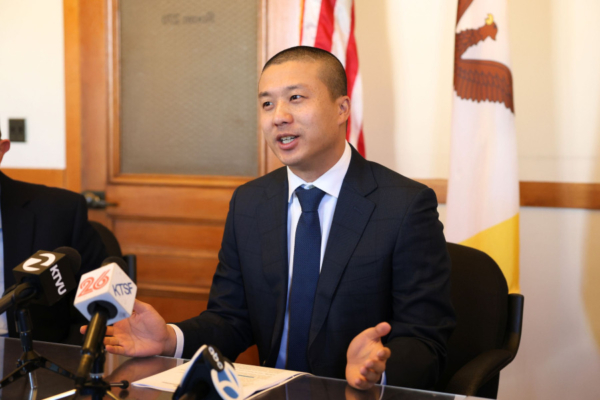
San Francisco City Councilman Alan Wong announced on March 11 the launch of the “Dumb Laws” collection competition, inviting residents and small businesses to submit what they consider outdated, cumbersome, or unnecessary city regulations to promote modernizing reforms to some municipal ordinances.
At the press conference that day, Wong stated that in the Sunset District he represents, many residents and businesses often complain about being constantly charged, penalized, or burdened by various complex regulations, making daily life and operations more difficult.
“As a city councilman, one of my responsibilities is to ensure that city laws reflect the needs of residents and businesses. When rules become outdated or create unnecessary burdens, we must carefully review them,” he said.
Wong pointed out that as the city develops, some regulations originally implemented with good intentions may no longer meet current needs, or even burden residents and businesses.
“When regulations no longer serve the people they were intended to help, we have a responsibility to make improvements to allow San Francisco to continue moving forward,” he said.
Wong stated that the competition aims to encourage citizens to discuss city regulations and submit laws, regulations, permit requirements, fees, or administrative processes they find unreasonable. “Some of these may be absurd, but many reflect the practical challenges people face when dealing with the city government,” he said.
Giving examples, Wong mentioned existing laws such as Section 407 of the San Francisco Health Code, which prohibits carrying bread or pastries in open containers on public streets, as well as another rule allowing households to keep two female goats without a stable permit.
Additionally, the city’s Animal Ordinance permits residents to keep up to four poultry, without distinguishing between hens and roosters, theoretically leading to the possibility of roosters crowing in residential areas.
“I have indeed heard complaints about roosters crowing,” Wong chuckled during the press conference.
Wong expressed that such regulations may have had their backgrounds in history but warrant reevaluation now.
Community leader from Inner Sunset, Frank Noto, shared his decades of experience in community organizing.
He noted that many residents perceive that the local government does not serve them, and the frustrating elements are often not major policies but small regulations in daily life.
For instance, if a resident wants to set up a six-inch red no-parking zone in front of their driveway to prevent vehicles from blocking it, they must contact the city government, pay inspection fees, and apply for permits, which is a very cumbersome process.
Noto also mentioned the existence of committees or task forces like the News Rack Advisory Commission that have not held meetings in years, and the Industrial Waste Review Board and Graffiti Advisory Board that do not convene at all.
Noto pointed out that San Francisco has over 120 task forces estimated, a number significantly higher than any other county in the state, which he finds concerning.
Vice Chairman of the San Francisco Entertainment Commission and owner of Wang Insurance Agency, Cyn Wang, shared her family business’s experience in dealing with the approval process for repairing their storefront after it was vandalized in 2023.
She recounted that after multiple instances of graffiti vandalism and all windows being shattered, what was initially a simple repair involving glass replacement and installation of protective doors became a bureaucratic nightmare due to complex approval procedures. Wang stated that the storefront remained boarded up for over a month as the city required the protective door to have 80% light transmittance, necessitating design reviews and permits.
To get approvals, she had to hire an architect, submit engineering drawings, and make multiple trips to the permitting office. “The whole process took many days and nearly $30,000 to get approval for the glass and protective door,” she said.
Wong announced that the collection competition is now open for submissions, and citizens must provide basic information, preferably with relevant law numbers. The selection criteria include verifying the existence of the law, determining if it’s outdated or overly complex, and assessing whether it imposes practical burdens on residents or small businesses.
Some selected cases will be announced and recognized through the councilman’s office on social media and could potentially spur future legislative reforms.
Wong mentioned that if certain regulations are confirmed as unreasonable and fall under the city ordinances, he may propose bills to abolish the relevant provisions.
He added that while some may think creating more laws represents achievement, that might not be the case in reality. For ordinary residents and small business owners, perhaps “less is more.”
The deadline for the collection competition is March 31, with selected cases expected to be announced in April. Citizens can submit proposals through the online form provided by the councilman’s office: https://gqr.sh/dn5p ◇