
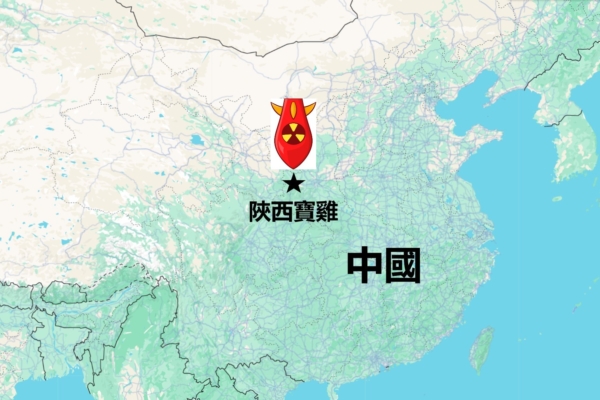
On March 9th, while the US military continued to strike Iran until its nuclear weapon program was completely destroyed, the China Aerospace Studies Institute at the Air University of the US suddenly released a report titled “PLA Rocket Force Nuclear Warhead Management,” publicly exposing detailed information about the storage of nuclear warheads at Base 67 of the Chinese Communist Party. The core secrets of the CCP were exposed by the US, and it was revealed that many of the key emergency equipment used at the base were from the US and Western countries. This move by the US not only embarrassed the CCP once again but also had further deterrence implications, possibly leading to new infighting within the CCP military.
The China Aerospace Studies Institute at the Air University, which had previously released detailed reports on the PLA Rocket Force, revealing the situation of each missile brigade, resulting in deep cleansing of the PLA Rocket Force leadership. At this sensitive moment when the US was striking Iran and the CCP’s annual meeting was ongoing, the institute released a new report titled “Dancers at the Knife’s Edge: PLA Rocket Force Nuclear Warhead Management,” providing even more shocking revelations and uncovering many little-known secrets about the CCP’s nuclear weapons.
The institute’s mission is described as enhancing the understanding of the CCP’s aerospace capabilities in terms of strategy, theory, operational concepts, capabilities, personnel, training, and organizational structure, providing intelligence support to senior US military leaders.
The report showed that the US had identified the Achilles’ heel of the CCP’s nuclear weapons. If US stealth bombers were to conduct an airstrike, they could potentially destroy the CCP’s nuclear arsenal in one fell swoop. This undoubtedly caused heightened fear among the top CCP and military leadership.
The report pinpointed the central nuclear arsenal built near Baoji City in Shaanxi Province known as “Hongchuan,” deep in the Qinling Mountains, approximately 56 kilometers from the CCP’s Base 67 headquarters in Baoji City, with only a narrow mountain road for access.
The series of above-ground and underground facilities at “Hongchuan” are extremely remote. As of 2019, apart from the computer rooms in the facilities, there was no mobile phone signal or convenient internet connection in other areas.
Base 67 is a deputy military-level base of the CCP responsible for the safe storage, testing, defense, and transportation of nuclear warheads; and the “Hongchuan” it supervises is the central nuclear arsenal of the CCP for storing nuclear warheads.
The PLA Rocket Force has six operational bases and three support bases, as detailed in previous reports. Base 67, one of the support bases, serves as the nuclear warhead storage base with the designation of Unit 0674. Its headquarters is located in Baoji City, Shaanxi Province, directly subordinate to the CCP Central Military Commission.
The various brigade-level and regiment-level units under the supervision of Base 67 are mostly scattered in Baoji City and its surrounding areas, as well as the nearby Qinling Mountains. The report listed the coordinates and designations of these units, indicating that the precise locations of the various units of the CCP’s nuclear arsenal were known to the US military.
The report described the work of the equipment inspection department under the technical service regiment of “Hongchuan,” including scientific research and warhead quality control and inspection; periodic maintenance; ensuring the safety and reliability of nuclear warheads during long-term storage; supporting the life extension and modification of missiles and warheads, among others. In 2009, a new missile system was restricted due to quality control and operational issues; a team at the department spent five years improving quality control and enhancing operational effectiveness.
The report pointed out that half of the technical staff members in the department originally held master’s or doctorate degrees, but it may now be challenging to attract highly educated personnel to the remote “Hongchuan.” Life in the mountainous region is harsh, and they are far from their families, with limited communication due to the lack of mobile phone signals and restricted internet access, while also engaging in potentially dangerous work with modest income. Although the CCP military propagandizes technical personnel as sacrificing comfort and family life to fulfill their duties, the actual situation may be quite the opposite.
Another unit, Unit 96038, responsible for the storage and testing of nuclear warheads, is headquartered in Luzhou, Sichuan Province and may oversee another facility for storing and inspecting nuclear warheads.
The report did not delve into whether the nuclear warheads used by the CCP’s ballistic missile submarines are also centrally stored or kept long-term in Sanya, Hainan.
The report described a specialized emergency response unit at Base 67 responsible for handling chemical, biological, radioactive, or nuclear accidents. This unit, along with other CCP military nuclear facilities handling units, extensively relies on foreign equipment for nuclear processing and emergency operations. The report listed the inventory of foreign nuclear processing and emergency equipment used by this unit; five items were from the US, two from Germany, two from France, and one from Sweden.
The CCP heavily relies on foreign technology and equipment for nuclear emergency equipment, indicating that its nuclear warhead technology and management level likely lag behind that of the US and Western countries.
The report identified a missile defense regiment at Base 67 equipped with Hongqi-11 or Hongqi-16 surface-to-air missiles. The unit had participated in five major missions, launching 32 missiles, hitting the target 15 times, but it was hailed by the CCP as a “historic breakthrough.” However, in an earlier exercise, the regiment failed to intercept an enemy plane that broke through the defense line using terrain advantage. In a major exercise in September 2017, the tracking and interference success rates of the unit were only 40% and 33% respectively; by 2018, these figures were promoted to 80% and 100%.
The report raised doubts about the combat capabilities of the small-sized air defense unit.
The CCP’s air defense system struggles to detect B-2 stealth bombers and counter US electronic warfare, hence the nuclear arsenal may be unable to withstand US airstrikes.
The report described the nuclear warheads at Base 67 need to be distributed and transported to other Rocket Force operational bases. This differs from the US, where under previous treaties, 1,550 nuclear warheads are deployed in frontline readiness, with the rest in storage.
A specialized transport unit of the CCP in Taibai County, Baoji City, Shaanxi Province, handles railway equipment concentrated near Xipo Township, Liangdang County, Gansu Province, about 80 kilometers west of “Hongchuan.” The railway transport journey can last for several days, with testing every 1-2 hours to strictly control the environmental temperature and humidity for the nuclear warheads. To avoid accidents due to railway malfunctions, the train is checked continuously at each stop during the journey. It is estimated that the unit conducts about 3-4 such missions each year.
This detailed revelation indicates that the centralized management of CCP nuclear warheads poses significant transport safety and efficiency challenges, with frequent interruptions making it vulnerable to attacks even during combat situations.
Base 67 also has a highway transport camp, but it is estimated not to be the primary long-distance transportation method. Railway transport is likely the main route for distributing nuclear warheads from the arsenal to various bases. Once the US military grasps this link, it can secure the CCP’s nuclear weapons deployment.
The report noted that the CCP’s air transport capability for nuclear warheads is limited. North of “Hongchuan,” about a four-hour drive away, there are two airports. However, the report revealed that in an unknown time before 2009, the CCP had conducted a missile air transport test and recorded data on inclines, bumps, displacements, indicating that the air transport almost resulted in a catastrophe. The aircraft ran out of fuel and was unable to fly to an alternate airport, making a dangerous forced landing in the fog.
The lack of experience in operating large transport aircraft by the CCP severely restricts the rapid transport of nuclear warheads; risky transport may lead to serious safety issues. While the CCP does not care about the safety of ordinary soldiers and civilians, senior CCP officials and high-ranking officers fear personal danger and the political implications of accidents.
The report described that various Rocket Force operational bases of the CCP also have storage facilities located in remote areas, often built into mountainsides. The conditions of these storage points should be similar to that of “Hongchuan.” However, when CCP propaganda workers touted the dedication of personnel, they inadvertently revealed serious security flaws. For example, at one storage point, radioactive dust had been continuously emitted into the air for many years, causing a staff member contaminated by the dust to develop chronic illnesses after working in the storage facility for 22 years, including low white blood cell counts, irregular heartbeat, chronic visual problems, digestive issues, and arthritis. This suggests that the decentralized storage points lack sufficient personal protective equipment.
The management of nuclear warhead storage points at various Rocket Force operational bases of the CCP is likely less stringent compared to the central nuclear arsenal, posing a significantly higher risk of accidents. In general, the CCP Central Military Commission would prefer not to keep a large number of nuclear warheads at various operational bases to eliminate security risks. What the CCP fears the most is perhaps a missile brigade launching a nuclear missile at the leadership in Zhongnanhai one day.
The nuclear warhead technology and management capabilities of each missile brigade within the CCP may be even worse, making them less likely to entrust nuclear warheads to subordinate missile brigades for transport, storage, and risk of accidental firing.
The report assessed that while most of the CCP’s nuclear warheads are stored in a single facility during peacetime, centralized management also leads to highly concentrated risks. The surrounding infrastructure of “Hongchuan” is rudimentary, with only a narrow road for access; roadblocks could severely delay operations. Concentration also requires frequent long-distance transport of nuclear warheads, increasing the possibility of accidents or interception during wartime.
The report suggested that the CCP’s nuclear warhead storage facilities and procedures suffer from disorganization and laxity, with significant use of foreign equipment in certain areas, indicating potential technological bottlenecks. The challenging living conditions in remote areas may increasingly make it difficult to retain and attract top talent.
Additionally, the report concluded that while the CCP’s Rocket Force has rapidly expanded over the past decade, the safeguard system for nuclear warheads has not expanded accordingly. The system is likely to face increasing pressure and could potentially collapse.
The CCP’s concentration of nuclear warheads results in low readiness levels, low deployment efficiency, high risk, making them susceptible to destruction with a single blow or interception, and even a self-collapse.
The report did not explicitly mention that this is precisely determined by the nature of the CCP’s party-guard army. Due to trust issues, the CCP military command system inevitably requires centralization, fearing unauthorized nuclear launches, thus nuclear warheads must be directly under the centralized management of the CCP Military Commission. The safest approach is to keep nuclear warheads detached from missiles for an extended period, and conventional warheads likely would be treated similarly.
Given the lack of military expertise in the CCP’s military command for the long term, and the shortage of professional personnel, only centralized usage is feasible, isolating from the outside world, making monitoring and secrecy easier.
The technological and managerial level of the CCP’s nuclear warheads is destined to be low. The title of the US report, “Dancers at the Knife’s Edge,” vividly illustrates this point. The CCP military completely understands where the issues lie but finds it challenging to make substantial changes. What the senior CCP leadership is most concerned about is not whether the nuclear weapons can be swiftly deployed or genuinely secure but rather the fear of nuclear warheads falling on their own heads.