
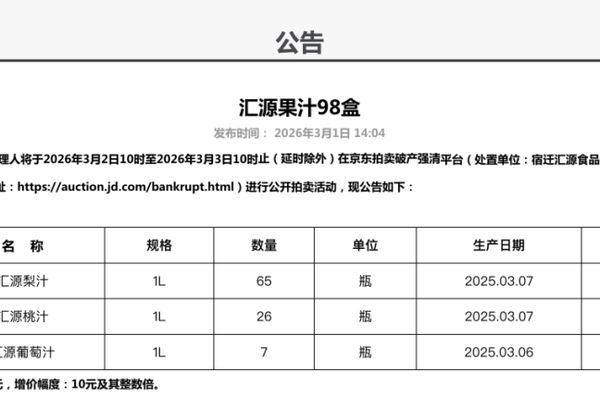
Recently, the “Huiyuan” factory in Suqian, Jiangsu Province, has applied for bankruptcy liquidation, and news about the auction of near-expiry fruit juice quickly sparked attention online. An auction notice was posted on a judicial auction platform: 59 bottles of Huiyuan fruit juice starting at 109 yuan, excluding shipping. With these beverages nearing their expiration date, many netizens joked, “Even near-expiry drinks are being auctioned off, and no free shipping? How did the former ‘King of Fruit Juice’ come to this?”
“Huiyuan Fruit Juice” is known as the “national fruit juice,” but its current situation is lamentable. Information shows that Suqian Huiyuan Food Co., Ltd. (referred to as “Suqian Huiyuan”) has entered a bankruptcy liquidation process, with its assets placed on judicial disposal platforms for processing. Among the liquidation assets is a batch of finished fruit juice inventory, totaling 98 boxes. One auction item is 59 bottles of Huiyuan fruit juice, with a starting price of 109 yuan, and it has become a hot search topic due to its close proximity to the expiration date and shipping fee issues.
A blog post by “Yingshouli” states, “Starting price of 109 yuan, with a shelf life of 1 month, excluding shipping.” These simple words convey a sense of extreme despair due to financial and resource depletion. The “King of Fruit Juice,” which once set a record for the largest IPO in Hong Kong and had a market value exceeding 31.3 billion Hong Kong dollars on its first day of listing, has long lost its competitiveness due to self-consumption.
The article mentions that the bankruptcy liquidation of Suqian Huiyuan is just the tip of the iceberg of the collapse of this massive system. Auditors, appraisers, and security companies have successively entered the scene, indicating that everything from the factory buildings, equipment, down to every screw on the land will be dismantled and liquidated.
Information shows that Suqian Huiyuan factory was established in 2009, and after operating for 17 years, it has entered the bankruptcy liquidation process. The liquidation team will dispose of the remaining inventory and production equipment, signifying the substantial cessation of operations at the factory.
It is worth noting that Suqian Huiyuan has been independent of Huiyuan Group’s direct control since 2017 but has continued to produce Huiyuan fruit juice. Company staff stated that their trademark usage is “legal and compliant,” and the specific authorization situation still awaits disclosure at the creditors’ meeting.
In January 2026, the battle for control over Huiyuan became public. Huiyuan Group announced a default by Shanghai Wensheng, leading to the failure of restructuring, and stated that it would take over the operation of Beijing Huiyuan and Huiyuan fruit juice. Subsequently, Beijing Huiyuan controlled by Shanghai Wensheng swiftly counterattacked, accusing Huiyuan Group of embezzling funds exceeding 600 million yuan after the completion of the restructuring, and initiated legal proceedings. Meanwhile, Beijing Huiyuan emphasized that it still holds the “Huiyuan” trademark, and Huiyuan Group’s continued production of related products is suspected of infringement.
Currently, both sides are locked in a complex standoff: Beijing Huiyuan, despite owning the trademark, lacks independent production capacity and must rely on outsourced factories; while Huiyuan Group holds the original supply chain and some factories but is passively affected by the suspension of trademark authorization. Both sides also question each other’s product quality and compliance.
The root of this dispute can be traced back to the 2022 restructuring and bankruptcy of Huiyuan. At that time, Huiyuan Group, with debts amounting to 12.467 billion yuan, brought in Shanghai Wensheng Assets as restructuring investors, who promised to inject 1.6 billion yuan and obtain a 70% stake in Beijing Huiyuan.
However, Wensheng did not fully invest with its own funds but attempted leveraged operations by introducing financial investors. During this period, Wensheng received 930 million yuan from Guozhong Water Affairs through equity transfer, earning approximately 180 million yuan premium after deducting the 750 million yuan already invested, leading to suspicion as a “wolf in sheep’s clothing.”
By 2025, disputes between Wensheng and related shareholders had frozen equities, and Guozhong Water Affairs announced the termination of the acquisition plan, resulting in subsequent investments falling through. During an audit, Wensheng discovered that the original management had transferred nearly 600 million yuan in advance payments to Huiyuan Group, depleting the company’s funds, rapidly escalating tensions between the two sides.
Since August 2025, conflicts between the two sides have continuously escalated: Wensheng privately held a shareholders’ meeting and muted the supervisory microphone, while Huiyuan Group publicly urged shareholders to resist related resolutions; Wensheng forged seals to attempt withdrawal of lawsuits, and Huiyuan Group took the largest shareholder to court. Corporate governance has descended into chaos.
Industry insiders believe that this event marks a further acceleration of the collapse of the Huiyuan system, and controversies surrounding brand control rights and product quality definitions are unlikely to be resolved in the short term.