
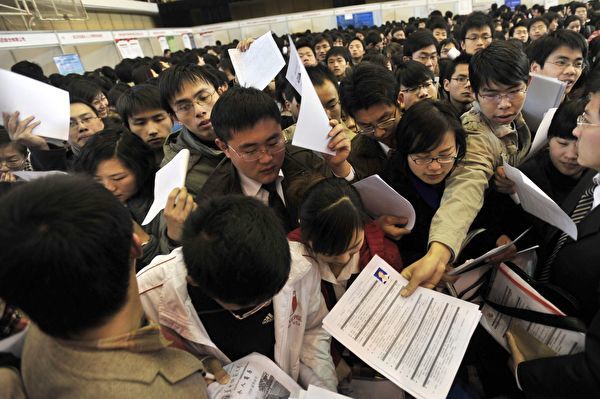
The number of graduates from Chinese universities is expected to reach 12.7 million this year, an increase of 480,000 compared to last year. Faced with the increasing pressure of employment, a representative of the Chinese People’s Congress recently publicly stated the encouragement of “encouraging college graduates to return to their hometowns to start businesses,” sparking criticism across the internet.
According to a report by China News Weekly on March 9, Song Bao’an, a national representative of the Chinese People’s Congress, academician of the Chinese Academy of Engineering, and president of Guizhou University, recently stated in an interview that he encourages college students to return to their hometowns to start businesses after graduation, especially students from universities in the western regions. Song Bao’an also suggested that universities should strengthen relevant knowledge and skill training in the talent cultivation process, while also recommending that local governments provide “important policies and economic support” to returning university students.
This is not the first time the authorities have encouraged university students to go to rural areas to engage in so-called “entrepreneurship.” Netizens criticized, “New educated youth going to rural areas?”; “Aren’t rural children going to college to escape rural areas and poverty, and seek better working and living environments?”; “Starting a business in the current environment? Really?”; “If everyone returns to their hometowns, they might all end up selling on the streets.” Some expressed concerns that this approach reflects a lack of successful job placement strategies.
According to official statistics from the Chinese Communist Party, starting from 2022, the number of university graduates in China has consistently exceeded 10 million annually. In 2022, the number of graduates reached 10.76 million, an increase of 1.67 million compared to the previous year; 1.158 million in 2023, an increase of 820,000 compared to the previous year; 1.179 million in 2024, an increase of 210,000 compared to the previous year; 1.222 million in 2025, an increase of 430,000 compared to the previous year. It is expected to reach 12.7 million in 2026, an increase of 480,000 compared to the previous year, showing a continuous trend of growing employment pressure.
Facing China’s economic downturn and the rapid contraction of the job market, more and more young people born in the 2000s are feeling overwhelmed. This has led to some choosing to “lie flat,” be passive, or even become “rat people” to resist societal pressures and alleviate inner anxieties.
Yuan Hongbing, a scholar studying in Australia, has previously stated that as the most knowledgeable group, these youths have long been in a state of unemployment or underemployment, directly shaking the confidence of the youth in their futures.
Renowned mainland economist Liu Yuanchun has warned that if not handled properly, the continuously rising youth unemployment rate in China may lead to a political crisis.