
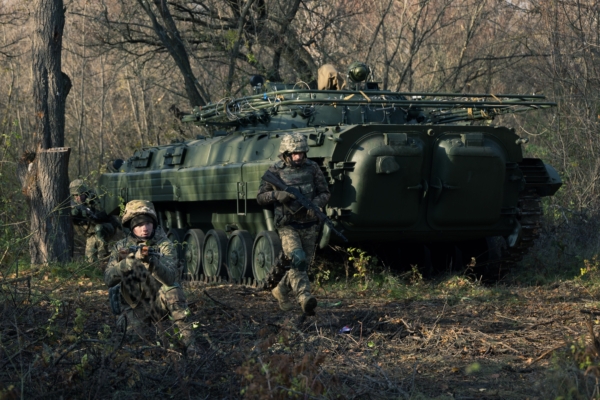
Ukrainian Armed Forces’ recent counteroffensive operation has achieved significant progress, with over 400 square kilometers of land reclaimed in the southern front in the past six weeks. This marks the largest monthly achievement since the recapture of Kursk in 2024.
According to Kyiv Independent’s report on Tuesday, Major General Oleksandr Komarenko, Chief of the General Staff’s Main Operations Directorate, stated that Ukrainian airborne assault units and mechanized brigades have taken back over 400 square kilometers of territory. Dnipropetrovsk Oblast is nearly fully liberated, with only a few small settlements remaining to be cleared.
Commander Oleksandr Syrskyi added that just the airborne assault units in the direction of Oleksandrivka have recaptured 285.6 square kilometers in the past month alone.
Zelenskyy, speaking through WhatsApp on Tuesday, mentioned that Moscow still seeks to establish buffer zones in Sumy and Kharkiv regions, but Ukrainian forces have intercepted them everywhere. He stated, “There is currently no risk in the Sumy region.”
Vladyslav Voloshyn, spokesperson for the Ukrainian Southern Defense Forces, stated that Ukrainian troops have launched a counteroffensive towards the town of Huliaipole in Zaporizhia Oblast, attempting to seize the initiative in multiple frontline areas. He noted that Russia is intensifying airstrikes and attacks along the contact line to hinder Ukraine’s expansion of gains.
Denys Bobkov, spokesperson for the 37th Marine Brigade, revealed that since late 2025, the frontiers at the border sections of Donetsk and Dnipropetrovsk Oblasts where they are stationed have been relatively stable, with Russian forces failing to make any advancements.
Despite Russia’s nearly three to one numerical advantage, Commander Syrskyi stated that they have had to postpone planned actions, strengthen weak points, and redeploy forces from other directions, as Ukraine has taken the initiative on multiple fronts.
President Zelenskyy stated that recent operations aim to thwart Russia’s strategies in Zaporizhzhia and Dnipropetrovsk Oblasts, combining defense with limited offensives.
Komarenko pointed out that Russia had previously attempted to advance into the region to expand its influence in Donbas and establish buffer zones to support future offensives.
The Institute for the Study of War highlighted in a assessment report on March 9 that Ukraine’s counteroffensive is yielding tactical, operational, and strategic effects that could disrupt Russia’s planned spring/summer offensives in 2026. The report suggests that Moscow may have to abandon or significantly revise its military plans in Zaporizhzhia, Donetsk, or both.
Emil Kastehelmi, analyst from the Black Bird Group in Finland, told Kyiv Independent that the main objective of the Ukrainian operation is to enhance tactical posture, stabilize the front, constituting localized tactical actions rather than a large-scale offensive. Due to the lack of significant geographical barriers in the area, both Ukrainian and Russian forces operate in a wide “disputed gray zone,” with the front line still in flux, making it difficult for outsiders to determine exact control areas.
He further mentioned that Dnipropetrovsk Oblast is not among the illegally annexed areas claimed by Russia, implying its limited political significance, and Russia might shift the focus of its offensive towards Donetsk Oblast in the future.