
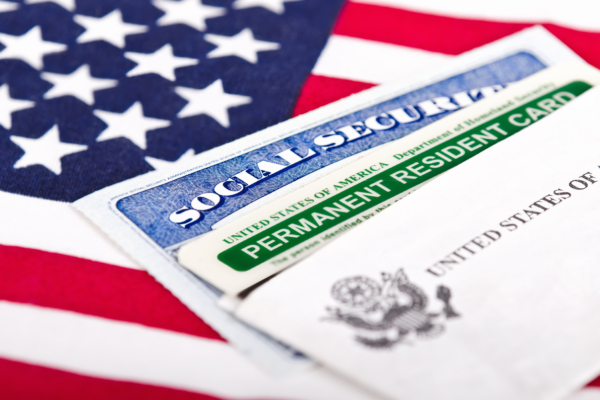
Many foreign spouses, after being granted marriage-based immigration, receive their first green card known as the Conditional Green Card, valid for two years. This card signifies a genuine marriage but is still under a “probationary period.” Before the end of the two-year period, the spouses must jointly file Form I-751, Petition to Remove Conditions on Residence, to prove that the marriage still exists.
However, life changes often happen faster than paperwork can keep up. So, what happens if during these two years the U.S. citizen spouse passes away, divorces, or even abandons the foreign spouse?
Will they automatically lose their green card status? The answer is – not necessarily.
According to section 216 of the Immigration and Nationality Act, those who obtained their green card within less than two years of marriage must file the I-751 petition jointly within the 90 days before the two-year mark.
If the genuine nature of the marriage can be proven, the U.S. Citizenship and Immigration Services (USCIS) will remove the conditions and issue a ten-year permanent green card.
However, the law also provides various “waiver provisions” that allow the foreign spouse to apply for condition removal under specific circumstances independently, without the need for the spouse’s signature. This serves as a lifesaver when unexpected events occur in a marriage.
If the U.S. citizen spouse tragically passes away, the foreign spouse can still retain their green card eligibility. As long as they can prove the marriage was genuine before the spouse’s death and not solely for immigration purposes, they can file the I-751 petition individually.
The required documents include the death certificate of the spouse and evidence of the authenticity of the marriage such as joint accounts, lease agreements, photos, and communication records.
If the evidence is sufficient, the USCIS typically approves the petition, allowing the foreign spouse to continue holding their permanent green card.
This is a legal recognition of genuine marriage – where love may end with death, but sincerity remains acknowledged by the law.
In the event of a divorce during the conditional green card period, the foreign spouse can still apply for a “divorce waiver.”
The key lies in proving that the marriage was entered into in good faith and not for the sole purpose of obtaining immigration status. This means that despite the marriage later dissolving, as long as it was based on genuine feelings and intentions of shared life at the beginning, it will not be considered fraudulent. The evidence required includes proof of cohabitation and shared life, joint financial records, and the divorce decree.
While such cases are scrutinized rigorously, if the marriage is proven genuine, there is still a chance for approval. USCIS does not demand a commitment to never divorce but focuses on the honesty at the marriage’s inception.
If the foreign spouse suffered abuse, control, threats in the marriage, or if the spouse abandoned them or refused to sign joint forms, they can apply for relief under VAWA (Violence Against Women Act) or an abuse waiver.
The purpose of these waivers is to protect the individual harmed in the marriage.
As long as it can be proven that the marriage was initially genuine and that there was physical or psychological abuse endured, they can submit the I-751 independently. Evidence that can be submitted includes medical or police reports, letters from therapists or social workers, testimonies from friends, neighbors, or church members, and records of shared life and emotional interactions.
If the marriage breakdown was due to violence or abandonment, USCIS will provide special protection to the applicant and not force them to lose their immigration status due to the spouse’s refusal to cooperate.
In these three scenarios, applicants still need to file the I-751 before the green card expires (or even if it has expired but with valid reasons as to why it’s delayed).
If the submission is significantly delayed, it may invalidate the immigration status and lead to deportation proceedings. During the review process, USCIS thoroughly examines the marriage evidence and might even request interviews.
Hence, all documents must be truthful, consistent, and have a timeline. It’s advisable to preserve all evidence of shared life when preparing, so even if the marriage ends, the original sincerity can be proven.
The two years of the conditional green card period can be a trial for many newlywed immigrants.
Some may reach the end, while some part ways midway; however, what the law acknowledges is authenticity, not eternity. If the marriage was based on true feelings and separation was only circumstantial, the U.S. immigration law still provides a fair way out.
(Note: This article is a general information compilation regarding immigration regulations and practical observations and does not constitute legal advice or specific legal recommendations for any particular case. The actual outcomes of cases depend on individual facts and applicable laws. In cases involving individuals, consultation with a qualified immigration attorney is advisable.)