
The United States’ military actions against the pro-communist regimes of Venezuela and Iran have had a significant impact on the Chinese Communist Party. Venezuelan President Maduro, a long-time ally of the Chinese Communist Party, was captured, while Iranian Supreme Leader Khamenei was killed in a bombing. The shockwaves from these events can be seen in the Chinese Communist Party’s frantic responses. Information provided by high-level informants from within these regimes played a crucial role in these operations, directly affecting Chinese President Xi Jinping.
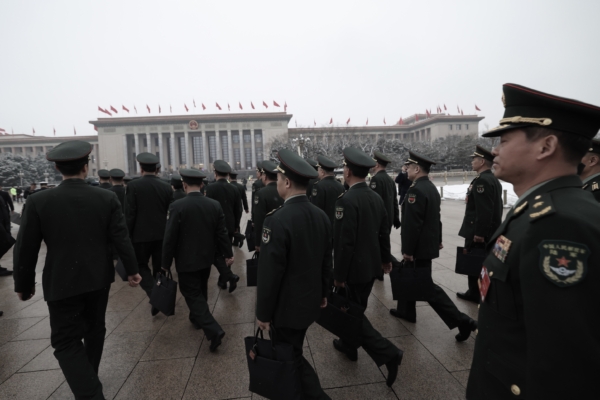
During a meeting with the National People’s Congress delegation from the Chinese military on March 7th, Xi Jinping emphasized the importance of absolute loyalty to the Party within the military. He warned against any hint of disloyalty or corruption, stressing the need to continue the fight against corruption unwaveringly.
Xi’s implication that there may be disloyalty within the military brings to mind the recent cases of Zhang Yuxia and Liu Zhenli, who were publicly denounced and accused of violating Party leadership protocols and engaging in political corruption that undermined the Party’s absolute control over the military.
Of particular note is the emphasis placed on “eliminating those with different aspirations” at the Fifth Plenary Session of the Central Commission for Discipline Inspection held in January 2026.
Xi’s direct warning to military leaders not to harbor disloyal intentions may be linked to recent significant international events, such as the capture of Venezuelan President Maduro by the US and the killing of Iranian Supreme Leader Khamenei.
On January 3rd, in a predawn operation, the US military captured Maduro and his wife, with crucial information provided by a close informant within the Venezuelan government who monitored Maduro’s movements and confirmed his exact location prior to the operation.
According to a report from the Chinese official media outlet “Global Times,” the “mole” within Maduro’s presidential palace was identified as his trusted personal bodyguard commander, Major General Javier Márkano Tavata. Tavata, born in 1969, is seven years younger than Maduro and grew up with him in a working-class community in Caracas, establishing a close bond.
Xi Jinping expressed fears of being “decapitated” and has previously used Chinese spokespersons to convey his concerns. For example, Chinese Foreign Minister Wang Yi condemned the US for “openly killing sovereign leaders and inciting regime change” as unacceptable.
On March 2nd, Chinese diplomat Gao Zhikai criticized China’s netizens for praising the US for targeting the top generals of two countries, claiming such actions were misguided. However, the Chinese public’s sentiment leaned towards supporting the idea of targeting top leaders and catching the ringleaders. Overseas audiences believed that under authoritarian regimes, subjects can sense the fear of dictators.
On March 5th, Chinese dissident Liu Min, citing sources from Beijing, reported that there was ongoing construction work around the clock in the West Hills area of Beijing, sparking rumors that Xi Jinping was expanding an underground command center. This construction in the West Hills area had been ongoing since the previous year and was growing in scale.
It was suggested that Xi’s expansion of underground command and shelter facilities was driven by the fear of a “decapitation strike” similar to the recent killing of Iran’s Supreme Leader Khamenei. The people of Beijing, with some knowledge of these activities, were becoming increasingly fearful as such information circulated.
In the tightly controlled information environment of the Chinese Communist Party, obtaining insights from local sources becomes increasingly difficult, highlighting the need to keep a close watch on developments. This recent revelation aligns with similar reported instances from foreign media last year, indicating a rapid expansion of military infrastructure, likely in response to new threats.
In early 2026, there were speculations that the Chinese Communist Party might launch a military attack on Taiwan around the time of the People’s Liberation Army’s 100th anniversary in 2027. These underground shelters could potentially serve as part of the preparations for such a scenario.
The military actions taken by the United States and Israel against Iran have exposed Xi Jinping’s global ambitions and, consequently, his inner fears.
In the event of a conflict in the Taiwan Strait, US special forces would conduct reconnaissance missions along the coast. Chinese nuclear facilities, including high-level underground command centers or bunkers, would become critical targets for US military strikes.
Academician Qian Qihu of the Chinese Academy of Engineering boasted of the impregnability of their defense projects against contemporary and future strategic attacks, claiming they were not afraid of any penetrating weapons. However, the Chinese Communist authorities face a more formidable challenge in dealing with internal opposition, including individuals within the Party who may have been compromised.
The CIA has been actively recruiting Chinese officials and military officers, releasing videos to encourage defection and preparing to launch a platform to help Chinese citizens access uncensored information.
As Xi Jinping enters his third term, facing economic crises, intensified political control, and internal purges, both the Communist Party and Xi himself have become targets for opposition both within and outside the system. Even with the fortified underground bunkers in the West Hills of Beijing, Xi Jinping may find it increasingly difficult to fend off the growing discontent among his own ranks.
Xi Jinping had visited the joint combat command center in the bunker on multiple occasions in April 2016, November 2017, and November 2022. Interestingly, the generals who accompanied him on these visits were later purged.
Among the military members present during Xi’s visit to the bunker in November 2017 were the then-Defense Minister Wei Fenghe, who later fell from grace. Similarly, in November 2022, Defense Minister Li Shangfu, who accompanied Xi during a visit to the joint combat command center, was also purged. Wei Fenghe was officially accused of “betraying loyalty,” sparking speculation of his alleged involvement with hostile forces, as he had previously served as the first commander of the Rocket Force.
Subsequently, Vice Chairman of the Central Military Commission He Weidong, Vice Chairman Zhang Yuxia, Commission Member and Chief of General Staff Liu Zhenli, and the Deputy Director of the joint combat command center at the bunker, Wang Xiubin, were also removed from their positions. Xi Jinping’s struggle to prevent potential collaborators remains a growing challenge.
Following the assassination of Iran’s Supreme Leader, a post on the “Junzhengping Studio” Weibo account under the Chinese Military News called for vigilance, suggesting that the strongest fortresses are often breached from within.
This scenario appears to resonate as a prophetic statement in hindsight, highlighting the deepest fears within the heart of the Chinese Communist Party and Xi Jinping.
(Originally published by The Epoch Times)