
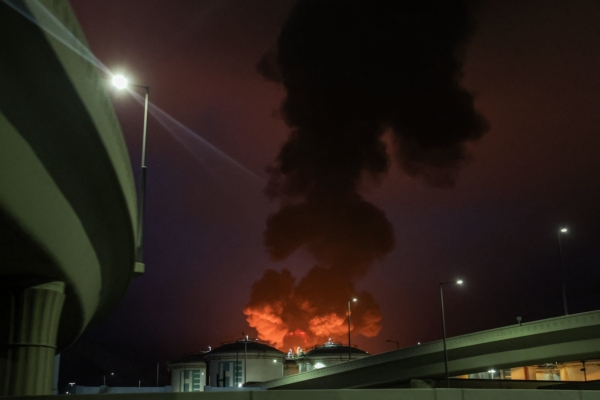
On Sunday, the 9th day of the Iran war, Gulf countries continued to be targeted by Iran’s unmanned drones and missiles. The Arab League strongly condemned Iran’s actions on Sunday and warned that these attacks could push the region onto a dangerous path.
The Arab League foreign ministers held an emergency video conference on Sunday to discuss the escalating tensions and strongly condemned Iran’s escalating attacks on civilian targets and vital infrastructures in the Persian Gulf region.
Ahmed Aboul Gheit, the Secretary-General of the Arab League, stated during the video conference that Iran’s attacks on neighboring countries are “unjustifiable,” reflecting its reckless policies.
He emphasized that Arab countries have not been involved in the wars waged by the United States and Israel against Iran, and have declared that their territories will not be used as launch pads for U.S. attacks on Iran, yet they are still being targeted by Iran.
“Iran’s unjustified aggression reflects a distorted understanding of the situation and further isolates Iran from the international community during this challenging and sensitive period,” he said.
Gheit further expressed that targeting civilian objectives and critical infrastructure is a serious strategic mistake that threatens regional stability.
The foreign ministers strongly condemned Iran’s attacks on its Arab neighbors, stating that it pose a “serious threat to international peace and security.”
In the final communiqué issued after the meeting, the foreign ministers expressed support for Gulf countries, Jordan, and Iraq in “taking measures to contain and respond to these acts of aggression.”
The Arab foreign ministers urged Iran to immediately cease the attacks and stop “provocative actions or threats” against neighboring countries. They called on the United Nations Security Council to condemn Iran and compel it to “immediately and unconditionally” halt its attacks on Arab countries.
Although Iran claims its attacks are targeting U.S. military bases in these countries, Gulf nations rebut this by stating that Iran’s attacks have also targeted hotels, ports, airports, and residential buildings, disrupting the normal lives of Gulf countries’ residents.
Government reports from Saudi Arabia, Kuwait, the UAE, and Bahrain indicated that Iran’s drones attacked their respective territories on Saturday and Sunday.
According to information from the UAE, Iran launched intense attacks on the country on Sunday. The UAE’s air defense forces shot down 16 Iranian ballistic missiles and 113 unmanned drones that day, with one missile falling into the sea and four drones hitting targets within the UAE.
The UAE stated that four foreign laborers have lost their lives in Iran’s attacks so far.
Following days of consecutive attacks by Iran, UAE President Mohammed bin Zayed Al Nahyan unusually referred to Iran as an “enemy,” signaling a significant shift in how the UAE characterizes its relationship with Iran.
In the attacks launched by Iran over the weekend, a government office building in Kuwait erupted in flames. The Kuwaiti Interior Ministry reported that two individuals perished while “performing official duties.”
Bahrain announced on Sunday that Iran’s unmanned drone attack caused damage to a desalination plant. However, the country’s Electricity and Water Authority stated that the attack did not disrupt water supply. This marks the first time during the conflict that an Arab country has reported an Iranian attack on a desalination facility.
According to Reuters, insiders revealed that Saudi Arabia has informed Tehran that if Iran continues to target Saudi Arabia and its energy sector, the country may be forced to respond with reciprocal measures.