
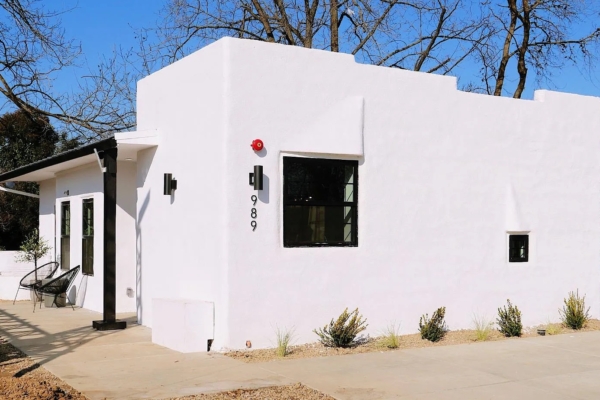
Recently, a 3D-printed home in Yuba County, California, has been listed for sale. The project, which plans to “print” a total of five homes, has completed the construction of its first house.
Constructed by 4DIFY, the company aims to build five 3D-printed homes on Kaizen Way in Olivehurst, forming a small community. This construction method involves using concrete as the base material and layering it with a large robotic system, similar to commercial 3D printers. After the concrete layers are complete, workers manually apply a plaster mixture to the walls to create a smooth and detailed finish.
Nan Lin, the founder of 4DIFY, mentioned in an interview with the Epoch Times that one of the initial challenges the team faced was learning and mastering 3D concrete printing from scratch. Lin, a real estate entrepreneur from Sacramento, stated, “Traditional construction processes revolve around familiar methods, while 3D printing requires dynamic coordination among different trades in a new environment, from reinforcing placement to printing sequence to inspection timing.”
Lin expressed that some members of the construction team were initially skeptical about the technology but eventually reached a consensus. With experienced personnel in 3D concrete printing, the team provided engineering support to construction workers from various trades. He emphasized that “the ultimate result is not just a completed home but also the establishment of an expandable and resilient housing construction model.”
According to 4DIFY’s update in February, the first of the five homes has been completed. These homes, made of non-flammable concrete materials, offer better resistance against wildfires. Additionally, the material outperforms traditional wood homes in terms of insect resistance, mold prevention, and moisture protection.
The property sits on 7,279 square feet of land with an interior living space of approximately 910 square feet. According to Zillow, the single-story building features three bedrooms, two bathrooms, electric stove, stackable washer/dryer, and other common appliances. The design of the homes draws inspiration from Spanish missionary style and is currently priced at $375,000, slightly below the average price of $441,300 in Olivehurst.
The first home was completed in about 40 days, and the entire five-home project is expected to be finished by late June or early July. Lin mentioned that the project site “creates an ideal environment for sequential printing of homes, allowing the team to adjust and optimize feedback mechanisms in real-time. Each construction contributes to the experience for the next.”
He added, “Yuba County has shown a willingness to support innovation,” and the regulatory process for starting new construction projects is relatively straightforward. However, the company aims to “establish a replicable basic model to promote 3D-printed homes throughout California.” 4DIFY currently has three similar projects in the early stages.
The use of 3D technology for printing homes has been around for several years. In 2023, California welcomed its first 3D-printed home in Redding.
Emergent, the 3D printing company responsible for the project, stated in a press release that its goal is to help California homeowners avoid property loss due to frequent wildfires.
Alaska, Colorado, Michigan, Montana, Ohio, Texas, and Virginia are also advancing 3D-printed home projects. In 2022, Montana became the first state to approve 3D printing construction regulations.
Meanwhile, the University of Florida is not only researching the application of 3D concrete printing technology in homes but also exploring its use in seawall construction.