
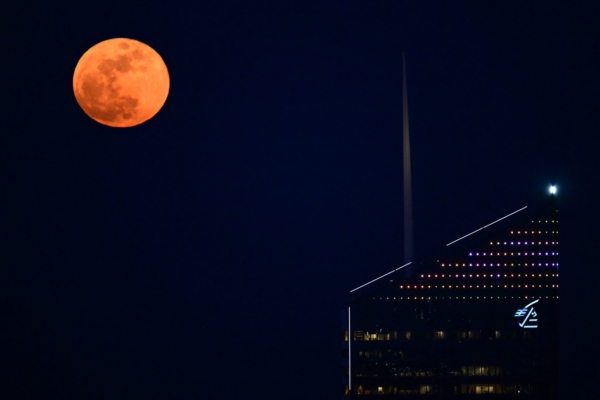
On March 3rd, which falls on the fifteenth day of the first month in the lunar calendar, marked the Lantern Festival, also known as Yuanxiao Festival. This year’s Lantern Festival not only coincided with the full moon of the first lunar month but also witnessed a rare event, a total lunar eclipse commonly referred to as a “blood moon.” It was the only total lunar eclipse of the year, making it a noteworthy astronomical event that won’t happen again until 2028.
The occurrence of a lunar eclipse is a result of a perfect alignment of the sun, Earth, and moon in a straight line, causing the moon to enter the Earth’s shadow. When the moon fully enters the core shadow of the Earth, known as the “umbral shadow,” a total lunar eclipse takes place. During this phenomenon, Earth blocks out most of the sunlight, particularly colors with shorter wavelengths like blue and blue-violet. Meanwhile, colors with longer wavelengths such as red and orange can easily pass through Earth’s atmosphere and reach the moon, giving it an orange-red or copper hue, hence the term “blood moon.”
The intensity of the moon’s red color during a lunar eclipse is closely related to the amount of dust or clouds in Earth’s atmosphere at the time – the more clouds or dust, the deeper the red color of the moon.
According to astronomers, the entire process of this “blood moon” total lunar eclipse lasted for 5 hours and 39 minutes. The noticeable dimming of the moon’s surface, called the “umbral eclipse,” began at 09:50 UTC/GMT on the 3rd and ended with the moon fully returning from the shadow at 13:17 UTC/GMT, with the spectacular total eclipse phase (the most exciting part) lasting for 58 minutes and 19 seconds.
This total lunar eclipse was observable in East Asia, Australia, New Zealand, the Pacific region, North America, and Central America. Most parts of Central Asia and South America only witnessed a partial lunar eclipse.
It’s worth noting that as long as the weather was clear, this spectacular astronomical phenomenon could be observed with the naked eye. However, binoculars or telescopes enhanced the viewing experience significantly.