
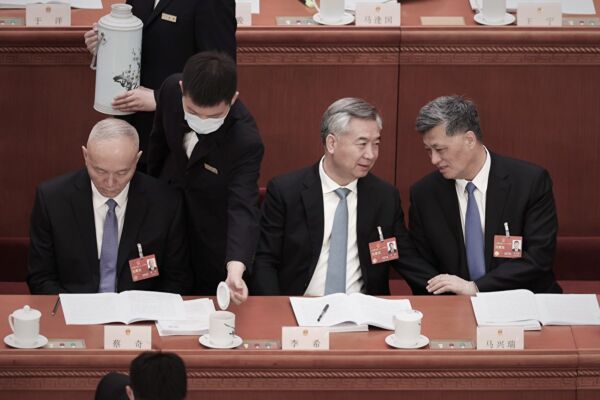
The former secretary of the Xinjiang Uygur Autonomous Region Committee of the Communist Party of China (CPC), Ma Xingrui, who is also a member of the CPC Central Political Bureau, stepped down in July last year amidst ongoing rumors of his downfall. Since the end of last year, he has been conspicuously absent from important occasions, leading to speculations but no official announcement has been made. Some analysts suggest that Ma Xingrui’s case may involve Xi Jinping and his wife, as well as the Secretary of the CPC Central Commission for Discipline Inspection, Li Xi, potentially causing a rift between Xi and Li Xi.
Ma Xingrui had a long career in the aerospace system before moving on to positions in Guangdong and Xinjiang. Following Ma Xingrui’s departure from Xinjiang, several officials from the region have been implicated in disciplinary actions.
Gao Shiwen, who served as Ma Xingrui’s secretary in the Aerospace Science and Technology Group for many years and later became the mayor of Nanchang City in Jiangxi Province, has been absent from important meetings in Nanchang City in February. The city government’s official social media account that updates “Comrade Gao Shiwen’s weekly governmental activities” every Sunday has not been updated since February 8th. There were rumors circulating on social media that Gao Shiwen had been summoned for questioning.
Guo Yonghang, who was Ma Xingrui’s chief secretary during his tenure in Shenzhen, was relieved of his positions as member of the Guangdong Provincial Committee and secretary of the Guangzhou Municipal Committee in December last year. On January 28th this year, he was appointed as the Vice Chairman of the Guangdong Provincial Committee of the Chinese People’s Political Consultative Conference. Given the shadow of Ma Xingrui’s rumored downfall, Guo Yonghang’s shift to a secondary role as the Vice Chairman of the Guangdong Provincial Committee of the CPPCC does not necessarily guarantee him safety.
In a recent article published in Taiwan’s media “Shangbao,” independent commentator Du Zheng pointed out that Guo Yonghang and Gao Shiwen share two obvious identifiers: both served as Ma Xingrui’s secretaries and are from Shandong Province, Ma Xingrui’s hometown. The downfall of a secretary often reflects on their superior’s crisis. The shared label of being “from Shandong” indicates the use of provincial connections as a bond within the Chinese Communist Party factions. The most influential figure in the “Shandong Faction” within the official circles is said to be Peng Liyuan, the wife of Xi Jinping. Ma Xingrui had a close relationship with Peng Liyuan, which played a role in his advancement before.
During Ma Xingrui’s tenure as Deputy Secretary of the Guangdong Provincial Committee and Secretary of the Shenzhen Municipal Committee, Hu Chunhua was the Secretary of the Guangdong Provincial Committee (from December 2012 to October 2017), who now serves as the Vice Chairman of the National Committee of the CPPCC. From January 2017 to December 2021, when Ma Xingrui left Shenzhen, the Secretary of the Guangdong Provincial Committee was Li Xi, who is the current Secretary of the CPC Central Commission for Discipline Inspection and governed Guangdong Province from October 2017 to October 2022.
Du Zheng disclosed that rumors in the official circles of Guangzhou revealed that after Hengda Group’s Chairman Xu Jiayin lost his freedom in September 2023, he provided authorities with a long list of top officials involved, including Ma Xingrui. On November 4, 2015, then Deputy Secretary of the Guangdong Provincial Committee and Secretary of the Shenzhen Municipal Committee Ma Xingrui had a meeting with Xu Jiayin, the Chairman of Hengda Group, after which, within a year and a half, Hengda quietly relocated its headquarters from Guangzhou to Shenzhen. Xu Jiayin reportedly offered significant benefits to Ma Xingrui, his “patron.”
Du Zheng noted that given that Hengda’s headquarters was formerly in Guangdong, Xu Jiayin had established some beneficial relationships with high-ranking officials governing Guangdong over the years. It remains uncertain whether Xu Jiayin had any private interactions or exchanged benefits with Li Xi at the beginning of Li Xi’s governance in Guangdong.
There were previous overseas rumors alleging that Li Xi’s wife had colluded with Ma Xingrui’s wife, Rong Li, to obtain significant benefits. Du Zheng conceded that these rumors are currently unverifiable. Nonetheless, many cases of high-ranking officials being brought down have also affected their close associates. According to the CCP’s internal regulations, the top leader bears leadership responsibility for the oversight or indulgence of their team members’ misconduct. If Ma Xingrui was involved in corruption during his time in Guangdong, Li Xi would, at the very least, bear a “neglect of duty” and might face disciplinary actions or internal sanctions.
Du Zheng believes that politically, Ma Xingrui had been a protégé of Xi Jinping and his wife. The move to target Ma Xingrui at the moment is a result of the military-industrial complex corruption spreading, combined with Ma Xingrui being on a lengthy list of beneficiaries from Xu Jiayin, as well as reports of familial corruption. Xi Jinping has no choice but to “shed tears and cut ties with Ma Xingrui” in the Year of the Horse.
He further noted that the complexity of the Ma Xingrui case lies in the fact that Li Xi, who heads the Central Commission for Discipline Inspection, is now tasked with dealing with his former “partner” in Guangdong. Ma Xingrui may also have incriminating evidence against Li Xi regarding corruption in Guangdong. It is said that Ma Xingrui’s case is being handled by Liu Jinguo, the top-ranked Deputy Secretary of the Central Commission for Discipline Inspection. If true, it indicates a compromise between Xi Jinping and Li Xi: while Xi wishes to protect Li Xi, he also wants to hold leverage over Li Xi to drive compliance.
Analyzing the situations of Guo Yonghang and Gao Shiwen falling one after the other, Du Zheng suggests that the Central Commission for Discipline Inspection is diligently investigating Ma Xingrui’s time in the aerospace system, moving on to his tenure in Shenzhen, which indirectly involves the era when Hu Chunhua governed Guangdong but skips over Li Xi’s governance in Guangdong. However, he does not rule out the possibility of Liu Jinguo secretly crossing boundaries to investigate Li Xi’s issues, as seen with the Central Military Commission delving into the corruption in the equipment sector, initially avoiding probing the era under Zhang Yuxia but eventually breaking through. If this is the case, it signifies a division between Xi and Li Xi due to the Ma Xingrui case, implying Xi’s lack of trust in those around him.
On November 28 last year, during a CPC Politburo collective study session, both Li Xi and Ma Xingrui were notably absent, sparking speculation about their situations.
On December 7 last year, Australian anti-Communist internet personality Jiang Wangzheng made a revelation that Ma Xingrui’s case was being handled by Liu Jinguo, the top-ranked Deputy Secretary of the Central Commission for Discipline Inspection; Li Xi and his family were implicated in the Ma Xingrui case; and 51 other key officials at ministerial and deputy-ministerial level were involved, asserting that the Ma Xingrui case had permeated half of Xi Jinping’s power structure. However, these claims have not been substantiated.
Du Zheng predicts that it has been over half a year since Ma Xingrui was relieved of his duties as the Secretary of the Xinjiang Uygur Autonomous Region Committee, from July last year until now. He speculates that around the time of the upcoming National People’s Congress in early March, we may see more developments in the Ma Xingrui case. Looking further ahead, the announcement of the case might coincide with the convening of the Fifth Plenary Session of the 20th Central Committee of the CPC in summer or fall. Given the high-level political maneuvers within the CPC, the eventual unveiling of the Ma Xingrui case is likely to be highly dramatic.