
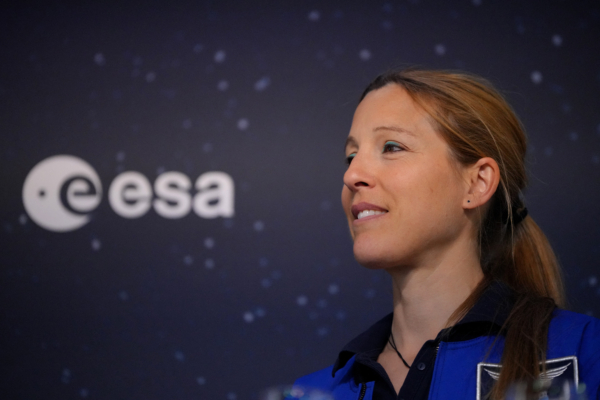
Astronaut Sophie Adenot, a member of the European Space Agency (ESA) from France, is set to embark on a journey to the International Space Station (ISS) aboard the “SpaceX Crew-12” spacecraft as part of a collaboration between NASA and SpaceX. This mission continues ESA’s longstanding tradition of hitching rides to space.
SpaceX Crew-12 marks the 12th official flight of NASA’s Commercial Crew Program and the 20th crewed orbital flight of the Crew Dragon spacecraft. Scheduled to launch after February 12, 2026, the mission will transport four astronauts to the International Space Station.
The crew members include NASA astronauts Jessica Meir and Jack Hathaway, ESA astronaut Sophie Adenot, and Russian cosmonaut Andrey Fedyaev from Roscosmos.
Since its establishment in 1975, the European Space Agency has chosen not to build and launch its own crewed spacecraft. Starting with the first flight of Danish astronaut Ulf Merbold in 1983, all European astronauts had to rely on Russian Soyuz spacecraft, American Space Shuttles, or more recently, SpaceX’s Crew Dragon to reach Earth’s orbit.
When asked by a journalist from Dajiyuan about the possibility of changing this situation, Andreas Mogensen, the head of ESA’s Human Spaceflight Exploration team, did not rule out the possibility. During a press conference before the Crew-12 launch on February 9, Mogensen stated, “This is certainly something we are carefully considering. If everything goes according to plan, we may submit this proposal to member countries.”
ESA, consisting of 23 European member states, convenes a meeting every three years in November to establish European space policies and approve new projects. The latest assembly took place in November 2025, and the next session is scheduled for 2028.
Mogensen highlighted that the increasing demand for astronauts in Europe has made this a topic of discussion. He referenced the selection process in 2022, where despite the need for only five European professional astronauts, 22,500 individuals applied, demonstrating a significant interest among Europe’s youth in the space sector.
ESA’s “2040 Strategy” seems to hint at Europe eventually having its own crewed spacecraft. The strategic plan outlines a series of goals to be achieved by 2040, including ensuring independent and competitive access to space through new (potentially reusable) transportation systems and services.
By enhancing Europe’s capabilities in space by 2040, ESA aims to become a key player in space transportation. The agency emphasizes reducing reliance on non-European entities to strengthen its own capabilities, as launch costs determine competitiveness in the space sector.
Despite ESA’s long-term plans, Mogensen informed the media that ESA hopes to send astronauts on at least two more missions before the International Space Station is retired in 2030. He also mentioned the possibility of short-term missions operated by private companies like Axiom, providing astronauts with more opportunities to stay at the space station.
European astronauts have participated in previous Axiom missions such as Axiom-3 in January 2024 and Axiom-4 in June 2025, but the crew lineup for the upcoming Axiom-5 mission is yet to be finalized.
Mogensen expressed the desire for a European astronaut to be part of the upcoming Artemis lunar missions by the United States. However, he did not confirm whether European astronauts would be selected for the three Artemis II missions following the lunar flyby in spring this year.
The day before Mogensen made these statements, there was an opportunity for Dajiyuan to ask astronaut Adenot whether she could envision flying aboard a European-made crewed spacecraft.
Adenot responded, “I believe we are in a very exciting era of space travel, but it’s also full of variables. No one can predict what will happen ten years from now, but what we can be sure of is that the space industry is rapidly evolving, with space programs proliferating globally.”
Adenot will follow in the footsteps of France’s first female astronaut, Claudie Haigneré, becoming the first French woman to fly to space in 25 years. Haigneré had flown to the Mir space station in Russia in 1996 and the International Space Station in 2001 aboard Soyuz spacecraft.