
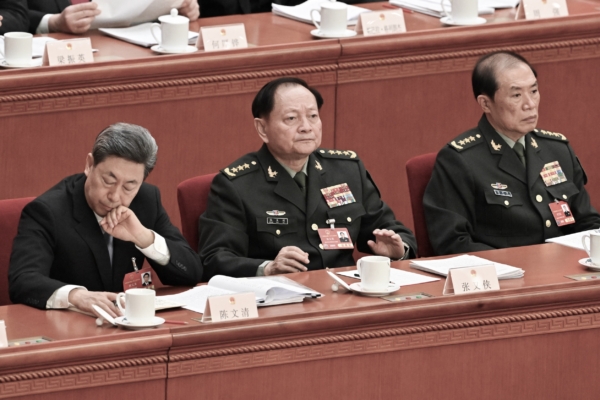
The People’s Liberation Army Daily continues to criticize Zhang Youxia, the Vice Chairman of the Central Military Commission of the Chinese Communist Party, and Liu Zhenli, the Chief of Staff of the Joint Staff Department of the Military Commission. In an article published yesterday (9th), the military newspaper cited the example of early Chinese Communist Party leader Zhang Guotao, accused of “setting up a separate center”, as a negative case, claiming that “the remaining corrupt elements have not been thoroughly eliminated” and should be eradicated through “political rectification”. Analysts believe that this confirms internal divisions within the Chinese Communist Party, possibly alluding to the Zhang Youxia incident, and that there may be further purges of retired old military leaders.
On February 9, the 6th edition of the Chinese Communist Party military newspaper published a commentary entitled “Being Politically Strong is Fundamental Strength”. The article only mentioned one example, that “Zhang Guotao conducted activities to split the party and the Red Army,” and mentioned that at the time, Zhu De expressed opposition to Zhang Guotao. The article declared that “all actions must obey the Central Party, the Central Military Commission, and the command of President Xi Jinping”, and pointed out that “the remaining corrupt elements have not been thoroughly eliminated, and it is urgently needed to eradicate the soil and conditions that breed corruption through political rectification.” The article was signed by Ren Long from the Political College of the National Defense University.
Chinese state media has repeatedly published articles criticizing early Chinese Communist Party leaders such as Zhang Guotao and Wang Ming, with Zhang Guotao being called an “ambitious person.” For example, in August 2021 during the sensitive period of the Chinese Communist Party’s Beidaihe Conference, official media published Xi Jinping’s criticism of Zhang Guotao, stating that Zhang Guotao “used his troops to elevate his own influence and set up a separate center.”
Historical records show that during the Chinese Communist Army’s retreat northward from October 1934 to October 1936, due to internal conflicts with Mao Zedong, Zhang Guotao led the main force of the Fourth Red Army and the Red Ninth Army and other units of the Western Route Army, moving west from northern Shaanxi. As a result, they were surrounded by the Nationalist Army and suffered complete annihilation. As a result, Zhang Guotao was attacked by Mao Zedong and gradually marginalized.
On April 5, 1938, after visiting the tomb of the Yellow Emperor in central Shaanxi, Zhang Guotao left the Chinese Communist Party and defected to the Nationalist Party, later making a statement renouncing his membership in Wuhan. In 1948, Zhang Guotao moved with his family to Taiwan, then later lived in Hong Kong, before immigrating to Canada in 1968. In December 1979, Zhang Guotao passed away in a nursing home in Toronto at the age of 82.
Zheng Haochang, a current affairs commentator based in the United States, told Epoch Times that in the Chinese Communist Party’s brainwashing propaganda, Zhang Guotao’s reputation had long been blackened enough. By revisiting Zhang Guotao’s case, the military newspaper is actually likening Mao Zedong to Xi Jinping, and Zhang Guotao to Zhang Youxia, suggesting that Zhang Youxia engaged in activities to sow division within the party and the military, while also calling for more so-called “new era Zhude” figures to resist.
After the Vice Chairman of the Central Military Commission of the Chinese Communist Party, Zhang Youxia, and Commission Member Liu Zhenli were taken down on January 24, the military newspaper editorial accused Zhang of “seriously trampling and undermining the system of the Chairman of the Military Commission” and “seriously aiding the political and corrupt issues that challenge the party’s absolute leadership over the military and harm the political foundation of the party.” However, subsequent related propaganda efforts were momentarily silenced. Starting on January 31, the military newspaper continued to publish articles on Zhang and Liu, calling on the military to support decisions made by the so-called “Central Party”, to understand the overall situation, and not be distracted, among other things, suggesting that the investigation of Zhang and Liu could lead to dissatisfaction among officers and soldiers, causing unrest within the military ranks.
There are various versions circulating as to why Zhang Youxia was taken down, with one of the most widely speculated reasons being that Zhang Youxia and some veteran Chinese Communist Party members joined forces to prevent Xi Jinping from seeking re-election at the 21st Party Congress.
The article in the Chinese Communist Party military newspaper yesterday has sparked discussions among netizens on the X platform overseas:
“It is obvious that Zhang Youxia and Xi have diverged, and Zhang has approached the second generation Reds and the elders of the past era to pressure Xi. This is something that Xi cannot tolerate at all.”
“At the same time, it sends a strong political signal—official media deliberately compares the severity of the current internal conflicts within the Chinese Communist Party leadership to the serious split within the party in 1935.”
“It’s far from over, Xi definitely doesn’t have complete control of the situation, which is why he is apprehensive and seizes every opportunity to appear. Because if he doesn’t show up, all sorts of rumors will arise, unsettling people’s minds.”
Dr. Hong Yaonan, Deputy Director of the Mainland China Research Center at Tamkang University, wrote in his new book “Xi Jinping’s Choices and Conclusions” that once power becomes highly personalized, loyalty is no longer important; having “independent authority” and the potential to become a “second power center” becomes the dividing line between life and death. This is why wave after wave of seemingly incomprehensible lists of people are being purged from both the military and the political spheres.
Australian scholar Yuan Hongbing recently stated in an interview with “Seeing China” that Zhang Youxia was arrested because he and Liu Zhenli collaborated to challenge Xi Jinping, attempting to dominate the appointment of senior military officials.
Yuan Hongbing analyzed that while Xi Jinping arrested Zhang Youxia and Liu Zhenli, at the same time, his personal rule crisis has been unprecedentedly exposed. The framework of the Military Commission constructed during the 20th Party Congress has collapsed, coupled with the prior large-scale purge of the factions led by Miao Hua and He Weidong, showing the outside world that the generals promoted by Xi are “no good,” greatly undermining Xi’s authority.
The content of the Chinese Communist Party military newspaper’s commentary yesterday stated that the “remaining corrupt elements” have not been thoroughly eliminated, and should be eradicated through political rectification.
Zheng Haochang told Epoch Times that the Chinese Communist Party does not want the common people to criticize it as becoming more corrupt the more it resists, so it has concocted a new term of “remaining corrupt elements” to confuse the public. In fact, there is no such thing as “remaining corrupt elements”; this party is thoroughly rotten. Xi Jinping does not need the excuse of “remaining corrupt elements” to target whomever he wants, to pull out the radish and bring out the mud, and it is possible that some retired military leaders who have been out of service for many years may still face investigations.
Indications show that since Xi Jinping unexpectedly arrested Zhang Youxia, the cleansing within the Chinese Communist Party’s military has not ceased.
On February 6, Xi Jinping attended a literary performance to celebrate the Lunar New Year and to show his respects to retired military personnel stationed in Beijing. Sitting alongside Xi Jinping and Zhang Shengmin were six former military leaders, including former Vice Chairman of the Military Commission Cao Gangchuan, Fan Changlong, former Commission members Chen Bingde, Li Jina, Zhao Keshi, and Wu Shengli.
Compared to the past couple of years, the number of current Military Commission members and retired military leaders accompanying Xi to watch the performance has significantly decreased. Since 2024, former Vice Chairman of the Military Commission Xu Qiliang, and former Commission members Liang Guanglie and Liao Xilong have passed away one after another.
It is worth noting that former Chinese Communist Party Military Commission member and former Joint Chiefs of Staff Li Zuocheng was absent from this year’s activity, raising concerns.