
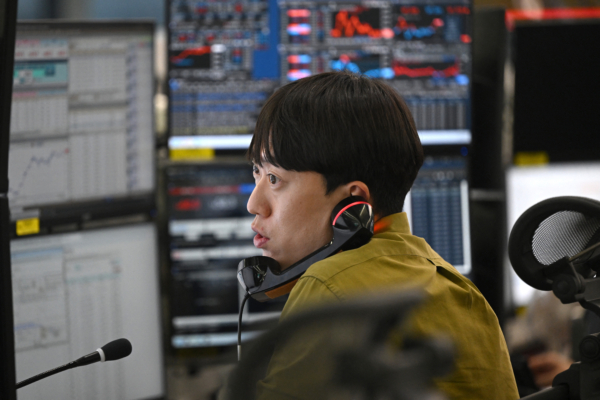
Asian stock markets plunged dramatically on Friday (February 6) following the tech stock slump on Wall Street the previous evening. The South Korean composite stock price index (KOSPI) had the most drastic performance, dropping by 5% shortly after opening, triggering a circuit breaker mechanism.
This global selling pressure not only impacted the stock markets but also spread to the cryptocurrency and precious metals markets, reflecting investors’ unease not only with the high valuations of tech stocks but also with concerns about whether the US economy is heading towards stagflation.
The core of this market turbulence comes from investors’ skepticism about the substantial returns on investment in artificial intelligence (AI). E-commerce giant Amazon announced on Thursday a capital expenditure budget of up to $200 billion for 2026, focusing on AWS data centers, AI proprietary chips, and low-orbit satellite projects, among others. Despite impressive revenue, this expenditure plan well above market expectations led to an 11% post-market stock price plunge.
Similar cost concerns also shadow other tech giants. Earlier this week, Alphabet revealed a capital expenditure of up to $185 billion for this year, sparking market worries about cost pressures.
Furthermore, Qualcomm issued weaker-than-expected earnings due to a global memory shortage, causing its stock price to plummet over 8%, further shaking investor confidence.
Adding to the woes, US labor market data showed signs of slowing down.
Data from the US Bureau of Labor Statistics released on Thursday indicated a decrease in job vacancies to the lowest level since 2020. Meanwhile, a separate survey from global outplacement firm Challenger, Gray & Christmas revealed an increase in layoff announcements by US employers in January, reaching the highest level for the same month in 17 years.
IG Group analyst Tony Sycamore told Reuters, “The three major pillars supporting the market over the past six months have been AI, cryptocurrencies, and precious metals, but investor confidence in these areas is wavering. This increases the likelihood of further deep market declines.”
In the cryptocurrency market, Bitcoin continued to show weakness, briefly dropping below the $62,000 mark on Friday to $61,238.64, nearly halving from its historical peak in October last year.
Precious metals were also hit hard, with silver plunging nearly 9% again on Friday following a sharp drop on Thursday, and gold prices also declining by 1.6%.
Strategist Mona Mahajan from Edward Jones told Bloomberg, “It’s been a tough week for those heavily positioned in leading sectors. While one might think of tech and AI first, we’ve recently seen selling in gold, precious metals, Bitcoin, and the broader cryptocurrency space.”
Regarding the current situation, eToro analyst Bret Kenwell said, “The latest employment data once again shows that the US job market is not operating at full speed. If conditions worsen, the Fed and investors must take this risk seriously. Volatility may persist, especially as short-term uncertainty rises.”
The selling spree on Wall Street also affected stock markets in various Asian countries. The South Korean composite stock price index (KOSPI) dropped by as much as 5.1% to a low of 4,899.30 points at the opening on Friday, and due to a heavy slump in KOSPI 200 index futures, a circuit breaker was triggered, leading to a 5-minute halt in algorithmic trading.
The Nikkei 225 index in Japan also opened lower, down by 1.22%. Influenced by the tech stock slump in the US, semiconductor-related sectors in Japan saw significant declines, with Advantest falling by over 3%. Japanese pharmaceutical stocks like Sumitomo Pharmaceuticals and Takeda Pharmaceutical also dropped in sync due to the launch of a discount prescription drug website in the US.
The Taiwan Weighted Index similarly weakened, with an initial drop of almost 2% after opening.
The Australian stock market saw a nearly 1.9% decline, with reports circulating about major corporate movements. Mining giant Rio Tinto abandoned its acquisition of Glencore due to valuation discrepancies.
However, as market panic gradually subsides, the declines in Japanese and Taiwanese stocks have started to ease, hovering around the flatline.
Influenced by this atmosphere, funds are beginning to shift towards US bonds for hedging, with the 2-year US bond yield dropping to nearly a one-month low.