
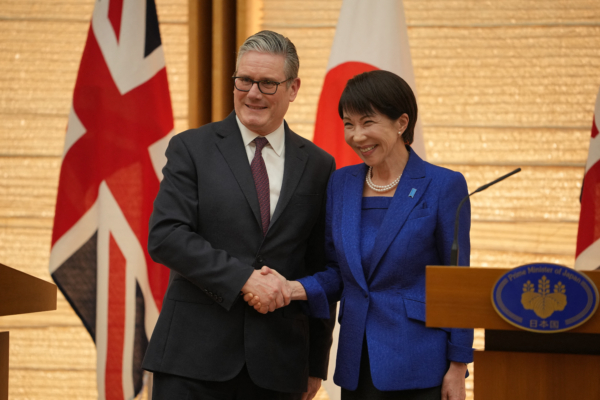
Japan and the UK’s leaders expressed the necessity to strengthen critical mineral supply chain cooperation to enhance overall economic and security resilience in the face of global supply chain instability and rising geopolitical risks. This agreement came after a meeting held in Tokyo on Saturday (January 31).
Japanese Prime Minister Sanae Takaichi and UK Prime Minister Keir Starmer agreed during a joint press conference to deepen strategic cooperation in frontier areas such as cybersecurity and outer space. They also announced the establishment of new consultation mechanisms to promote the institutionalized development of relevant collaborative efforts.
Furthermore, they disclosed plans for a “2+2” security dialogue later this year, which will involve foreign and defense ministers from both countries to further enhance security policy coordination.
Takaichi emphasized that Japan and the UK are entering a new phase of deepening cooperation. She mentioned expanding cooperation in both traditional security and emerging technology fields to address the constantly evolving security environment.
In addition to bilateral arrangements, Japan, the UK, and Italy are speeding up the joint development project for the next-generation fighter jet, aiming for deployment by 2035. This project is seen as a symbolic endeavor of defense industry cooperation among the three countries.
During the press conference, Starmer highlighted the direct connection between supply chain security and societal stability, noting that small and medium-sized enterprises and ordinary workers are most vulnerable to supply interruptions and market disruptions.
He stressed the necessity for the UK and Japan to respond to challenges in a “clear and resolute” manner by strengthening their resilience, capabilities, and alliance relationships to better serve their respective populations.
Starmer also reiterated the UK’s clear interests in upholding a free and predictable trading system and fostering a “free and open Indo-Pacific region,” ensuring that businesses can continue to thrive amidst international turmoil.
This visit to Japan marked Starmer’s first visit since taking office as Prime Minister in July 2024. Prior to his visit to Japan, he concluded a four-day visit to China and held a meeting with Chinese Communist Party leader Xi Jinping in Beijing.
After his visit to China, Starmer promptly traveled to Tokyo for high-level interactions. According to Nikkei Asia’s analysis, this move highlights the UK’s concurrent diplomatic engagement with China and ally coordination.
As a member of the Group of Seven and a close ally of the United States, both Japan and the UK remain vigilant about China’s dominant position in critical mineral sectors such as rare earths and its economically coercive trade practices.
Against this backdrop, Tokyo and London have been consistently strengthening defense cooperation in recent years. The consensus is that security in the Indo-Pacific region and Europe-Atlantic security are closely intertwined, a sentiment further solidified by Russia’s invasion of Ukraine.
On the economic and trade front, cooperation between the UK and Japan has significantly intensified post-Brexit. In 2024, the UK formally became the 12th member of the Comprehensive and Progressive Agreement for Trans-Pacific Partnership (CPTPP), a pact led by Japan and effective since 2018.
Starmer extended an invitation for Takaichi to visit the UK later this year. The last time both leaders met was during the G20 Summit in South Africa in November last year.