
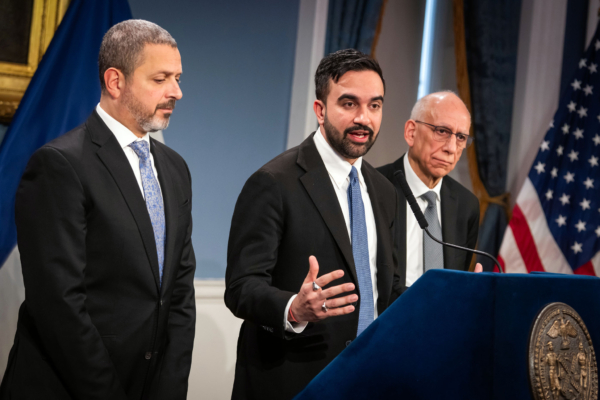
New York Mayor Mamdani held a press conference on the 28th, warning that New York City is facing a budget deficit of at least $12 billion, attributing responsibility to former Mayor Adams and former Governor Cuomo. However, while detailing the financial crisis, the new mayor Mamdani has limited focus on specific solutions to address the gap, mainly emphasizing his long-standing position of calling for taxing the wealthy and corporations, demanding the state government and Governor Hochu to do so.
Mamdani’s remarks in the Blue Room of City Hall were strong, describing the city government he inherited as a “poisoned chalice” and bluntly stating that New York City is in a “serious financial crisis.” He stated that the Adams administration systematically underestimated key expenses including rental assistance, homeless sheltering, and special education, deliberately leaving behind a massive budget gap for the future.
“This is not just mismanagement, it is dereliction of duty,” Mamdani said.
The mayor pointed out that the preliminary assessments within the city government are consistent with the forecasts made recently by City Comptroller Mark Levine, indicating that the combined budget deficit for the current fiscal year and the next could reach up to $12.6 billion. However, this figure does not yet include the additional revenue that could come from Wall Street, which may help shrink the deficit to some extent.
Nevertheless, Mamdani stated that the city government will present its first preliminary budget under his administration by February 17th and submit a balanced budget in accordance with the law. However, he avoided providing specific details on how to achieve this goal when questioned by several journalists after the conference, only mentioning the need to find “efficiencies” and to cut the “fat” from the budget.
In contrast, his demands for reform at the state level were expressed more clearly. Mamdani stated that Hochu must make structural changes, including raising taxes on the wealthiest New Yorkers and high-profit corporations. He pointed out that New York City contributes 54.5% of the state’s tax revenue but only receives 40.5% in return, describing this as a “shocking financial imbalance.”
This stance has placed him in sharp contrast with Governor Hochu. Hochu reiterated her opposition to tax hikes while attending an event in Manhattan that day.
“We will not be raising taxes in New York state. I will not raise taxes just for the sake of raising taxes,” Hochu told reporters from the New York Post, adding that Mamdani “will continue to say what he wants to say.”
Mamdani’s statements quickly drew counterattacks from the Adams and Cuomo teams. A spokesman for former Governor Cuomo, Rich Azzopardi, criticized Mamdani for lacking a basic grasp of the facts and pointed out that under Cuomo’s tenure, the state increased funding to New York City schools by 68% and also absorbed billions in rising costs for city-level healthcare subsidies.
Azzopardi also noted that Cuomo has been out of office for five years, and during this period, Mamdani, as a state legislator, should have had the opportunity to push for the reforms he now claims are unfair but failed to do so.
The Adams camp also pushed back. Todd Shapiro, a spokesman for former Mayor Adams, stated that Adams took office facing nearly $10 billion in debt and the public health and economic crises brought on by the COVID-19 pandemic, followed by significant expenditures related to immigrants that the city had to bear.
“Despite facing significant challenges, Mayor Adams led the city towards recovery through steady leadership and tough decisions,” Shapiro said in a statement, attributing the decades-long state-city financial inequality to Adams as “inaccurate and dishonest.”
Adams himself countered that Mamdani “emotionally blames others instead of admitting his own misleading of the public.”
While Mamdani criticized Adams for “intentionally underestimating the budget,” he did not mention the City Council’s approval responsibility for the budgets over the years. Additionally, according to the New York Post, the budget director under the Adams administration, Jacques Jiha, was a protégé of the current First Deputy Mayor Dean Fuleihan, who was standing beside Mamdani at the press conference, indicating a continuity in budget philosophies at the senior levels of the city government that contrasts with Mamdani’s criticism.