
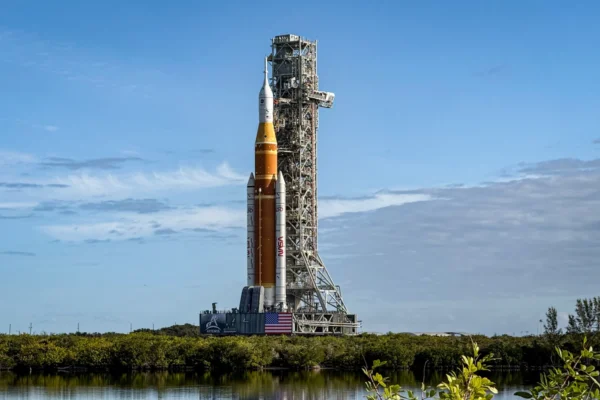
Recently, the United States National Aeronautics and Space Administration (NASA) installed a rocket on the launch pad at the Kennedy Space Center in Cape Canaveral, Florida, in preparation for a manned mission around the moon. This marks the first manned moon rocket launch planned by NASA in over 50 years. The rocket, named Space Launch System (SLS), will use 700,000 gallons of fuel and carry 4 astronauts on a 10-day flight to complete the Artemis II mission.
The SLS, a super heavy-lift launch vehicle, is powered by over 700,000 gallons of liquid oxygen and liquid hydrogen fuels and equipped with two solid rocket boosters reminiscent of the space shuttle era. This massive orange and white rocket is set to carry a team of astronauts including NASA astronauts Reid Wiseman, Victor Glover, Christina Koch, and Canadian Space Agency astronaut Jeremy Hansen on a 10-day lunar flyby mission starting as early as February 6.
On January 17, hundreds of assembly workers braved the cold to witness the rocket being transported from the assembly building to the launch pad. Astronauts for the Artemis II mission, mission officials, and NASA administrator Jared Isaacman were present to witness this milestone moment.
Despite the excitement, there is still much work to be done before the actual launch date is confirmed.
Artemis II is the second mission of NASA’s Artemis program, named after the twin sister of Apollo, the Greek goddess of the Moon, Artemis. The goal of the Artemis program is not only to return to the Moon but also to establish a sustainable, permanent human presence on the Moon’s surface and in lunar orbit by 2030.
Chief Flight Director Jeff Radigan emphasized that this mission is primarily a test flight. Wiseman, Glover, Koch, and Hansen will be the first to fly on the Space Launch System and the NASA Orion spacecraft, which includes a crew module and a service module provided by the European Space Agency.
NASA’s priorities for this test flight include verifying that the spacecraft and ground team can ensure the astronauts complete the entire mission and return safely to Earth, demonstrating critical operational procedures required for future manned lunar missions, and validating emergency systems and operations.
These demonstrations will include verifying the readiness of critical functions such as life support systems, radiation shielding, maneuvering required for future mission docking, and refining daily cabin operations. This includes how to properly store flight suits in the cramped crew cabin and meet physical training requirements.
The astronauts will also test a new type of laser communication array, engage in ship-to-ship communication with the International Space Station, and conduct human science experiments. These experiments will not only deepen understanding of how deep space affects the human body but also enhance NASA’s ability to tailor treatment plans for each astronaut.
“This is a test flight, and there will certainly be some unexpected situations,” Radigan emphasized during a press conference on January 16. “You know, I think we’ve done everything we can to prepare for this, and we are very excited to work with the crew to successfully complete this mission and learn from Artemis II what needs to be improved for future Artemis missions.”
Artemis II could launch as early as February 6, with the latest launch date set for April 6. To fulfill its long-standing commitment, NASA must ensure that the mission launches before the end of April and aims to complete it within the specified launch windows.
Due to mission objectives and spacecraft limitations, NASA has identified a six-day launch window at the beginning of each month.
The initial launch window spans from February 6 to February 11, followed by additional opportunities on March 6, 7, 8, 9, 11, and April 1, 3, 4, 5, 6. Specific launch dates will depend on the precise alignment of Earth and the Moon’s positions and rotations on the launch day to ensure the spacecraft is placed in the correct high Earth orbit. Subsequently, the spacecraft will fly along a free-return trajectory around the Moon and ultimately splash down in the Pacific on a shorter reentry orbit.
Additionally, the spacecraft and its service module cannot exceed 90 minutes in darkness due to the power provided by the solar panel wings on the service module.
Aside from these conditions, the lunar rocket must undergo testing and system integration before being cleared for launch, including a wet dress rehearsal. This rehearsal involves ground crew simulating various launch day scenarios, such as full fuel loading and unloading, key system startups and shutdowns, and ensuring safe procedures for crew reentry into the capsule if any issues arise, such as fuel leaks as seen in the Artemis I mission.
Weather conditions could also cause delays. For instance, if the temperature on the launch pad falls below the set limits for 30 continuous minutes (ranging from 38 to 49 degrees Fahrenheit depending on wind speeds and relative humidity), the lunar mission cannot proceed. Additionally, the launch may be postponed or canceled if lightning or thunderstorms are detected within 10 nautical miles of the launch pad.
While NASA has only released launch windows for the next three months, Artemis Launch Director Charlie Blackwell-Thompson stated that there are suitable launch windows every month this year, allowing the rocket to be exposed on the launch pad in various natural conditions between two launch windows before needing to return to the assembly building.
Regardless of the launch date, NASA leadership anticipates that the 10-day flight of Artemis II will launch at night and culminate in a nighttime splashdown.
Crew members and flight directors describe the workload for the first two days of the mission as extremely heavy.
On the first day, the spacecraft will depart from Launch Pad 39B at Kennedy Space Center and, after over three hours of flight, enter a high Earth orbit where the spacecraft will reach an altitude of 46,000 miles. In comparison, the International Space Station typically orbits at an altitude of 250 miles above Earth.
After reaching the high Earth orbit, Wiseman, Glover, Koch, and Hansen will conduct approximately a 23-hour check-up on the spacecraft while still relatively close to Earth. This check-up includes NASA’s “proximity operations demonstration.” Glover will manually control the spacecraft to test its maneuvers for docking. He will fly to a position just 30 feet from the upper stage separated by the Space Launch System (SLS). The Orion spacecraft must be able to dock with lunar landers built by SpaceX or Blue Origin companies in order for future astronauts to successfully land on the Moon.
This demonstration will make Glover the first astronaut to manually pilot NASA’s new lunar spacecraft and stand shoulder to shoulder with the previous Apollo astronauts.
Mission officials state that astronauts will rest for approximately four hours on the first day, then wake up for a final orbit adjustment before transitioning into a lunar transfer orbit.
If all checks and tests show the spacecraft is in good condition, Artemis II will perform a “translunar injection burn” just 25 hours and 37 minutes after the mission begins, where the astronauts will ignite the spacecraft’s main engine to depart Earth and travel to the Moon along a free-return trajectory.
The spacecraft and its crew will take three days to reach the Moon. During this time, the astronauts will perform three orbit adjustment burns, test deep space communication networks, and demonstrate operations inside the new spacecraft, including rapidly donning spacesuits. They will also review imaging plans for lunar flybys and prepare for upcoming geological observations.
Four days and seven hours after launch, the spacecraft will enter the Moon’s gravitational sphere, with Artemis II expected to fly farther from Earth than any Apollo mission.
Approximately five days after launch, the astronauts will conduct a close flyby of the Moon at its nearest point, spending three hours observing the far side of the Moon from this newly arrived deep space vantage point.
When the astronauts fly past the Moon at a distance of 4,000 to 6,000 miles, the Moon will appear as if it is holding a basketball with an outstretched arm, according to mission officials. The astronauts’ task is to conduct geological observations, with oversight from a lunar science ground team. The team will provide real-time observation requests and track data throughout the flyby, although signals may briefly interrupt when the Moon is directly between the astronauts and the Earth.
While the lunar far side is often referred to as “The Dark Side of the Moon” as it is in darkness compared to the sunlit near side visible from Earth, this side is expected to be just as illuminated by the sun, with light potentially stronger than during any previous Apollo mission. If so, the flyby mission of Artemis II may reveal lunar surface features unseen by human eyes.
However, NASA cannot determine the extent of sunlight on the lunar far side until the astronauts depart, with mission science leads confirming that lunar visibility will not impact the launch date.
The return journey to Earth will also take three days. Crew members will conduct additional orbit adjustments, participate in lunar science mission briefings, and perform radiation shield demonstrations as well as another manual flight demonstration.
The reentry process into the atmosphere will begin 8 days and 22 hours after launch, with crew members donning their spacesuits and engaging in checks. Their atmospheric crossing journey will commence from an altitude of 400,000 feet, near the Southern California coast, about 9 days and 1 hour after launch, and end in a controlled splashdown within approximately 20 minutes.
The heat shield of the spacecraft is expected to reach temperatures of up to 3,000 degrees Fahrenheit.
If the Artemis II mission is successful, it will pave the way for the Artemis III mission in 2027 or 2028. This mission plans to return astronauts to the lunar surface with the assistance of lunar landers built by SpaceX or Blue Origin. Subsequently, the Artemis IV mission will deliver the first components of the Gateway lunar space station to lunar orbit.
However, the success of these and all future missions will depend on the successful test flight of the Artemis II mission with the Orion spacecraft.
“This is the beginning of a long journey,” Isaacman told reporters on January 17. “Before this, we finished the Apollo program with Apollo 17, the last human lunar landing mission. I hope that one day, maybe in a few decades, my children will witness the Artemis 100 mission.”
He added, “What you see now, the structure behind us, the Space Launch System, and the Orion spacecraft, is just the beginning. Over time, by executing missions like this launch, we will accumulate valuable experience, and the spacecraft architecture will change accordingly. With the evolving architecture, we should be able to conduct repeatable, cost-effective round-trip lunar missions.”