
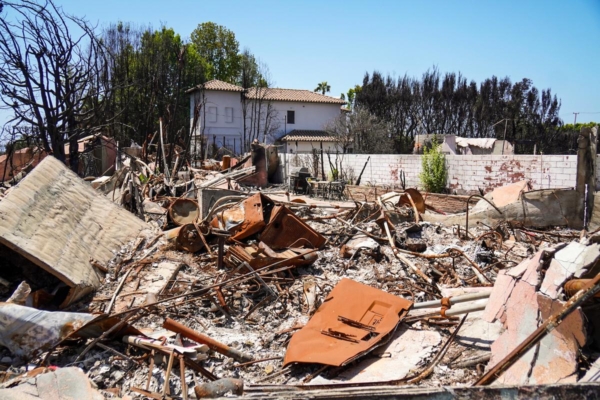
When wildfires strike, why do some houses get destroyed while others are spared? While luck may play a role, post-disaster investigations and analyses have shown that clearing debris and flammable materials around buildings, and preventing embers from entering the house, can reduce or avoid houses from being burnt down.
The California Department of Forestry and Fire Protection (CAL FIRE), in collaboration with the Institute of Business and Home Safety, believes that key to preventing wildfire disasters is to stop the fire from spreading to structures and causing destruction.
The most destructive wildfires in California were the Camp Fire in November 2018, and two fires in Los Angeles in early 2025: the Palisades fire on January 7 at 10:30 am, which burned 23,707 acres, destroyed 6,837 buildings, damaged 973 buildings, and resulted in 12 fatalities; and the Eaton fire on the same evening at 6:18, which burned 14,021 acres, destroyed 9,418 buildings, damaged around 1,073 buildings, and caused 19 deaths.
After the Los Angeles fires, Harry Statter, founder and CEO of Frontline Wildfire Defense, stated that surviving houses often have Class A fire-resistant roofs, fire-resistant vents, double-pane windows, and avoid planting flammable vegetation in the yard. While the outcome of wildfires may seem random at times, it is often influenced by specific factors such as the structure of the houses, surrounding environment, and proactive defense strategies.
Architect Greg Chasen highlighted a scenario where a house survived despite a car exploding in the driveway, attributing it to solid concrete walls, tempered glass windows, and no vents. If embers enter the house, and the interior is filled with combustible items like furniture, carpets, and clothes, it would undoubtedly lead to the house burning down to ashes.
The Camp Fire destroyed 18,804 buildings, resulted in 85 fatalities, and devastated the town of Paradise. Ecologist Eric Knapp from the USDA Forest Service’s Pacific Southwest Research Station mentioned that typically, trees themselves do not fuel fires, but it is the ground litter that causes the flames. Paradise, known for having many deciduous trees in autumn, made it easy for embers or ashes to ignite the fine fuels. Despite large trees remaining after the Los Angeles fires, houses were still burnt down.
Research also indicated that in Paradise, 86% of standalone houses built before 1990 only had an 11.5% survival rate, while houses constructed post-1996 had a 38.5% survival rate. Furthermore, around 44% of houses built after 2008 survived the wildfires. This demonstrates that enhancing fire building codes can improve a house’s fire resistance.
Alexandra Syphard, an ecologist at the Conservation Biology Institute and part-time professor at California State University, spent over 20 years studying wildfires in California and Mediterranean ecosystems. Her 2019 study showed that double-pane windows reduce the risk of houses being destroyed by fire by 26%.
An independent study in 2022 found that reinforcing house structures and clearing surrounding shrubs can reduce the likelihood of house destruction from 40% to 20%.
Syphard noted after the 2025 Los Angeles fires, “Many houses actually catch fire from the inside rather than the outside because embers fly into the house.” Ember showers are a significant factor leading to house ignitions, with strong winds rapidly spreading fires.
Based on insights from firefighters and excellent experiments and field research, the Institute of Business and Home Safety found that retrofitting or strengthening houses can enhance their fire resistance. Measures to reduce the entry of embers into houses include:
Roofs: Wooden roofs are highly susceptible to destruction in fires, so it is best to use composite materials, asphalt, metal, clay, or tile roofs to enhance fire resistance. Sealing gaps under roof tiles and wooden shingles can prevent windborne embers. Regularly clearing leaves, pine needles, and other debris from roofs helps prevent fires.
Chimneys: Covering chimneys and stovepipe outlets with non-combustible metal screens; in forest fire seasons, if chimneys are not in use, it is best to close the fireplace flue.
Vents: Install non-combustible, corrosion-resistant metal mesh to avoid using meltable fiberglass or plastic nets.
Windows: Install double-pane windows or at least one layer of tempered glass to withstand fire-induced shattering; restrict the size and quantity of windows facing large vegetated areas; use non-combustible screen windows to block embers and reduce radiant heat.
Walls: Avoid using flammable wall materials; preferred materials include stucco, fiber cement, or specially treated wood that extends from the foundation to the roof.
Decks: Construct decks and their roofs with non-combustible building materials; simultaneously remove all combustible items beneath the deck.
Eaves and Soffits: Use fire-resistant or non-flammable materials to enclose eaves to prevent embers from entering.
Garage: Store fire extinguishers and essential firefighting tools within reach; equip garage doors with backup batteries to ensure they function during power outages; install weather-stripping around and under garage doors to prevent ember ingress.
Fences: Use non-flammable materials for the fence portions connected to the house to hinder fire spread.
Driveways and Pathways: Maintain a minimum distance of 10 feet between driveways/pathways and vegetation on both sides; ensure emergency access gates open inward and are wide enough for emergency vehicle passage; trim branches above pathways.
Gutters: Keep gutters clean and free of vegetative debris; install non-combustible metal drip edges to protect roof edges from ember intrusion; use non-combustible gutter guards to prevent debris entry and reduce maintenance.
Water Source: Install sufficiently long garden hoses around your house to reach all areas; consider installing water pumps for swimming pools or wells to increase water supply during fires.