
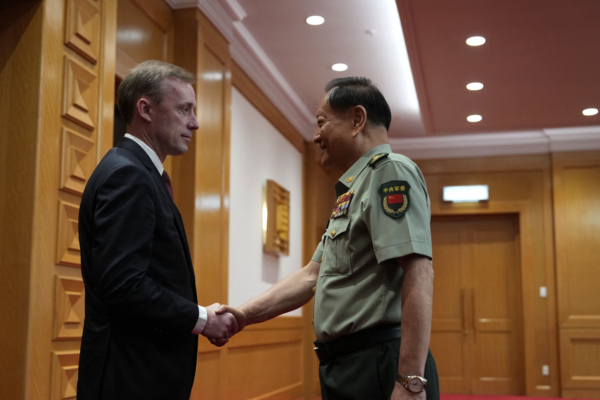
Internal purges of senior military leaders within the Chinese Communist Party have left Western diplomats without key contacts, resulting in concerns over a more closed-off communication channel with the Chinese military.
The second-highest figure in the CCP military, Zhang Youxia, has become the highest-ranking general to be purged since the CCP’s crackdown on the 1989 Tiananmen Square protests.
Last Saturday, the Chinese Ministry of National Defense issued a brief statement announcing that Zhang Youxia, a member of the Politburo and Vice Chairman of the Central Military Commission, along with Liu Zhenli, a member of the Central Military Commission and Chief of the Joint Staff Department, were under investigation for “serious violations of discipline and law.”
According to Bloomberg, Western diplomats believe that the CCP’s military purges will make Chinese military officials more cautious when communicating with their Western counterparts, fearing a similar fate. They added that this will pose an increasing risk to Sino-Western relations.
Former U.S. Department of Defense official Drew Thompson wrote a lengthy piece on Substack on Monday, stating that Zhang Youxia, during his visit to the U.S. in 2012, was the most engaged Chinese general in exchanges with American personnel. Thompson, now a researcher at the International Institute for Strategic Studies (IISS) in Singapore, noted that Zhang was more willing to engage with foreign officials compared to other high-ranking CCP officials.
“He was willing to talk to me, which was impressive because it was quite unusual,” Thompson wrote.
Western diplomats, as quoted by Bloomberg, mentioned that dismissed General Liu Zhenli had been the most effective key contact in CCP military efforts to minimize risks and prevent miscalculations when dealing with Western counterparts. Due to security concerns, these officials requested anonymity.
They stated that unlike other senior Chinese officials, 61-year-old Liu Zhenli was more willing to meet with Western counterparts and maintain open communication channels. They emphasized that there were no signs of any interactions beyond professional boundaries. In recent months, Liu had met with representatives from the U.S., Australia, and the U.K.
Liu Zhenli was promoted to a member of the Central Military Commission and assumed the role of the Minister of the Joint Staff Department in 2023. He was one of the more internationally prominent military officers in the Chinese military. In December 2023, he had a phone call with the then Chairman of the U.S. Joint Chiefs of Staff, General Charles Brown, a signal of a thaw in U.S.-China military relations following tensions over Chinese espionage balloons flying over U.S. soil.
While Defense Minister Dong Jun should theoretically serve as the CCP’s primary military diplomat, he is not a member of the Central Military Commission and does not directly oversee operational matters.
Liu Zhenli played a crucial role in daily military operations, and his removal could complicate CCP plans and actions, particularly regarding any potential attacks on Taiwan.
As the Minister of the Joint Staff Department, Liu coordinated intelligence, operational planning, and cooperation across all branches of the People’s Liberation Army, making him a core figure in enhancing joint operational capabilities.
Xi Jinping, the CCP’s top leader, aims to complete the military modernization by 2027, emphasizing the integration of the army, navy, air force, missile force, and other units in operations. The removal of Liu could directly impact the CCP’s joint operational capabilities.
The CCP’s five-year plan released in 2025 prioritizes improving joint operational systems as an ongoing objective, highlighting persistent challenges in command and communication.
Bloomberg’s economic analyst Jennifer Welch and others mentioned in a report on Tuesday that following the removal of Zhang Youxia and Liu Zhenli, critical weapon development projects of the Chinese military might face delays, training reforms could stall, and progress in military joint operations—coordinated actions among various branches—might weaken.
The dismissals of Zhang Youxia and Liu Zhenli mark a historic peak in the CCP’s sweeping actions within the highest echelons of its military command.
A commentary in the PLA Daily, the official newspaper of the Chinese military, charged that Zhang Youxia and Liu Zhenli had “seriously trampled and damaged the system of the system chairman responsibility.”
Currently, the CCP military has not announced successors to Zhang Youxia and Liu Zhenli.
M. Taylor Fravel, Director of the Security Studies Program at MIT, mentioned that the appointment of successors is unlikely to happen quickly.
“Someone from Liu Zhenli’s office may temporarily take over his duties, but that person may also be under investigation or very concerned about his own situation,” he told Bloomberg.
Fravel noted that while the CCP military may not become paralyzed due to this, the purges will create systemic challenges.
He predicted that in the short term, uncertainty over planning responsibilities persists, and the CCP military might focus more on loyalty and ideology rather than operational matters.