
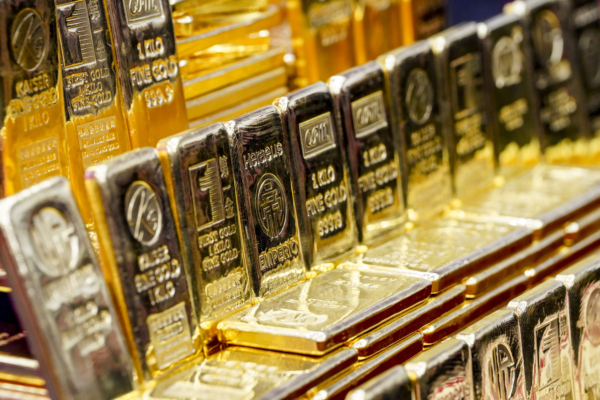
On Monday, January 26th, the spot price of gold once exceeded $5100 per ounce, marking a fourfold increase in gold prices over the past decade. However, the value of diamond rings has been on a continuous decline. Why are these two precious commodities moving in opposite directions? Those who purchased wedding diamond rings a few years ago feel like they are out of sync with the times.
In the Chinese market, over a decade ago, a diamond ring worth tens of thousands of yuan was considered a must-have for weddings. Fast forward twenty years, and these rings are barely attracting interest in the second-hand market.
According to a report by First Financial on Monday, Zhang Lin’s in-laws spent 100,000 yuan in Guangzhou to buy her a trendy diamond ring for her wedding twenty years ago when gold processing fees were just over a hundred yuan per gram.
Now that their son is getting married, Zhang Lin visited a jewelry store only to find out that the type of diamond rings purchased back then are now practically unwanted, with gold prices having surpassed a thousand yuan per gram. The hundred grams of gold from back then now hold a market value of exactly 100,000 yuan, leveling the playing field with time.
Miss Li, who works in the finance industry in Shenzhen, said that when she got married eight years ago, she followed a friend’s advice that “diamonds hold their value better” and purchased a nearly 20,000 yuan diamond ring for her wedding. Now, when she tried to exchange it, she was informed that the buyback price is less than 400 yuan, while the platinum ring setting is worth a bit more, around 1000 yuan.
Meanwhile, if she had invested in gold jewelry during that period, its market value would now exceed 70,000 yuan. “It feels like I’ve missed the beat of an era,” she said.
How much has the price of gold soared? On Monday, the spot price of gold once soared to over $5100 per ounce, reaching a historic high.
Over the past decade, the price of gold has been steadily rising. Wind data indicates that the current London gold price has been on an accelerated upward trend since reaching a low point of around $1000 per ounce in 2015, breaking through the $5100 per ounce mark recently, with a cumulative increase of over fourfold.
In contrast, the diamond index continues to decline. The International Diamond Exchange (IDEX) Diamond Index has plunged from a 2022 peak of 158, currently hovering around 86.08, representing a decrease of over 45%.
The RapNet Diamond Price Index (RAPI) shows that in 2025, the price of 0.5-carat diamonds fell by over 20% for the whole year, and even diamonds over 3 carats were not spared, recording a slight drop of 0.4%.
Looking at the stock market, as the largest company in the A-share gold sector, Zijin Mining saw its stock price surge by over 6% in a single day on January 6th, temporarily surpassing a value of 1 trillion yuan.
Throughout 2025, the company’s stock price saw a staggering increase of 135.77% for the entire year, marking six consecutive years of growth. Incomplete statistics from First Financial show that many major gold enterprises in China, including China Gold, Hunan Gold, and Shandong Gold, all experienced significant stock price increases in 2025.
On the other hand, in the diamond industry, the parent company of DR Diamond Rings, Dia Group, soared by 41% on the day of its debut on the Growth Enterprise Market in 2021, reaching over 160 yuan per share. However, due to the cyclical nature of the diamond market, its stock price fluctuated downward, hitting a low of 16.91 yuan per share in 2024.
While the company’s stock price has recently rebounded to around 33 yuan per share, it has already fallen by over 80% from its peak value.
Despite both being symbols of “eternity,” why has gold been steadily climbing while the diamond market is on the brink of collapse? Industry insiders cited by First Financial attribute the potential collapse of the diamond market to a reversal in supply and demand dynamics.
Firstly, one of the diamond’s traditional main markets – weddings and celebrations – is experiencing a significant downturn in demand.
In China alone, official statistics from the Communist Party show that the number of marriages plummeted by one-fifth in 2024, marking the largest decrease in history, with only 6.1 million couples registering for marriage. Although there was a rebound in the first three quarters of 2025, the long-term trend has shown a continuous decline from the peak of 13.47 million couples in 2013.
Moreover, lab-grown diamonds have emerged as a new force. “Lab-grown diamonds are rapidly changing the entire industry landscape.”
A jewelry store manager in Beijing stated that the production costs of lab-grown diamonds are significantly lower than natural ones, priced at only 1/10 to 1/5 of the latter’s cost. Furthermore, from composition, Mohs hardness, to refractive index and fire, all key physical properties are almost identical to natural diamonds and cannot be differentiated by the naked eye.
Additionally, the rapid expansion of lab-grown diamond production capacity allows for mass production in just a few weeks, directly challenging the traditional diamond supply system.
Will the price trends of diamonds and gold realign in the future? Most analyses suggest that the divergence between the two trends may be difficult to reverse in the short term, but driving factors and market prospects are quietly nurturing new variables. After all, the long-term value logic of natural diamonds still exists.