
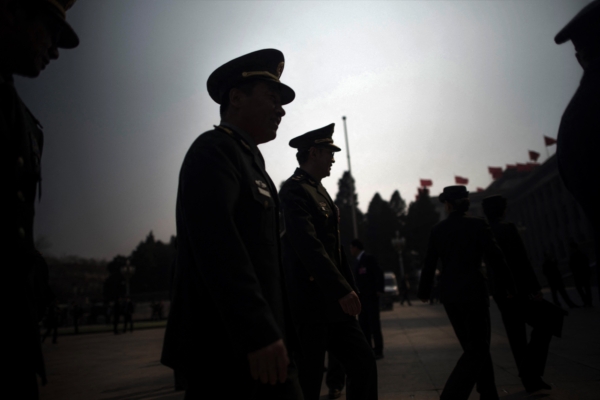
The deputy chairman of the Central Military Commission, Zhang Youxia, and the Chief of the Joint Staff Liu Zhenli were announced by the authorities to be under investigation. Several mainland China observers have told The Epoch Times that the unusual speed at which the authorities handled this case has far-reaching implications, reflecting a high-risk stage in the power struggle within the Chinese Communist Party’s top leadership and revealing a crisis of trust within the system.
On January 24, the Chinese Ministry of Defense announced the investigation into Zhang and Liu, and the PLA Daily quickly issued an editorial, accusing the two of seriously violating and undermining the Chairman Responsibility System of the Central Military Commission, damaging the ruling foundation of the CCP, impacting the political and ideological foundation of the entire military personnel, and causing damage to the political ecology and combat readiness construction of the military, resulting in great harm to the ruling foundation of the CCP. Xinhua News Agency also promptly reposted the editorial of the PLA Daily.
Mainland Chinese writer Shen Bocai believes that the wording and presentation in the relevant reports by Xinhua News Agency and some official media outlets show a significant difference from the customary way of handling cases of senior officials over the past several decades, especially in the past decade.
Media personality Chen Mingzhe is particularly concerned about the abnormal pace of handling this case. He analyzes that compared to the long paving and public opinion heating before the fall of high-ranking officials in the past, this time, the announcement came almost immediately after the rumors surfaced, followed by an official political classification given by the official media.
He believes that this “thunder-like” way of announcement aims to quickly establish a fait accompli, suppress the military’s wait-and-see, hesitation, and linking space, prevent subordinate units from taking radical actions when the information is unclear.
There are various circulating versions regarding the reasons for the investigation of Zhang and Liu, including differences in Taiwan strategies between Zhang Youxia and Xi Jinping, as well as Xi Jinping’s precautionary clean-ups around power security.
Chen Mingzhe believes that Zhang Youxia is well aware of the current power balance between China and the United States, judging that the mainland lacks the conditions to directly confront the United States, hence not inclined to launch a war across the Taiwan Strait. On the other hand, the top leader needs to consolidate his reelection and the legitimacy of his governance through historic achievements, viewing military action against Taiwan as an important option.
“In this context, the military, which holds real power and adopts a cautious attitude, has become a structural obstacle for the top leadership to achieve political goals. Removing its influence is seen as a necessary prerequisite,” he said.
Regarding the rumors of a coup, Chen Mingzhe believes that the long-standing rumors on the internet about Zhang Youxia possibly plotting a coup, regardless of their veracity, in a highly insecure power structure, the top leader would choose to deal with potential threats preemptively.
He emphasized that understanding this move should be based on the leader’s personality and power operation method, meaning that zero tolerance would be exercised towards anyone who is not fully obedient or considered a potential threat to authority.
However, mainland lawyer Zheng Zhiyao holds a reserved attitude towards the “coup theory.” He believes that the widely circulated claims about “Zhang Youxia may launch a coup” and “challenge the highest authority” are more the result of long-term hype and amplification in overseas public opinion, forming effects of either “elevating” or “dividing” the individuals involved.
Zheng Zhiyao judges that Zhang Youxia does not possess the political awareness and psychological readiness to initiate a coup or replace the top leader. Launching a coup not only requires substantial power but also demands clear political goals and high-risk tolerance, conditions not conspicuously present in Zhang Youxia.
The impact of this incident on the system is continuing to manifest.
Chen Mingzhe noted that after the announcement of the incident, there has not been the usual intensive expressions of loyalty from the party, government, and military system, indicating that grassroots and mid-to-high-level officials are generally in a state of observing or even fear.
He pointed out that in the current atmosphere, both expressing and not expressing loyalty are equally risky, reflecting a high level of uncertainty within the system.
Shen Bocai believes that the core of the Zhang and Liu incident lies not in the detailed handling but in the open conflict of contradictions. This openness itself signifies that the related political games have entered a new stage.
He believes that this case has a significant impact on the operation of the mainland regime and the high-level political landscape, which will not only impact the policy direction in the coming years but could also become an important turning point in the fate and personnel arrangement of the current generation of political figures.
Taking into account the nature of the system, Zheng Zhiyao points out that the high-ranking members of the CCP, including Zhang Youxia, are all beneficiaries of the current system. Their basic consensus is “preserving the Party comes first.” Once the regime undergoes fundamental turmoil, the relevant families and interest groups will face unbearable political and historical risks.
Based on this assessment, he believes that classifying Zhang Youxia as “anti-party” or “seeking a change of power” does not align with reality logic; a more likely explanation is the cracks among the top leadership in terms of power, security, or political trust.
Observers have expressed concerns over the stability of the military and the decision-making mechanism.
Chen Mingzhe believes that the risks to military morale and societal stability are accumulating. When middle-level officers feel uncertain about their future, any incidental event could become a trigger point. Although the central government may prevent coordinated mutinies by confiscating communication devices and tightly controlling the flow of information, in the face of a large military force with relatively weak local control, the effectiveness is still questionable.
He further analyzes that with the handling of several key members of the Military Commission, the authority of the central government is not necessarily strengthened. Instead, a “power vacuum” might be created in the short term, setting the stage for unforeseen actions at the local or grassroots level. At the same time, the flow of real information within the system is difficult, decisions are highly opaque, and the risks of misjudgments and wrong judgments continue to rise.
Shen Bocai emphasizes that whether in the case of Zhang and Liu or in the Taiwan Strait situation, a linear, textbook-style logic cannot be simply deduced. History has repeatedly shown that significant shifts often occur in the most unpredictable places, and their outcomes are yet to be revealed over time.
Regarding the Taiwan Strait issue, there is a basic consensus among the interviewees: the probability of war is extremely low, but if it were to break out, the consequences would be unbearable.
Zheng Zhiyao believes that even if Zhang Youxia was not under investigation, a full-scale military action against Taiwan – as speculated by the public – is unlikely to be implemented. The economic pressures, social contradictions, and external strategic environment facing China at present make the risk of a full-scale war extremely high, especially when considering the reactions of the United States, Japan, and neighboring countries simultaneously.
He judges that a more realistic scenario would involve maintaining a tough stance through public opinion mobilization, military drills, or limited demonstrations of force, but the probability of a large-scale, sustained military operation is low.
Shen Bocai analyzes that the probability of a Taiwan Strait war is extremely low, perhaps even less than one percent. He believes that there is no necessity for a full-scale war between the two sides in terms of practical interests; war would not bring any substantial benefits and would only result in unacceptable damage and losses.
However, he also acknowledges that the development of history generally does not entirely follow rational logic. Sudden events, complex variables, and the interaction of multiple forces could still trigger conflicts in extreme situations.
Regarding the potential impact of a Taiwan Strait conflict, Shen Bocai stated that compared to local conflicts like the Russia-Ukraine war or conflicts in the Middle East or Latin America, a Taiwan Strait conflict has incomparable amplification effects in terms of geopolitics, economic scale, population size, and cultural significance. If a war were to break out in the Taiwan Strait, the scale, parties involved, level of involvement, extent of influence, and historical weight might far exceed any current regional conflict.
He mentioned that if a Taiwan Strait conflict were to occur, its essence would not be just military confrontation but rather “a significant showdown between democracy and authoritarianism, civilization and barbarism.”
Several observers believe that China is currently in a highly tense and unstable stage. The concentration of high-level power, rapid purges, and uncertain military morale are overlapping, making the situation more fragile. Whether the events continue to escalate or not, the systemic risks exposed pose a serious challenge to the future political and societal stability.