
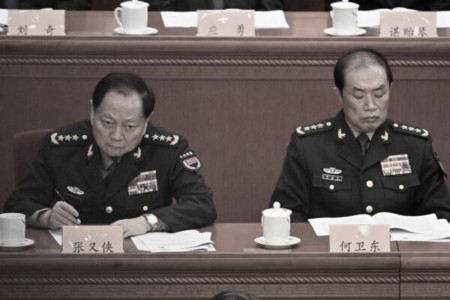
On January 24th, Zhang Youxia, the second-in-command in the Chinese Communist Party’s military, suddenly fell from power, breaching the bottom line of anti-corruption in the Party’s military ranks. Experts believe that Zhang’s arrest signifies a crucial turning point in the CCP’s political landscape, where loyalty is no longer as important as grasping dictatorial authority, as this has become the dividing line between life and death. The facade of “anti-corruption” can no longer deceive public opinion, and in order to consolidate power, the CCP may create even greater crises, heralding the arrival of turbulent times.
Zhang Youxia’s arrest has surprised observers, as not only is he a “princeling” and the son of a founding general, but he is also closely associated with Xi Jinping. In 2022, at the age of 72, when Zhang should have retired, Xi asked him to stay on to oversee the military, only for him to be arrested three years later.
His downfall has shattered the anti-corruption line within the military, leaving no one safe anymore.
After Zhang’s fall, the military’s editorial criticized him for “seriously trampling and damaging the Chairman of the Military Commission’s responsibility system” and “seriously promoting problems of politics and corruption that undermine the Party’s absolute leadership over the military and harm the Party’s governance foundation.”
Editor-in-chief of a media outlet and founder of an NPO in Shenzhen, Ai Shicheng, said to Epoch Times that Zhang Youxia’s arrest marks a significant turning point for the CCP, where the party leadership has taken the step of viewing all potential power opponents as enemies to be eliminated, leaving him with no one he can trust.
Dr. Hong Yaonan, Deputy Director of the Mainland China Research Center at Tamkang University, believes in his new book “Xi Jinping’s Choices and Endings” that when power becomes highly personalized, loyalty is no longer important. The crucial factors become whether one has independent authority and the potential to become a second power center. This is why waves of seemingly incomprehensible purges are occurring in the military and political arenas.
In reality, unlike the traditional focus on internal moral rectitude and external peace, power is the core pursuit of all communists, used to reshape individuals and society. Therefore, everything communists do revolves around power – fighting for it, seizing it, holding onto it, preventing its loss, and battling in its name become the norm.
Associate Professor at the University of Technology Sydney, Feng Chongyi, told Epoch Times that power struggles within the CCP are naked, without any bottom line. According to Lin Biao and Lin Liguo, the CCP itself is a meat grinder. During the Cultural Revolution, Mao eradicated everyone, while Stalin eliminated the Central Committee members from the first session in 1917, including all military commissioners, including Trotsky, the founder of the army.
Feng Chongyi mentioned that Mao first purged the likes of Zhang Wentian and Wu Jiaxiang from other factions within the Party, then turned his sights internally, targeting figures like Zhou Enlai and Zhang Guotao. The current party leader has eliminated other factions and is now targeting his own faction, removing one after another. This is not surprising.
He noted that previously it was understandable why Guo Boxiong and Xu Caihou were targeted as they were not Xi’s people, but then figures like Fang Fenghui and Zhang Yang, who helped clear out Xu and Guo, were also taken down. Following them, Xi’s trusted aides, Miao Hua and He Weidong, were also removed. Now, even Zhang Youxia, who had previously protected Xi, has been targeted.
“He has shown that he has no confidence in himself, relying solely on continuous purges to stay in power.”
Feng Chongyi pointed out that it is unfortunate that the centralized power structure of the CCP entrusts whoever sits at the top with controlling the secret police.
He stated that a soldier should have a sense of honor, but if you force a Lin Biao into a corner, being a professional soldier, he would resist and fight back. If Zhang Youxia, who has been rumored to have significant influence within the military, truly held the power, he could have challenged Xi.
Feng Chongyi expressed that if the senior CCP leadership were still men with some spirit, they should join forces. This would be the most natural and logical political development.
He believed that if a coup with a low cost does not take place, the current internal political crisis, economic crisis, financial crisis, and external relations crisis will escalate, triggering a societal crisis leading to popular uprisings, military upheaval, and political changes with even greater costs.
After Zhang Youxia’s fall, the PLA Daily emphasized the need to continuously enhance the “penetrating power of anti-corruption.”
The spokesperson for the Chinese Embassy in Washington, Liu Pengyu, said in a statement to The Wall Street Journal that the decision to investigate Zhang demonstrates the leadership’s commitment to a “comprehensive coverage, zero tolerance” anti-corruption stance.
However, observers are questioning the credibility of the anti-corruption slogan given the sudden arrest of a high-ranking figure like Zhang Youxia today.
Mr. Liang, a Chinese political and economic analyst, told Epoch Times that Xi’s resort to terrorism against the bureaucratic group indicates his profound fear.
He pointed out that while a supreme leader demands loyalty, it was already bankrupt. Communist ideology has been proven unsuccessful from Marxism to Lenin and Stalin’s models, to the practices in various socialist countries post-World War II. Loyalty is now enforced through intimidation, without any genuine foundation. As the top echelons of power become increasingly centralized and paranoid, trust has vanished. Once trust is eroded, the organization resorts to high pressure and frequent personnel upheavals to maintain control, rather than focusing on genuine anti-corruption efforts.
He stressed that anti-corruption is just a means to an end; the actual goal is political control.
Feng Chongyi remarked that the CCP’s anti-corruption campaign has always been a case of “the pot calling the kettle black,” devoid of any sense of justice. It is widely understood now that anti-corruption is a farce, merely a tool for political power struggles. This system is not only outdated but also malicious, putting many people’s lives and fortunes in jeopardy, leaving everyone in a state of constant fear.
In contrast to anti-corruption is the principle of loyalty, which the CCP propagates to maintain the purity and loyalty of its ranks.
Ai Shicheng said that the current CCP leadership is increasingly emphasizing ideological and personal loyalty, but this loyalty has long been bankrupt. The communist ideological system, from Marxism to Lenin, Stalin, and post-World War II practices in socialist countries, has been proven to be bankrupt historically. Loyalty is now enforced solely through power intimidation, as the higher the position, the greater the lack of security. The quirky death of Li Keqiang, the arrest of Zhang Youxia, Xi’s childhood friend, and the lack of a sense of security even among figures like Wang Qishan demonstrate that every level of power within the system is rife with insecurity.
Feng Chongyi stated that the supreme leaders of the CCP in the post-totalitarian era have never truly enjoyed the loyalty of their subordinates. This loyalty never actually existed; it was just a facade. As the Supreme Leader describes it, under the guise of the light, there are shadows, senior shadows, double-faced people, including Cai Qi, Zhang Youxia, and Miao Hua, who are all double-faced, feigning loyalty to the leader for personal gains. Feigning loyalty is merely a means of profiting.
He mentioned that formerly those who feigned loyalty still had the chance for promotion and wealth, but the situation is different now. For those who have degraded themselves to act as lackeys, feeling humiliated, Xi’s constant purges have led them to the point where they think they have the opportunity to stop pretending.
He said that since pretending no longer benefits them and guarantees harm to their lives, loyalty even among those who have stooped low will erode. The ultimate fate of the CCP’s top leader will eventually lead to isolation and betrayal, facing a day when everyone has turned against him.
At the age of 75, Zhang Youxia, regardless of his military status, background, or relationship with Xi, is similar in many respects to Mao Zedong and Lin Biao.
Overseas public opinion believes that the impact of this event can be compared to the “Lin Biao incident” and “Wang Lijun fleeing to the consulate incident,” both of which are rare “random events” in history, leading to significant changes in the CCP’s political landscape.
After the “Lin Biao incident,” Mao’s political reputation was severely damaged, and he never recovered. Now, with Zhang Youxia under investigation, this event may have a similar effect to the “Lin Biao incident,” causing a significant impact on CCP politics and the military.
Hong Yaonan stated that from a “political psychological shock” perspective, this event is reminiscent of the “Lin Biao incident.”
Both incidents touch upon the most sensitive issues for the highest authorities – “military loyalty” and the “security of the top leadership.” Once the highest levels of the military are involved, the impact spills over to the risk expectations of the entire political elite.
Feng Chongyi mentioned that during the Cultural Revolution, Mao, who did not have a military of his own, used strategic maneuvers within the Central leadership. He relied on Lin Biao to suppress all other military heads from different factions. At that time, the three field army commanders Mao had brought down, including Liu Deng’s 2nd Field Army, Chen Su’s 3rd Field Army, especially Peng Dehuai’s 1st Field Army, were very dissatisfied. They had fought for the revolution, so why were they marginalized, leaving the entire army under Vice Commander Lin Biao?
When Mao ousted Lin Biao, it caused a significant uproar, as Mao had now offended the 1st, 2nd, and 3rd Field Armies. Even the Central Military Committee had slight reservations towards him, but they were also offended. Therefore, after Lin Biao’s downfall, not only did other military units begin to voice their discontent, but Mao’s followers also began to doubt him. Lin Liguo’s “571 Project Memo” described Mao Zedong as the greatest dictator and tyrant, resonating widely among young people and even many Red Guards, creating a huge uproar.
The inherent paranoia of dictators is a common trait. Those below them tread carefully, despite their contributions, gaining nothing and facing immense risks. In the case of figures like Wang Qishan, they become the henchmen, offending many, resulting in dire consequences.
“Thus, the current CCP leader has entered a cycle of isolation and betrayal. In this sense, his power has become more fragile.”
Hong Yaonan expressed that as the leader slides into a state of “distrusting anyone,” three likely consequences emerge in the next six months to a year.
Firstly, there may be a reorganization centered around “political discipline/military commission chairman responsibility system,” involving personnel reshuffles, changes in military zones and key departments, and an intensified political work system, all aimed at squeezing military power back to a single center.
Secondly, there may be a trend toward more conservative foreign policies and a stronger stance internally. In the face of unstable military morale, major risky actions usually come with higher costs. Internally, more intensive retraining, accountability, and loyalty tests may be introduced to bolster control.
And thirdly, if the plot of “seizure of power/mutiny” were to materialize, it could trigger a “elite panic,” akin to the Lin Biao incident, but current information indicates this step has not been reached yet.
Ai Shicheng stated that since assuming power, the CCP leader has witnessed rapid economic decline, social turbulence, widespread unemployment, and deteriorating living conditions without reaching a peak. The political purges now forebode the imminent climax.
“The CCP’s red regime is in its twilight, and behind it lies a dark period of societal turmoil, economic decline, distress among the populace, and various political upheavals lying ahead.”
“We are entering an era of chaos in China’s history. Let’s hope this period is short, with less suffering and loss for the Chinese people.”