
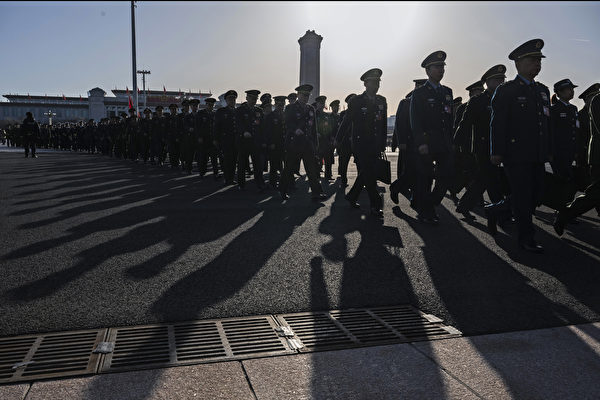
On January 26, 2026, Vice Chairman of the Central Military Commission of the Chinese Communist Party (CCP), Zhang Youxia, and Chief of the Joint Staff Department, Liu Zhenli, were suddenly removed from their positions, prompting immediate official classification and sparking intense external attention. Experts suggest that the authorities aimed to instill psychological deterrence within the military to prevent internal instability or mutiny risks. However, this move could escalate tensions and discontent within the military, adding new pressure to internal stability.
The CCP’s Ministry of National Defense officially announced on January 24 the dismissal of Zhang and Liu, followed by an editorial in the PLA Daily categorizing their actions as “severe,” including accusations of “seriously trampling and undermining the system of the Chairman of the Military Commission,” “seriously fostering an influence on the absolute leadership of the CCP over the military,” and “seriously affecting the image and authority of the Military Commission leadership.” This editorial marked a more intense language compared to previous cases involving high-ranking military officials like He Weidong and Miao Hua.
Political commentator Chen Pokong, speaking to Epoch Times on January 25, mentioned that the swift announcement after rumors emerged was a deliberate tactic to create psychological deterrence within the military, guarding against potential internal instability or mutiny risks.
Zhang Youxia and Liu Zhenli were considered senior military figures with practical and combat backgrounds within the military, holding a special status among current senior leadership.
However, Chen Pokong also pointed out that this rapid and high-profile approach may have short-term deterrence effects but could also exacerbate tensions and discontent within the military, placing new pressure on internal stability.
Researcher Shen Mingshi from the Taiwan Institute for National Defense and Security Studies noted the differences in the pace and nature of handling this case compared to previous dismissals of officials like Wei Fenghe, Li Shangfu, and He Weidong.
He mentioned that instead of the lengthy process involving the Central Commission for Discipline Inspection investigating corruption allegations, as seen in past cases, the quick announcement of Zhang and Liu’s removal following rumors, and the deliberate avoidance of specific corruption issues in favor of emphasizing political discipline and military loyalty, is distinct in its approach.
Both experts agreed that the core of the accusations this time was not economic corruption but a clear political classification. The official accusation of “undermining the system of the Chairman of the Military Commission” has significant political symbolism.
Chen Pokong analyzed that this accusation as the primary charge indirectly reflects abnormalities within the current operating mechanism of the Military Commission, hinting at prolonged serious disagreements among senior leadership.
If the collective responsibility of the Military Commission were strictly enforced, the recent succession of incidents involving high-ranking officials handpicked by top leader Xi Jinping could undermine the legitimacy of the current CCP system.
Shen Mingshi suggested that the political classification implies that Zhang Youxia and Liu Zhenli might not have fully obeyed directives from the top leadership regarding significant military or security decisions, even being suspected of challenging the existing power structure.
“Although rumors like the ‘Jingxi Guesthouse Mutiny’ have not been officially confirmed, the intense political accusations in the PLA Daily editorial indicate that only a coup or mutiny-level event could support such severe charges,” he stated.
A notable observation after the official announcement was the limited public statements in support compared to the widespread “declarative support” that typically follows high-level officials’ dismissals.
Chen Pokong noted that this silence reflects widespread caution and unease within and outside the party. The state of “everyone for themselves” has become the reality, seen as even core faction figures hesitated to publicly express support.
Shen Mingshi also observed this phenomenon, pointing out that the usual immediate formation of a unified stance through the CCP’s central propaganda system has not occurred, apart from the PLA Daily’s editorial addressing the military system. The relatively delayed public opinion response may indicate anxiety among some high-ranking officials regarding the current power structure’s uncertainties.
He believed that the military is currently in a wait-and-see mode, with no widespread high-profile loyalty declarations or factional alignments in the military and no unified intensive “defend the core” style propaganda seen in public discourse.
Experts provided diverse assessments on the long-term implications of the events.
Chen Pokong suggested that by handling senior military figures through unconventional means, short-term personal control may be strengthened. However, in the long run, this could weaken institutional stability, increase information opacity, decision distortion, and raise the risk of misjudgments.
He noted that the current political operations within the CCP exhibit highly securitized and centralized characteristics, with trust within the party’s political and military ranks eroding steadily.
Shen Mingshi laid out three possible directions: a standoff leading to the next party congress for natural power transitions, a substantive challenge within the military that could adjust the current power structure, or full control of military power by the top leader, entering a more severe phase of power centralization.
He believed that the development currently leans towards the third scenario but cautioned that this does not mean the risks have been eliminated. If this action was merely a temporary crisis suppression through public purges, future power conflicts might still emerge, impacting CCP foreign policy, cross-strait relations, and economic decision-making significantly.
Regarding the various rumors surrounding Zhang Youxia’s removal, Chen Pokong emphasized that in a highly closed political system, fragmented information and divergent accounts are inevitable. The focus should be on the structural issues revealed by the events rather than specific details.
Shen Mingshi also noted that initial information originating from overseas media, though mixed with truth and falsehood, still holds some “warning” significance within the tightly controlled information landscape, reflecting loosened coordination and trust mechanisms within the system.