
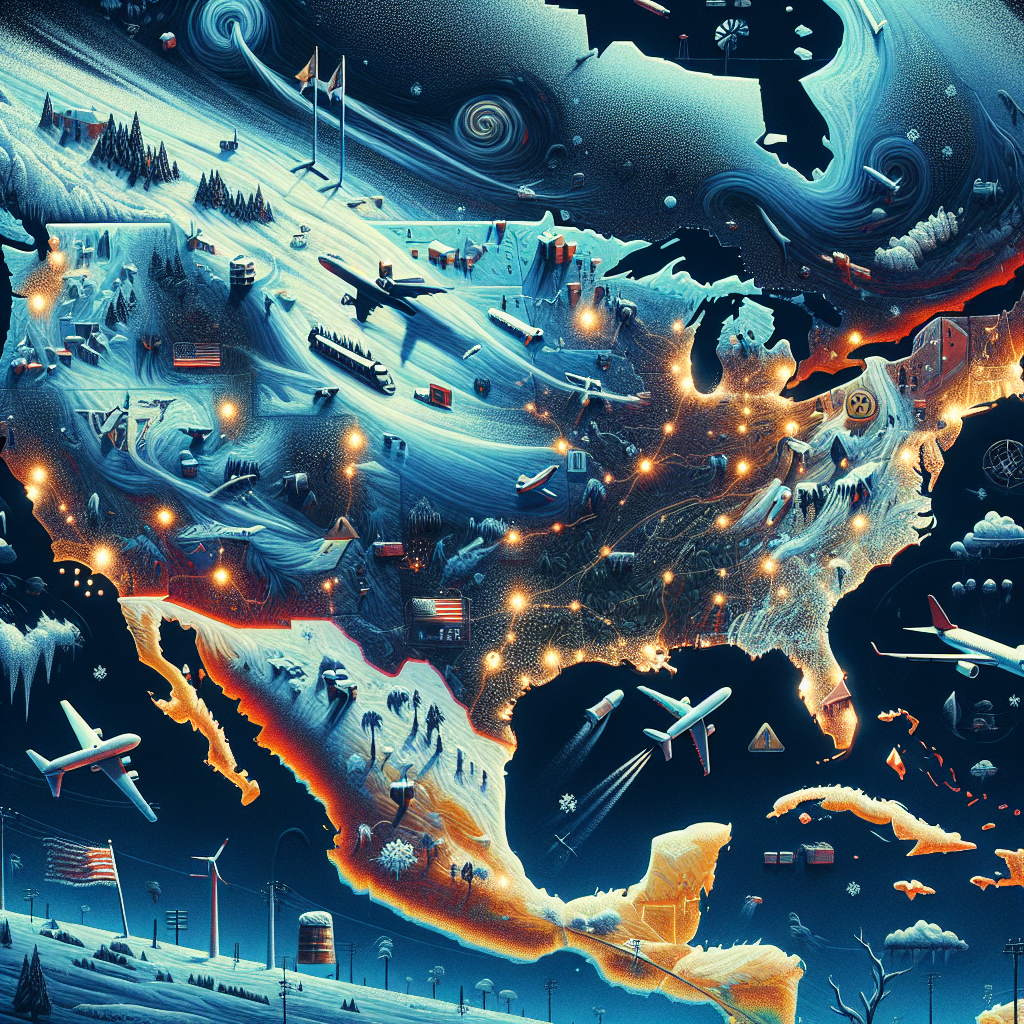
A powerful winter storm described by officials as “historic” is currently sweeping across the United States, causing large-scale power outages from the South to the Midwest and severely disrupting air travel. With ongoing heavy snow, freezing rain, and extreme low temperatures, authorities warn that the storm’s impact could last for several days, posing significant challenges for the Eastern and Midwestern regions.
According to the U.S. Department of Homeland Security, as of early Sunday morning (January 25), approximately 230,000 households across the U.S. were without power, primarily concentrated in Louisiana, Mississippi, Texas, Tennessee, and New Mexico. The number of power outages continues to rise, with the Southern and Midwestern power grids under tremendous pressure, as reported by the power monitoring website PowerOutage.com.
President Donald Trump approved at least 12 states, including South Carolina, Virginia, Tennessee, Georgia, North Carolina, Maryland, Arkansas, Kentucky, Louisiana, Mississippi, Indiana, and West Virginia, to enter a “federal emergency status” in response to the winter storm. In a post on the social media platform Truth Social, he stated that the federal government will maintain communication with the states and urged the public to prioritize safety and stay warm.
The Department of Homeland Security announced that 17 states and the District of Columbia have declared weather emergencies. Homeland Security Secretary Kristi Noem noted that tens of thousands of people in several Southern states have lost power, and federal and local utility workers are working tirelessly to restore power as quickly as possible.
To cope with the peak electricity demand brought by the extreme weather conditions, the U.S. Department of Energy issued emergency orders on Saturday authorizing the Texas Reliability Council to utilize backup power resources, including data centers and other large facilities, to reduce the risk of widespread power outages. On Sunday, the Department of Energy issued further orders allowing the Mid-Atlantic region grid operator, PJM Interconnection, to activate specific power resources to ensure grid stability without state law or environmental permit limitations.
The National Weather Service warned that the winter storm’s impact is unusually widespread and long-lasting, with the Southeast expected to experience significant ice accumulation, potentially leading to “paralyzing and locally catastrophic effects.” Weather forecasters predict record low temperatures and dangerous wind chill effects to further hit the Great Plains on the 26th.
The severe weather has also severely impacted the U.S. aviation transportation system. Data from flight tracking website FlightAware shows that as of Saturday evening, over 4,000 flights have been canceled nationwide; for flights scheduled on Sunday, cancellations soared to over 9,400.
Multiple airlines have proactively adjusted their operations to mitigate the storm’s impact. Delta Air Lines stated that they have continuously adjusted flight plans in Atlanta and along the East Coast and deployed experts from cold weather regions to support de-icing and baggage operations at Southern airports. JetBlue Airways reported canceling approximately 1,000 flights through Monday (26th). United Airlines also announced proactive cancellations in anticipation of the worst weather conditions to ensure safety.
Noem reiterated at a press conference that many parts of the U.S. are facing “extremely cold” weather and urged the public to stock up on fuel and food, minimize unnecessary travel, and prepare to weather this severe test. She emphasized that the federal government will work with states to mitigate the storm’s impact on livelihoods and critical infrastructure.
(This article referenced Reuters’ reports)