
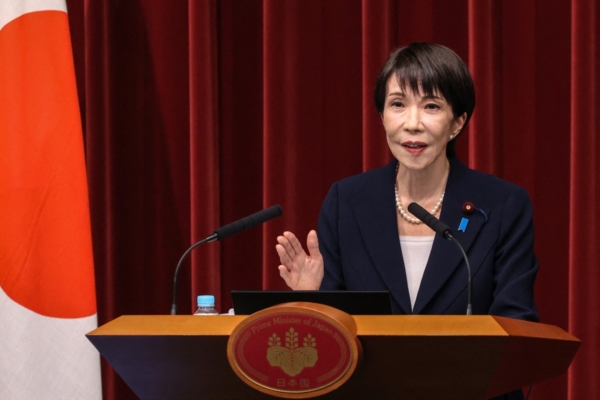
After the dissolution of the House of Representatives in Japan, the ruling and opposition parties officially started their policy debate on Saturday (January 24). Prime Minister and Liberal Democratic Party President Takaichi Sanae emphasized during the debate the comprehensive strengthening of security policies, stating that “without the determination and capability to defend one’s own country, no one else will defend it for you.” She also mentioned that dialogue at various levels between Japan and China is still ongoing.
Ten leaders of Japan’s ruling and opposition parties attended a debate on a web video platform on Saturday evening, marking the first policy showdown among party leaders since the dissolution of the Lower House.
Takaichi Sanae stressed in the debate that Japan is facing the most severe security environment since the post-war period, noting that “without the determination and capability to defend one’s own country, no one else will defend it for you.” She stated that the Japan-U.S. alliance remains the cornerstone of Japan’s security, but it is also necessary to reaffirm the fundamental stance that “one’s own country must be defended by oneself.”
Takaichi pointed out that the joint agreement established when the government was formed incorporates further revisions to security documents, strengthening the defense industry and relaxing related regulations, which will help enhance Japan’s overall defense capabilities.
She also emphasized that intelligence and counter-spy systems are equally crucial, including the legislative framework to prevent espionage activities and strengthen intelligence organizations. Related bills are already in progress, and Japan must advance in terms of system, strength, and national consciousness to establish a pragmatic diplomatic and security system.
Regarding Takaichi’s previous statement in Parliament that a situation involving Taiwan could constitute a “matter of life and death” for Japan, Noda Yoshihiko, co-representative of the new party, the Democratic Reform Union, believes that “such statements clearly exacerbate tensions with China.”
Noda pointed out that the current Japan-China relationship is in an extremely severe state. He stated that although “I personally believe that China’s recent actions are indeed too aggressive, such as radar incidents against Self-Defense Force aircraft, which are extremely dangerous and unacceptable, Japan should make a strong protest against this,” on the level of “cognitive warfare,” Japan is being labeled as experiencing a “resurgence of militarism,” and “I believe Japan has not provided a sufficient and forceful rebuttal to these accusations.”
In response, Takaichi stated that the government is not “completely without rebuttal.” She emphasized that Japan has been continuously explaining its position through various channels and in multilateral diplomatic settings, including holding remote meetings with other country leaders, clearly stating that “Japan is not a militaristic country, but continues its consistent peace stance.”
Takaichi also noted that dialogue at various levels between Japan and China is still ongoing. She mentioned that as neighboring countries, Japan and China indeed have multiple issues, which is why dialogue and communication need to be maintained, and “such dialogue is still ongoing.”
Regarding defense budgets, Takaichi stated that Japan’s basic policy is to gradually enhance each aspect based on its own needs “to secure the necessary defense capabilities for Japan.” She also said that with the growth of the Gross Domestic Product (GDP), Japan has already achieved the 2% of GDP target for defense spending ahead of schedule, and the amount itself is quite substantial. In addition, there is a need to further strengthen areas of deficiency, including responding to cognitive warfare, protecting satellites and undersea cables, and enhancing the scale of the defense industry. The overall direction is to enable Japan to independently and autonomously strengthen its defense capabilities.
(Translated from CNA)